Foundation Repair Permits Edmonton: What You Need and When
Quick Answer: Most Edmonton foundation crack repairs do not need a building permit. Structural repairs always do: helical piers, underpinning, carbon fibre wall anchors, and load-bearing changes all require City of Edmonton approval and an APEGA-stamped engineering drawing. Skip a required permit and risk a $1,000 minimum fine plus insurance claim denial.
In This Guide
Reading time: 9 minutes
When a foundation repair company tells you no permit is required, that might be completely true. It might also be wrong, and if it is wrong, the problem lands on you, not them. Edmonton homeowners are often left guessing, because competitors in this space rarely explain permit rules clearly.
The line between “maintenance repair” and “structural alteration” determines whether you need a City of Edmonton building permit, an APEGA-stamped drawing, or both. That line is real, it matters, and this guide explains exactly where it falls for the most common types of foundation work.
Paperwork rarely tops anyone’s list, but permits are a real part of scheduling foundation repair anywhere in Edmonton, and skipping them causes grief later. This guide lays out which permits apply and when the City wants to see one.
Which Foundation Repairs Need a Permit in Edmonton?
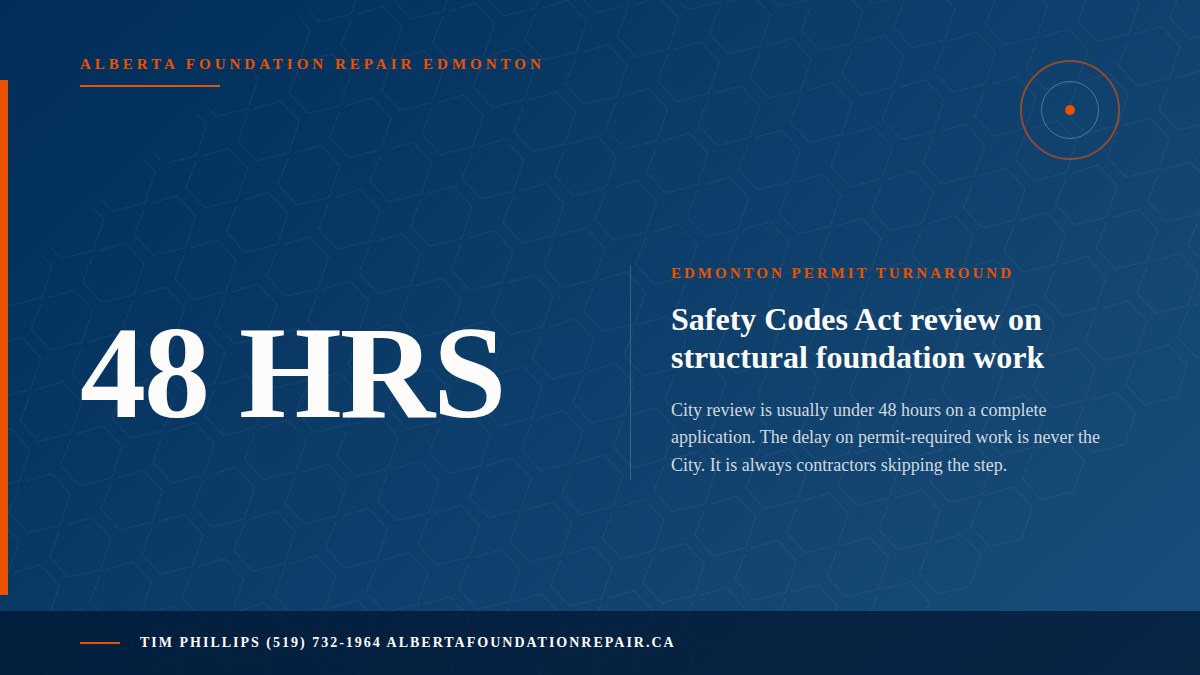
The Alberta Safety Codes Act requires a building permit for any work that alters the structural capacity or load path of a building. Work that qualifies as routine maintenance, with no structural change, generally does not require a permit.
Here is how the most common foundation repair types fall:
| Work Type | Permit Required | APEGA Stamp Typically Required |
|---|---|---|
| Crack injection (epoxy or polyurethane) | Generally no* | No |
| Interior waterproofing and drainage systems | Generally no* | No |
| Sump pump installation | Generally no* | No |
| Concrete levelling (polyjacking) | Generally no* | No |
| Exterior waterproofing membrane | Often yes (excavation involved) | Depends on depth and wall height |
| Helical pier installation | Yes | Yes |
| Underpinning (push piers, micro-piles) | Yes | Yes |
| Carbon fibre wall anchor installation | Yes (structural wall repair) | Yes |
| Foundation wall repair exceeding 3m height | Yes | Yes |
| Load-bearing wall modification | Yes | Yes |
| New footing installation or extension | Yes | Yes |
| Window or door opening enlargement in foundation wall | Yes | Yes |
*These are the general positions as of 2026. The City of Edmonton can update permit requirements at any time. If you are unsure whether your specific repair requires a permit, call Edmonton 311 or check edmonton.ca before work begins. Getting the wrong answer from a contractor is your risk, not theirs.
Edmonton Permit Portal and Levy Costs
All City of Edmonton building permit applications are submitted online at selfserve.edmonton.ca. Foundation repair permits fall under the Safety Codes Permit Bylaw 15894. Every permit in Alberta includes a Safety Codes Council levy of 4% of the permit fee, with a $4.50 minimum and a $560 maximum per transaction. This levy is provincial, not municipal, and funds the Safety Codes Council’s oversight of certified inspectors across Alberta. The City targets 25 business days for permit processing, though straightforward structural permits often clear in approximately 15 business days.
When Do You Also Need an Engineer’s Stamp?
For the full decision framework on when a P.Eng stamp is mandatory versus when a contractor can complete the repair without engineering involvement, see our guide on whether you need a structural engineer for foundation repair in Edmonton.
A building permit and an engineering stamp are two different things. A permit is a City of Edmonton approval. An APEGA stamp means a Professional Engineer registered in Alberta has reviewed the structural design and accepted professional responsibility for it.
Most structural foundation repairs require both: the permit from the City and the APEGA-stamped drawings to support that permit application.
APEGA Stamp: What It Means Technically
APEGA is the Association of Professional Engineers and Geoscientists of Alberta. When a Professional Engineer stamps structural foundation drawings, they are certifying that the design meets or exceeds the requirements of the Alberta Building Code and the National Building Code of Canada 2025. For helical piers, this means specifying pier diameter, steel grade, minimum torque-to-capacity correlation, pile depth to below the 2.4-metre Edmonton frost depth, and required load capacity. The engineer assumes professional and legal liability for the design. The Safety Codes Officer reviewing your permit application will check that the stamp is present before approving structural work.
The following types of foundation work trigger the APEGA stamp requirement:
- Helical pier installation: The engineer specifies pier size, depth, spacing, and required installation torque.
- Underpinning and push piers: Load transfer calculations and soil bearing capacity analysis required.
- Carbon fibre or steel wall anchors: Lateral earth pressure analysis and anchor spacing calculations required.
- Foundation walls exceeding 3 metres in height: Structural wall design required.
- Spans exceeding 4.9 metres: Beam and footing design required.
- Any load-bearing modification: Full load path analysis from roof to foundation required.
The cost of APEGA-stamped drawings varies by project complexity. Simple helical pier installations typically run $500 to $1,500 for an engineer’s review and stamp. Complex underpinning projects with site investigation may cost $2,000 to $5,000 or more. This cost is separate from the permit fee and should be itemised in your contractor’s quote.
Tim Phillips, Alberta Foundation Repair: “When someone asks whether they really need the engineer’s stamp, I always say the same thing: the stamp exists because lives depend on foundations not failing. It is not bureaucratic overhead. If a contractor is pushing back on getting proper drawings stamped, that tells you something important about how they approach their work.”
How to Apply for an Edmonton Foundation Repair Permit
The permit process is more straightforward than most homeowners expect. All applications go through the City of Edmonton’s online portal. Here are the steps from start to approval:
- Obtain your contractor’s drawings and specifications. For structural work, this includes APEGA-stamped engineering drawings that specify all design parameters. For non-structural work, a written scope of work from the contractor is typically sufficient.
- Create or log into your account at selfserve.edmonton.ca. This portal manages all permit applications, payments, inspection scheduling, and permit status tracking for the City of Edmonton.
- Submit the permit application. Provide the project address, a clear description of the work, contractor name and business information, and the estimated construction value (used to calculate the permit fee).
- Upload required documents. Attach APEGA-stamped structural drawings for any structural work. Attach site plans or other documents as prompted. Incomplete applications delay processing.
- Pay the Safety Codes Council levy and permit fee. Payment is made online at time of submission. The levy is 4% of the permit fee ($4.50 minimum, $560 maximum).
- Wait for City review and approval. The City of Edmonton’s target is 25 business days. Straightforward structural permits commonly clear in approximately 15 business days. The portal shows application status in real time.
- Post the approved permit on-site. The approved permit must be visibly displayed at the work location throughout the repair project. Keep the original safe and post a copy if needed.
- Request required inspections through the portal. The Safety Codes Officer will conduct inspections at designated stages. For helical pier work, inspection typically occurs after pier installation but before backfilling, so the officer can verify depth and torque records.
An On-Site Inspection Before Permit Submission Saves Money
Before your contractor submits permit drawings, a thorough on-site inspection can identify the cause of the foundation movement and flag where utilities and existing structure need to be accounted for. Engineers need a clear picture of what is happening to specify pier placement accurately. Discovering an unexpected condition after permit approval and work begins can require permit amendments and additional delays. Tim inspects every project on site and identifies the cause before any design work begins, so the engineer has real information rather than assumptions. This avoids costly mid-project revisions. Read more in our guide on foundation repair in Edmonton.
What Happens If You Skip the Permit?
Some contractors suggest skipping permits to save time or money. It is worth understanding exactly what you are agreeing to when you accept that suggestion.
The Real Consequences of Unpermitted Structural Work
Municipal fines: The City of Edmonton can issue stop-work orders and levy fines for unpermitted structural work. First-offence fines begin at $1,000 minimum. Subsequent offences start at $2,500. Under the Alberta Safety Codes Act, provincial fines can reach $100,000 per violation. These fines are the homeowner’s liability, not the contractor’s.
Insurance denial: If structural repair work was required to be permitted and was not, your home insurer may deny claims connected to that work, including subsequent foundation failure, water damage, or structural collapse. “Unpermitted work” is a standard exclusion clause in most Alberta home insurance policies.
Home sale complications: Unpermitted structural work is a material latent defect under Alberta real estate law. You are legally required to disclose it to buyers. Buyers can require retroactive permits before closing, which typically means excavating or opening walls to expose the work for inspection. They can also negotiate a significant price reduction or walk away from the deal entirely.
Tim Phillips, Alberta Foundation Repair: “I have seen both ends of this situation. Homeowners who skipped permits and then faced a failed warranty claim years later because the insurer found out. And homeowners who had to excavate a finished basement wall to expose unpermitted work before they could sell their house. The permit cost is a few hundred dollars. The consequences of skipping it can be tens of thousands. It is not a close call.”
Alberta Contractor Licensing: The Honest Answer
Here is something most Edmonton homeowners do not know, and most contractors do not advertise: foundation repair is not a designated trade in Alberta.
Unlike electrical work, gas fitting, or plumbing, there is no provincial exam, no journeyman certification, and no licensing body for foundation repair contractors. Anyone can legally operate a foundation repair business in Alberta without any formal training or certification. This is not an opinion. It is the current state of Alberta’s designated trades legislation.
What does exist:
What Legitimate Edmonton Foundation Contractors Should Have
- WCB Alberta clearance letter: Workers’ Compensation Board clearance confirms the contractor has active WCB coverage for their workers. Without it, you as the homeowner may be liable for injuries to workers on your property if the contractor has unpaid WCB premiums. Request a clearance letter dated within 30 days of work starting.
- Prepaid Contracting Business Licence: Under Alberta’s Consumer Protection Act, any contractor who collects a deposit or payment before completing work must hold a valid Prepaid Contracting Business Licence, registered with Service Alberta. This applies to virtually every foundation repair job. Ask for the licence number.
- Certificate of general liability insurance: Minimum $2,000,000 coverage. This protects you if the contractor damages your property, a neighbour’s property, or causes injury during work. Ask to be listed as an additional insured on the certificate.
- CRA business number: Confirms the business is properly registered with the Canada Revenue Agency. Any contractor unwilling to provide this number should be treated as a red flag.
- APEGA-affiliated professional engineer: For any structural work, the contractor should have an established relationship with a Professional Engineer registered in Alberta who will stamp the drawings. Ask who the engineer is and verify APEGA membership at the APEGA website.
The absence of a designated trade licence for foundation repair does not mean anyone with a truck and a drill is qualified. It means you need to do your own verification. The checklist above is your starting point.
Questions to Ask Before Hiring Any Edmonton Foundation Repair Contractor
Given that the regulatory environment leaves much of the verification to the homeowner, here are the direct questions Tim recommends asking before signing any contract or paying any deposit.
- “Will you pull the permit, or am I expected to?” In Alberta, it is typically the contractor’s responsibility to obtain the permit. Some contractors shift this to homeowners to reduce their paperwork. Be clear about who is responsible before work begins.
- “Do you have a current WCB clearance letter?” Ask for it in writing, dated within 30 days of work starting. Do not accept verbal confirmation.
- “What is your Prepaid Contracting Business Licence number?” Service Alberta’s consumer protection registry can confirm whether the licence is active. If the contractor does not have one and is taking a deposit, walk away.
- “Who is the engineer stamping the drawings?” For structural work, you want a name and APEGA registration number. Verify membership at apega.ca before paying any deposit.
- “Do you inspect on site and identify the cause before quoting?” This tells you immediately whether the contractor is diagnosing your foundation or guessing. A contractor who skips a proper on-site inspection is working blind. Refer to our foundation repair guide for what to expect from a proper pre-repair assessment.
- “What does your written warranty cover, and is it transferable?” Get the warranty terms in writing before signing. Ask whether the warranty transfers to a future buyer of your home. Most injection warranties do not transfer; structural pier warranties from reputable contractors often do.
Edmonton 311: Your Free First Call for Permit Questions
If your contractor gives you an answer about permits that does not match what you read here, or if your repair scope falls into a grey area, call Edmonton 311. The Development and Building Inspections department can clarify whether your specific project requires a permit before work starts. This call is free, takes about 10 minutes, and removes all ambiguity. You can also submit questions online through the City of Edmonton’s website. Getting the answer directly from the City protects you if there is ever a dispute about whether a permit was required.
For a deeper look at what Edmonton’s clay soil does to foundations over time, and why some repairs escalate from maintenance to structural faster than you’d expect, see our guide on Edmonton clay soil and foundation problems.
Frequently Asked Questions
Does crack injection in Edmonton need a building permit?
In most cases, no. Crack injection (epoxy or polyurethane) is typically classified as maintenance rather than structural alteration, so no building permit is required. However, permit requirements can change and may vary depending on the scope and severity of the specific work. Tim recommends confirming with Edmonton 311 or your contractor before starting if there is any doubt. Getting clarity before work begins costs nothing; unpermitted structural work discovered later can cost thousands.
How long does a building permit take in Edmonton for foundation work?
The City of Edmonton targets 25 business days for permit processing. In practice, straightforward structural foundation permits often clear in approximately 15 business days. Complex projects requiring additional engineering review may take longer. Applications and status tracking are managed online through selfserve.edmonton.ca. Submitting a complete application with all required documents significantly reduces processing time.
What is the Safety Codes Council levy and how much does it cost?
The Safety Codes Council levy is a provincial charge applied to every Alberta building permit. It is set at 4% of the permit fee, with a minimum of $4.50 and a maximum of $560 per transaction. This levy funds the Safety Codes Council’s training, accreditation, and oversight programs for safety codes officers across Alberta. It is not a municipal charge and applies province-wide.
Is foundation repair a licensed trade in Alberta?
No. Foundation repair is not a designated trade in Alberta. There is no provincial exam, no journeyman certification, and no licensing body for foundation repair contractors. This makes independent verification critical before hiring anyone. Always ask for a WCB clearance letter, certificate of insurance (minimum $2M general liability), a CRA business number, and a Prepaid Contracting Business Licence number before signing any contract or paying any deposit.
What happens if a previous owner skipped a permit on foundation work?
Unpermitted structural work is a material latent defect under Alberta real estate law. You are legally required to disclose it to buyers. A buyer discovering unpermitted foundation work can require retroactive permits before closing (which typically means excavating or opening walls for inspection), negotiate a significant price reduction, or walk away from the sale. Obtaining retroactive permits is far more expensive and disruptive than pulling them correctly before work begins.
Sources
- Government of Alberta. (2023). Safety Codes Act, RSA 2000, c S-1. King’s Printer for Alberta. open.alberta.ca
- City of Edmonton. (2025). Building Permit Requirements for Residential Projects. City of Edmonton Development and Building Inspections. edmonton.ca
- Safety Codes Council of Alberta. (2025). Safety Codes Council Levy Schedule. Government of Alberta. safetycodes.ab.ca
- Government of Alberta. (2022). Consumer Protection Act, RSA 2000, c C-26.3: Prepaid Contracting Regulation. King’s Printer for Alberta. open.alberta.ca
- Workers’ Compensation Board Alberta. (2025). Clearance Letter Requirements for Contractors. WCB Alberta. wcb.ab.ca
- National Research Council Canada. (2025). National Building Code of Canada 2025, Division B, Part 4: Structural Design, Footing Depth Requirements. NRC Canada. nrc.canada.ca
Get Your Foundation Inspected in Edmonton
If you are trying to figure out whether your repair needs a permit, or whether the crack you found is maintenance or structural, the best first step is a professional assessment. A permit question answered wrong costs money. A structural problem misidentified costs far more.
Alberta Foundation Repair serves Edmonton and surrounding areas: (519) 732-1964
Tim inspects every foundation on site and identifies the cause before starting any repair. That means you know exactly what is wrong before anyone touches your foundation, and you have the information to support any permit application that follows.