Foundation Crack Repair Edmonton
Most foundation cracks in Edmonton are vertical shrinkage cracks that are cosmetic, but a horizontal crack, a widening stair-step crack, or any crack actively leaking water is structural and needs a professional read fast. This page on foundation crack repair Edmonton homeowners can use sorts every crack type by cause, severity, and the right fix before you spend a dollar.
Start with one question before anything else: is the crack moving or is it just there? A hairline that has looked the same for ten winters is a different animal than one that has doubled since the snow melted. Foundation crack repair is really crack triage first, sealing second. Get the severity read wrong and you either overpay to fix a cosmetic line or, far worse, inject a structural crack shut and bury the real problem under a tidy bead of epoxy.
The fast verdict most people are looking for: vertical and hairline cracks are usually low risk, diagonal cracks sit in the middle, and a horizontal crack across a poured wall is the one that makes a foundation contractor stop and look closer. Below, each crack type gets its own read.
Treat these as an emergency, not a weekend project
Call a professional the same week if you see any of the following: a horizontal crack running across the wall, a wall that bows or leans inward, a stair-step crack in block that is wider at the top, a crack you can fit a coin into, or water pushing through under pressure during a rain. These are not sealing jobs. They point to soil load or hydrostatic pressure overwhelming the wall, and injecting them without first understanding why the wall is loaded is how a cosmetic invoice turns into a structural one.
Why do Edmonton foundations crack in the first place?
Before the taxonomy, the local cause, because it explains why the crack-type odds in this city are not the same as in, say, coastal soil. Edmonton sits on roughly 65% glacial till with about 25% lacustrine clay, and that lacustrine clay is highly expansive, with a Plasticity Index measured as high as 44%. Expansive clay swells 5 to 10% when it takes on water, then shrinks back as it dries. That seasonal swell-and-shrink cycle works a concrete wall like a slow lever.
Layer frost on top. Edmonton’s design frost depth is 2.4 metres and water expands about 9.05% when it freezes, generating pressures that can reach roughly 50,000 kPa against a footing or wall. Between clay that breathes with the seasons and frost that heaves from below, the surprise is not that Edmonton foundations crack. It is which cracks are the wall relieving harmless curing stress and which are the wall telling you the soil is winning.
“When a homeowner sends me a photo, the first thing I am reading is direction, not width. A thin vertical line near the centre of a poured wall is almost always shrinkage and I will tell them so honestly. A horizontal line at mid-height, even a thin one, means the soil is pushing, and I want to get on site and inspect that wall, read why it is loaded, before anyone drills a single port. Width tells you how far it has gone. Direction tells you whether it is dangerous at all.”
Tim Phillips, Alberta Foundation Repair
What does a vertical foundation crack mean?
A vertical crack, or one leaning slightly off vertical, is the most common crack we see in Edmonton poured-concrete walls and the least alarming. Most are shrinkage cracks: as the concrete cured in its first year, it gave up water and pulled itself tighter, and the wall relieved that tension somewhere, often near the middle of a span or beside a window opening.
Cause: concrete curing shrinkage, minor settlement, or mild seasonal clay movement. Severity: low, as long as the width is stable and stays under roughly 3 mm. Fix: these are the textbook candidates for injection. A dry vertical crack takes polyurethane or epoxy cleanly because the path is continuous top to bottom. The reason to repair a benign vertical crack is rarely structure. It is water, since even a hairline vertical channel will wick groundwater into a basement during spring melt.
How serious is a horizontal foundation crack?
Serious enough that it sits in its own category. A horizontal crack runs side to side across the wall, usually around mid-height, and it is the signature of lateral soil pressure, exactly the load Edmonton’s expansive clay and frozen ground are built to deliver. The wall is being pushed inward, and the horizontal line is where it is starting to fold.
Cause: hydrostatic and frost pressure from saturated or frozen clay against the outside of the wall, sometimes worsened by poor grading or a failed weeping tile. Severity: high, and it climbs the more the wall bows. Fix: not a simple injection. A horizontal crack often needs the lateral load addressed, through carbon-fibre or steel reinforcement, wall anchors, or drainage correction, before or alongside any sealing. This is the crack type with its own dedicated breakdown, and it is worth understanding why horizontal cracks are the dangerous ones rather than assuming any crack can be sealed and forgotten. The honest rule: a horizontal crack is a structural conversation, not a product choice.
What about stair-step cracks in a block wall?
Stair-step cracks climb diagonally through the mortar joints of a concrete-block or brick foundation, following the path of least resistance from joint to joint so they read like a staircase. They are the block-wall equivalent of a settlement or movement signal.
Cause: differential settlement (one part of the footing dropping more than another) or, when the steps lean and the wall bulges, the same lateral soil pressure that drives horizontal cracks in poured walls. Severity: moderate to high. A fine, stable stair-step with no displacement is watchable. One that is wider at the top, offset so the blocks no longer line up, or paired with a bulge, is structural. Fix: the joints can be repaired, but only after the cause is settled. If a footing is still moving, tuckpointing the cracks just gives the movement somewhere new to show up. Stabilization comes first, cosmetic repair second.
Is a diagonal foundation crack a problem?
Diagonal cracks angle across a poured wall, very often radiating from the upper corner of a window or door opening, where stress naturally concentrates. They sit in the middle of the severity range and have to be read by their angle and origin.
Cause: differential settlement or heave, where one side of the foundation moves relative to the other and the wall tears along the line of greatest stress. In Edmonton, a corner of the house sitting over a wetter pocket of lacustrine clay can settle or heave out of step with the rest. Severity: moderate, but a diagonal crack that is wider at one end is signalling active differential movement and deserves a closer look. Fix: a stable diagonal crack injects much like a vertical one. A widening one means the movement has to be diagnosed and arrested first, or the repair will simply re-crack alongside the old line.
Do hairline foundation cracks need repair?
Hairline cracks are thinner than about 1.5 mm, often map-like or spidery across the surface, and they are usually the least structurally meaningful crack a homeowner will find. Many are surface crazing or early shrinkage that never penetrates the full wall.
Cause: surface shrinkage, curing, minor temperature cycling. Severity: low, provided they are not on a wall already showing bowing or other warning signs. Fix: often none structurally, though a hairline that weeps during spring melt is worth sealing to keep the basement dry. This is the one crack type where a careful homeowner repair can make sense, and we lay out when a hairline crack is safe to patch yourself and the clear lines where it stops being a DIY job. The caution: a hairline on an otherwise sound wall is cosmetic; a hairline next to a bow or a horizontal line is the wall warning you, and that one is not yours to patch.
That is the taxonomy. Five crack types, sorted by direction first and width second, because direction is what separates a cosmetic seal from a structural intervention. Crack diagnosis is, of course, one slice of what we do, and it connects to AFR’s complete foundation services when a crack turns out to be a symptom of larger movement rather than the whole story.
Epoxy or polyurethane: which injection is right?
Once a crack is confirmed as a sealing job rather than a structural one, the method comes down to two materials, and they are not interchangeable. Choosing wrong is a common reason a “repaired” crack reappears.
Epoxy versus polyurethane injection
Epoxy injection creates a rigid, structural bond. It cures hard and effectively welds the two faces of a crack back together, restoring much of the wall’s monolithic strength. That makes it the choice for a structural crack in a dry, stable wall that needs its strength back. Its weakness is the flip side of its strength: because it is rigid, epoxy does not tolerate ongoing movement, and it bonds poorly to a wet or actively leaking crack.
Polyurethane injection is the waterproofing workhorse. Injected as a liquid, it reacts and expands into a flexible foam that fills the full depth of the crack and chases water into the soil side of the wall. It is hydrophilic versions cure even in a wet crack, and because it stays flexible it accommodates the small seasonal movement that Edmonton’s clay guarantees, without re-cracking. It seals water; it does not restore structural strength.
The decision in one line: if the priority is structural rebonding of a dry, stable crack, epoxy; if the priority is stopping water and tolerating seasonal movement, polyurethane. Many Edmonton crack repairs land on polyurethane precisely because the clay never truly stops moving.
One important boundary. Injection seals the crack you can see. It does not fix the water table or grading that is driving water against the wall, so a crack that keeps wetting from chronic hydrostatic pressure may need stopping water that seeps through a sealed crack at its source rather than another bead of foam. If your basement is wet in more than one spot, the crack is a symptom, not the disease.
Pricing varies with crack length, depth, access, and material, and rather than guess it here we keep it transparent in one place: typical injection pricing per crack is broken down by method so you can sanity-check any quote you receive. The honest range for crack injection runs from roughly $1,500 to $3,500 per crack depending on severity, with the higher end reflecting structural work, not a simple hairline.
How does AFR diagnose a crack before repairing it?
This is where we differ from a contractor who arrives, looks at the crack, and starts drilling. Our process is to inspect the cause first, then fix it right. Tim comes to your home, inspects the crack and the wall around it, and reads why the crack formed: the direction and pattern of the crack, signs of bowing or displacement, moisture and grading at that wall, and how the soil and frost are loading the foundation. That on-site read is free, because a set of honest eyes on the wall is what tells us whether a crack is a sealing job or the visible edge of a structural problem.
Why does it matter? Because injecting a horizontal crack without understanding that the footing behind it may be washing out is how a repair fails by next spring. Inspecting the cause first tells us whether a crack is a sealing job or a symptom of larger movement. We fix based on what the inspection shows, then confirm the repair held. Competitors inject blind. We read the cause first.
Crack questions I get after I send the severity read
Which foundation cracks are serious and which are cosmetic?
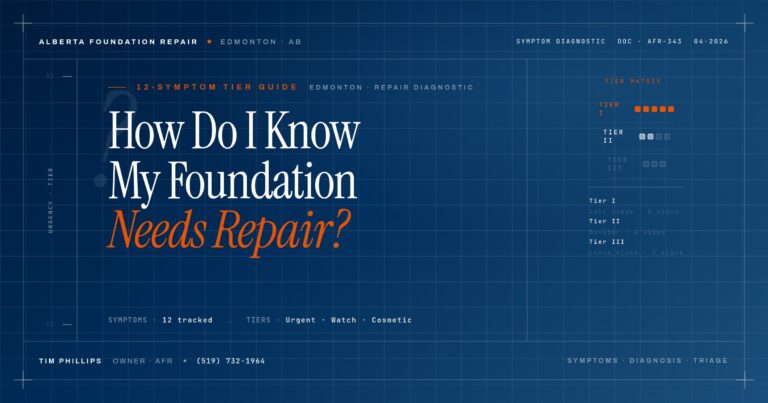
Direction is the tell. Vertical and hairline cracks that are stable and under a few millimetres are usually cosmetic shrinkage. Horizontal cracks, stair-step cracks that are wider at the top, diagonal cracks that are widening, and any crack leaking under pressure are structural and need a professional read before any repair.
Can a foundation crack be repaired permanently?
A cosmetic crack sealed correctly with the right material stays sealed, polyurethane for water and movement, epoxy for structural rebonding of a stable crack. A structural crack only stays fixed if the underlying cause, soil load, settlement, or drainage, is corrected first. Seal the symptom without addressing the cause and the crack returns nearby.
Is epoxy or polyurethane better for a foundation crack?
Epoxy is rigid and structural, best for a dry, stable crack that needs its strength back. Polyurethane stays flexible, seals water even in a wet crack, and tolerates Edmonton’s seasonal clay movement. For waterproofing a moving foundation, polyurethane usually wins; for rebonding a dry structural crack, epoxy.
Do I need an on-site inspection for a foundation crack?
For a clearly cosmetic hairline, not always, but for any crack that might be structural, yes. Tim’s free on-site inspection reads the crack, the wall, and how the soil and frost are loading it, so the repair targets the real cause instead of just the visible line. It is the difference between fixing the crack and fixing what caused it.
Sources and references
- Alberta Geological Survey, surficial geology and lacustrine clay distribution of the Edmonton region.
- National Building Code of Canada 2025, footing depth and foundation design provisions (frost protection, minimum embedment).
- National Research Council of Canada, Canadian Building Digests on soil movement, frost action, and basement wall loading.
- CSA Group, CSA A23.1 Concrete materials and methods of concrete construction.
- APEGA, Association of Professional Engineers and Geoscientists of Alberta, guidance on stamped drawings for structural foundation work.
- Canada Mortgage and Housing Corporation (CMHC), guidance on diagnosing and repairing foundation cracks and moisture.
Pinpoint your crack repair starting point
Foundation cracks are not all the same, and neither is the fix. Use the path below to jump straight to the guide that matches what you are dealing with right now, from reading the crack on your wall to understanding what the repair will run you.
Figure out what crack you have
- A field guide to every foundation crack pattern Edmonton homes show
- Why diagonal stair-step cracking climbs block and brick walls
- Reading horizontal wall cracks and the soil pressure behind them
Decide how to fix it
- Weighing epoxy against polyurethane for injected crack repairs
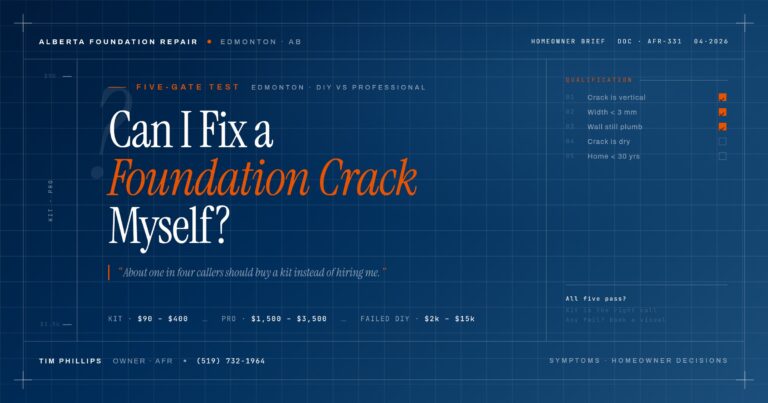
- What homeowners can patch themselves and where the line really sits
Plan the cost and handle urgency
Send Tim a photo and get a fast severity read
Not sure if your crack is the cosmetic kind or the kind that needs acting on this week? Text or call Tim a clear photo of the crack with something for scale, and you will get an honest first read on whether it is a sealing job or a structural one, before anyone talks about drilling. If it warrants a closer look, the next step is a free on-site inspection where Tim reads the wall and identifies the cause.