Edmonton Clay Soil and Your Foundation: Why This City Is Hard on Houses
Quick Answer: Edmonton’s foundation problems trace back to one thing: the glacial lake clay sitting beneath the city. This expansive soil swells when wet, shrinks when dry, and moves with every freeze-thaw cycle. Combined with Edmonton’s 2.4-metre frost depth and 91 annual freeze-thaw cycles, it puts relentless pressure on every residential foundation.
In This Guide
- The Glacial Lake That Made Edmonton’s Clay
- The Layers Beneath Your House
- Why Expansive Clay Is the Problem
- Frost Action in an Edmonton Winter
- The Three Damage Mechanisms
- Mill Woods and Solonetzic Soils
- The River Valley Slope Problem
- What Climate Change Is Doing to This
- What You Can Actually Control
- Frequently Asked Questions
Reading time: 14 minutes
Every other article on this site references Edmonton clay soil as the reason foundations crack in this city. This is the article that explains why, in as much depth as the science supports. It is the longest piece in our series because the story starts 12,000 years ago and passes through three distinct fields (geology, clay mineralogy, and geotechnical engineering) before it gets to what happens to your basement wall in February.
If you came here looking for the short version, the quick answer at the top has it. If you want to understand why Edmonton is genuinely harder on residential foundations than most Canadian cities, and why a repair contractor who doesn’t know this geology will misdiagnose your problem, read on.
Edmonton clay drives two separate foundation failure mechanisms that most articles conflate. For a side-by-side diagnostic of which one is affecting your home, see settlement vs heave in Edmonton.
The clay beneath this city swells and shrinks with moisture, and that movement drives a large share of the foundation repair needs of Edmonton properties. Here is how local soil behaves and what it does to the concrete sitting on top of it.
The Glacial Lake That Made Edmonton’s Clay
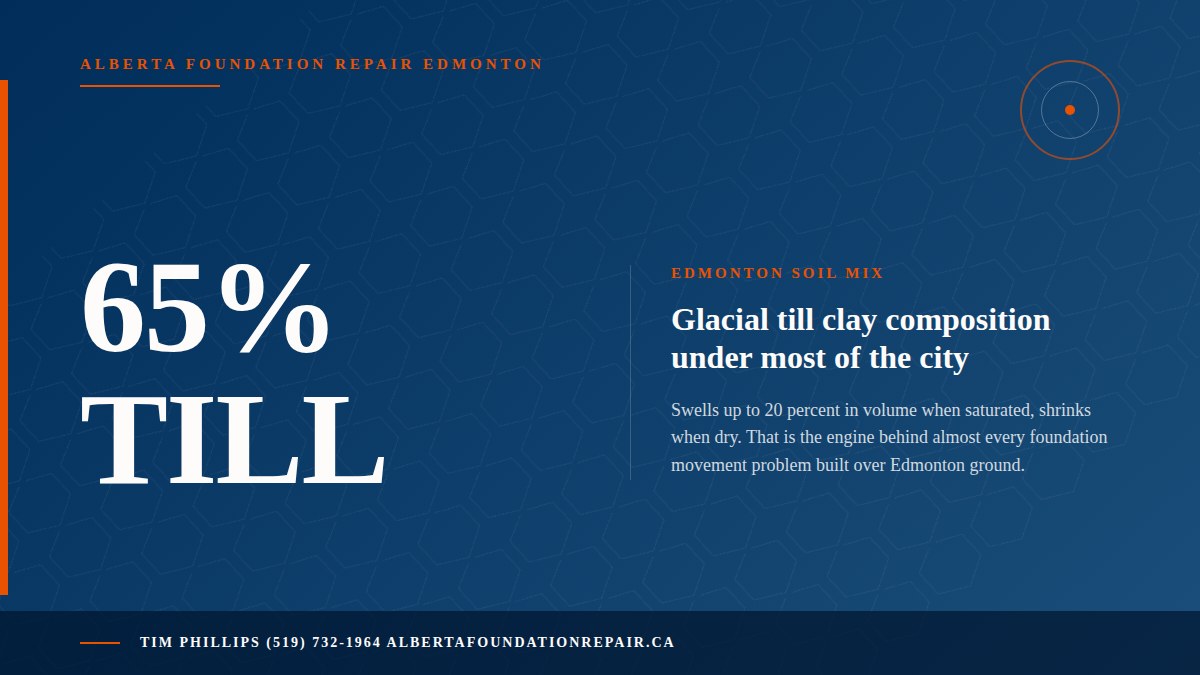
At the end of the last ice age, the Laurentide Ice Sheet retreated across what is now Alberta. As the ice melted, enormous volumes of meltwater pooled in front of and between the retreating ice lobes, forming temporary proglacial lakes. One of those lakes covered most of the region now occupied by Edmonton, plus a significant area to the west. Geologists refer to it as Glacial Lake Edmonton. It existed for only a few thousand years, but it left behind something the city has been dealing with ever since: a thick blanket of fine-grained lake-bottom sediment across the entire Edmonton region.
While the lake existed, suspended silt and clay particles carried in by glacial meltwater settled slowly to the bottom. Over centuries, those settled particles built up into a layer of glaciolacustrine clay (lake-bottom clay of glacial origin). When the ice dam that impounded the lake eventually collapsed and the water drained, the clay stayed. It is now the surface soil across most of Edmonton, sitting on top of older glacial till and, beneath that, Cretaceous bedrock.
Why This Origin Story Matters
Lake-bottom sediment has very different properties than soil formed in place by weathering of local rock. Particle size is small and uniform. Mineralogy is dominated by the clay minerals that were already fine enough to travel in meltwater before settling. Moisture absorption capacity is high. And because it was deposited under a lake rather than compacted by ice, the upper portion was never heavily over-consolidated, which means it retains the capacity to swell and shrink freely as moisture conditions change.
This is the fundamental reason Edmonton foundations have different problems than, say, Halifax foundations (granite-derived soils, non-expansive) or Vancouver foundations (glacial till and alluvial deposits, variable but less active).
The Layers Beneath Your House
In most of Edmonton, the subsurface follows a consistent four-layer sequence from the ground surface downward. Knowing this sequence helps explain why different types of foundation problems happen at different depths.
| Layer | Typical Depth | Composition | What It Means for Foundations |
|---|---|---|---|
| 1. Glaciolacustrine clay and silt | Surface to 2-4 m | Fine-grained lake-bottom sediment from Glacial Lake Edmonton | This is the layer your foundation footing sits in or just below. Expansive, frost-susceptible, and seasonally active. |
| 2. Glacial till (diamicton) | ~2-4 m to 12-15 m | Very stiff clay-silt-sand-gravel mixture deposited directly by ice | Dense and stable. Capable of carrying significant load. Many engineered foundations in Edmonton bear on this layer. |
| 3. Saskatchewan Sands and Gravels | ~12-15 m to 22-26 m | Compact to very dense pre-glacial river deposits | Excellent load-bearing capacity. Reached only by engineered pile foundations in heavy construction. |
| 4. Cretaceous bedrock | Below 22-26 m (variable) | Claystone, bentonitic sandstone, siltstone, coal seams (Horseshoe Canyon Formation) | Rock. Very rarely reached by residential foundations. Relevant to slope stability along the river valley. |
A typical Edmonton house foundation sits in or just below Layer 1 (the glaciolacustrine clay). The basement wall rests on a concrete footing placed below the design frost depth of 2.4 metres, which means the footing itself is often still within the glaciolacustrine layer. That is why the shrink-swell behaviour of this specific layer is the single most important thing affecting residential foundations.
Note that the total thickness of unconsolidated sediments (Layers 1 through 3) varies dramatically across the city because of buried pre-glacial valleys. In some Edmonton areas the thickness is less than 1 metre; in others it reaches over 100 metres. The specific depth to glacial till under any given lot requires a site-specific geotechnical investigation.
Why Expansive Clay Is the Problem
Not all clay is expansive. The shrink-swell behaviour that damages Edmonton foundations comes from a specific group of clay minerals called smectites, of which montmorillonite is the most active. Understanding why smectite clays behave this way explains why the problem is chemical, not just physical.
The Molecular Structure of Swelling Clay
Smectite clays like montmorillonite have a layered crystal structure. Between each crystal layer is a gap capable of absorbing water molecules. When water is present, it enters these inter-layer gaps, forcing the layers apart and expanding the overall volume of the clay. When the water leaves, the layers collapse back together. The process is driven by electrical charge differences in the clay structure, not just physical absorption, which is why the effect is so strong and so repeatable.
Published research on expansive clay soil behaviour documents swelling pressures of several hundred kilopascals under confined conditions, which is more than enough to lift a residential foundation, bow a basement wall, or crack concrete. The pressure acts in every direction at once, but it concentrates against rigid structures like foundation walls because they cannot compress to accommodate the expansion.
In Edmonton’s glaciolacustrine clay, the smectite content is high enough to produce measurable seasonal movement in any home that is not continuously stabilized by uniform moisture. The practical result is that every foundation in the city is subject to some amount of annual clay movement. The question is not whether the clay moves. It is how much it moves and whether the foundation can accommodate that movement without cracking.
Tim Phillips, Alberta Foundation Repair: “People ask me all the time why their house is cracking when their neighbour’s house is fine. Usually it is not that one house was built better. It is that the moisture conditions around one house are different. One has a downspout discharging right at the wall. One has a big elm five metres from the foundation drinking up the soil moisture every summer. One has perfect grading. Same soil, same neighbourhood, completely different movement behaviour. The clay will do what the clay will do. Your job is to control what you can control.”
Frost Action in an Edmonton Winter
On top of the shrink-swell problem, Edmonton foundations face a second and separate mechanism: frost heave. This happens when the soil underneath a structure freezes, expands, and lifts the structure upward. Understanding how it works in detail matters because most homeowners think of frost heave as “water in the soil expands when it freezes”, and while that is partly true, the actual mechanism is more complicated and more damaging.
The Ice Lens Mechanism
Water does expand approximately 9 percent when it freezes into ice. This is real physics. But in fine-grained soils like Edmonton’s clay, the larger effect is not bulk freezing. It is the formation of segregated ice lenses.
Here is how an ice lens forms. As the freezing front penetrates downward into the soil during early winter, the temperature at the freezing interface reaches 0 degrees Celsius. At this interface, water already in the soil pores freezes. But the freezing does not stop there. Because the frozen soil above the interface is drier than the unfrozen soil below, there is a capillary gradient pulling more water upward from the unfrozen zone toward the freezing front. That water arrives at the interface and also freezes, adding to the ice already there. Over weeks of sustained cold, this process builds a lens of nearly pure ice at the freezing front that is several millimetres or even centimetres thick.
The critical insight is that an ice lens contains far more ice than the water originally present in that volume of soil. The lens grows by pulling water in from below, so its volume can be many times what simple 9 percent expansion would predict. And when the lens forms under a footing, it lifts the footing upward by the full thickness of the lens.
This mechanism was formally described in Canadian geotechnical literature by Konrad and Morgenstern in 1980 and 1981, and it is the basis for how Canadian foundation engineering handles frost action under the Canadian Foundation Engineering Manual. It is directly relevant to Edmonton because the city’s fine-grained clays are exactly the soil type that supports ice lens formation most aggressively.
Edmonton’s Freeze-Thaw Cycle Count
Why Edmonton’s 91 Cycles Matter
Edmonton averages approximately 91 freeze-thaw cycles per year, based on 30-year climate normal data. A freeze-thaw cycle is counted whenever the air temperature crosses the 0 degree Celsius threshold, causing surface and near-surface moisture to alternate between liquid and solid states. Individual years vary from around 70 cycles in mild winters up to 120 in cold-and-variable ones.
Ninety-one cycles per year is a lot. For comparison, Vancouver averages around 25 cycles per year, Toronto around 55, Calgary around 110 (more Chinook events), and Winnipeg around 75. Edmonton sits high on the list, and the high cycle count is what makes the cumulative damage to foundations steady over years rather than dramatic in a single event.
Each cycle that crosses through the first 2 metres of soil under a footing produces a small amount of ice lens expansion, a small amount of displacement, and (importantly) a small amount of thaw-settlement when the ice melts. A foundation does not crack from one cycle. It cracks from the accumulation of hundreds of cycles over decades.
The 2.4 Metre Frost Depth Number
Edmonton’s design frost penetration depth is 2.4 metres (approximately 7.9 feet). This number represents the depth below which water in the soil is not expected to freeze during a statistically severe winter (generally a 50-year return period). It is determined using methodology from the Canadian Foundation Engineering Manual, which accounts for soil thermal properties, mean annual air temperature, and snow cover.
The Alberta Building Code requires residential footings to be placed at a minimum of 1.2 metres below finished grade. In practice, most Edmonton foundations are poured deeper than that because builders know the local frost depth is greater than the code minimum. The best Edmonton residential foundations follow the 2.4 metre design frost depth for the footing. The ones built cheaply or before modern code enforcement sometimes do not, which is one of the things Tim looks for when he inspects a foundation on site and reads the cause of the movement.
The Three Damage Mechanisms
Now the pieces connect. Edmonton’s soil is expansive because of its clay mineralogy. Edmonton’s climate subjects that soil to approximately 91 freeze-thaw cycles per year, with frost reaching 2.4 metres below grade. A residential foundation placed in that soil experiences three specific types of damage over time.
Mechanism 1: Lateral Swell Pressure
When the clay behind a foundation wall becomes saturated (spring snowmelt, heavy rain, plumbing leak, downspout discharge), the clay expands. Because the foundation wall is rigid and the clay is confined between the wall and the undisturbed soil behind it, the expansion has nowhere to go except into the wall. Lateral pressure builds and acts horizontally against the concrete.
If the pressure exceeds what the wall can resist, a horizontal crack forms at the mid-height of the wall (where bending stress is maximum), or the wall begins to bow inward. This is the mechanism behind horizontal foundation cracks, which are always a structural emergency in Edmonton because the underlying cause does not go away with the wet season. Each spring thaw reapplies the pressure to the same wall.
Mechanism 2: Differential Settlement from Shrinkage
During dry periods, the same clay that swelled with water now shrinks as it dries out. If the shrinkage is uniform across the foundation footprint, the whole house settles together and visible damage is minimal. If the shrinkage is uneven, which it almost always is because of irregular moisture patterns (trees, drainage, sun exposure, interior moisture from basements), one part of the foundation sinks while another stays supported.
The result is differential settlement. The visible symptoms are diagonal cracks running from window or door corners (where stress concentrates), stair-step cracks in block walls (following the path of least resistance through mortar joints), and cracks that widen over years rather than appearing suddenly. This mechanism is responsible for most of the “the cracks are getting worse every year” reports homeowners describe during inspections.
Mechanism 3: Frost Heave Under the Footing
When ice lenses form in the soil beneath or beside a footing, the footing lifts. When the lenses melt in spring, the footing settles back down, but not always to the exact original position because the thawed soil is now softer and partly disturbed. Repeated cycles of lift and settle gradually displace the footing, often unevenly because frost penetration is not uniform across a typical foundation perimeter (corners lose heat faster, sun-exposed sides warm faster).
Frost heave damage often appears as a house that feels “off level” or has doors that stick only in certain seasons. In severe cases, it produces visible vertical displacement between adjacent sections of the foundation. Addressing it requires fixing the drainage that saturates the soil in the first place, because dry soil does not form ice lenses.
Mill Woods and Solonetzic Soils
Mill Woods has the best-documented soil conditions of any Edmonton neighbourhood because of a detailed survey done in 1970 during the planning phase of its development. Pawluk and Bayrock studied 260 acres of Mill Woods and classified four distinct soil associations across that area:
- Ellerslie (Chernozemic): dark topsoil with good agricultural properties, lower shrink-swell activity
- Mill Woods (Solonetzic): sodium-affected clay with moderate shrink-swell activity
- Argyll (Alkaline Solonetz): poorly drained, saline, with the highest shrink-swell activity and elevated risk of concrete corrosion from the sulphate content
- Hercules (Humic Gleysol): poorly drained wetland soil
The 1972 published paper explicitly noted that the soils may present problems related to shrink-swell potential and concrete corrosion. This was before Mill Woods was fully developed as a residential neighbourhood. The homes built in the decades after that warning were built on soil known in advance to be problematic for foundations.
Solonetzic Soils Explained
Solonetzic soils are clay soils with an unusually high sodium content in the subsoil. When wet, the sodium disperses the clay platelets, which amplifies the swelling effect beyond what the clay mineralogy alone would produce. When dry, the same sodium leaves behind a hard columnar structure in the subsoil. The result is a soil that shrinks and swells more aggressively than a typical calcium-dominated clay, and that has very low permeability when saturated.
Solonetzic soils in Alberta formed from glacial parent materials that originally contained sodium salts. They are distributed in pockets across the Glacial Lake Edmonton basin, including the Cooking Lake moraine area east of the city. Mill Woods sits partly on this moraine, which is why the 1970 survey found solonetzic associations in its soil profile. We break down what this means for homeowners in our guide to Millwoods foundation problems.
Practical implication for Mill Woods homeowners: if your home is on the Argyll or Mill Woods soil association, seasonal clay movement is likely to be greater than average for Edmonton. This does not mean your foundation will fail. It means that moisture management (grading, drainage, tree placement) matters more than it would elsewhere, and that early crack inspection is more important.
Similar solonetzic patterns exist in other east Edmonton neighbourhoods along the Cooking Lake moraine, including Glastonbury and Clareview, though these neighbourhoods do not have published soil surveys as detailed as Mill Woods.
The River Valley Slope Problem
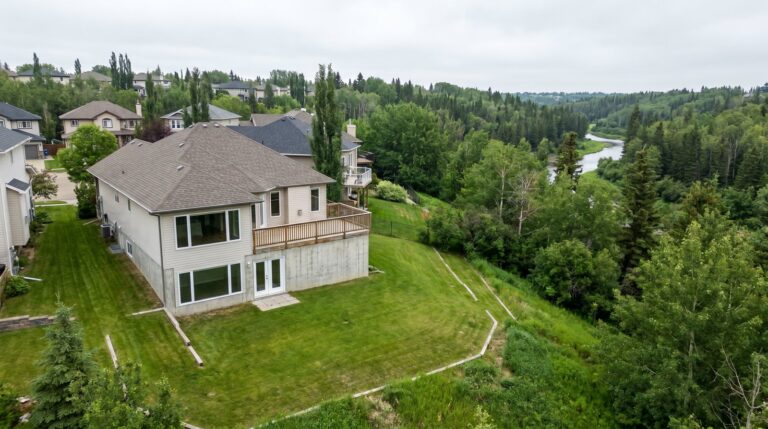
Homes built on or near the North Saskatchewan River valley slopes face an additional concern beyond clay movement: slope stability. The river has been cutting into the valley walls for thousands of years, and the combination of steep slopes, saturated soils during high-water events, and the same expansive clay mineralogy creates conditions where entire slope sections can fail.
This is not a hypothetical concern. Three large documented landslides along the Edmonton North Saskatchewan River valley have affected residential and infrastructure:
- Whitemud Road landslide: damaged five residential lots; the upper two-thirds of the slope slid along a weak plane in Upper Cretaceous bedrock, with a vertical drop of up to 18 metres at the slope crest
- Keillor Road landslide (May 2005): produced a 5-metre-deep graben at the head of the displaced material; the toe of the slide moved 22 metres into the river
- Lesueur landslide: over 35 years of documented progressive movement
These are published case studies in Canadian geotechnical literature, not rumours. The causes identified in the engineering reports include toe erosion by the river, residential development behind slope crests (adding load), rising groundwater levels from urban activity (lawn watering, leaks, sewer seepage softening bedrock), and high pore water pressure following heavy precipitation events.
If Your Home Is Near the Valley Crest
Neighbourhoods at or near the river valley edge (Riverdale, Cloverdale, Forest Heights, parts of the University area, Rossdale, Riverbend slope edges) carry a combined risk: the same clay issues every Edmonton neighbourhood faces, plus a documented history of slope movement within the city. If your home is within 50 metres of the valley crest and you notice new cracks, tilting, or unusual settlement patterns, the first step is a geotechnical inspection, not a crack repair. The crack may be a symptom of slope movement rather than foundation problems, and the right response is very different in each case.
For homes not directly on the slope, the general Edmonton guidance in this article still applies. The slope stability concern is specifically for properties within the immediate valley edge zone.
What Climate Change Is Doing to This
Edmonton’s climate is warming. The City of Edmonton’s 2025 climate report projects that the current annual average temperature of 2.1 degrees Celsius will rise to between 5.6 and 8 degrees Celsius by 2080, with winter temperatures warming faster than summer. This has specific implications for clay soil foundations, and they are not all obvious.
A warmer winter means less frost depth and fewer days of sustained sub-zero temperatures. That sounds like it should be good news for foundations (less frost heave potential), but the reality is more nuanced. What is actually happening is that Edmonton winters are producing more mid-winter thaw events and more shoulder-season freeze-thaw cycles rather than a single long deep cold period. The annual freeze-thaw cycle count is increasing even as total frost depth is decreasing.
This is worse for foundations, not better. Ice lens formation and the expansion-contraction cycles that damage foundations are driven by the number of cycles, not by the absolute depth of cold. More cycles means more seasonal movement over any given decade, even if no single cycle is as severe as the historical worst case.
In addition, precipitation patterns are becoming more extreme. Dry periods are drier, wet periods are wetter, and extreme single-event rainfall (like the 2013 Alberta flood pattern, though that event primarily affected southern Alberta) is increasing in frequency across the province. For expansive clay, this means the shrink-swell amplitude is increasing over time. The clay under an Edmonton house will move more per year in 2050 than it moved per year in 1990, under the projected climate trajectory.
The practical consequence for Edmonton homeowners is that foundation repairs done today need to assume the stress environment is getting worse, not stable. A repair that lasts 30 years under current conditions may need to be re-assessed in 20 years under future ones. This is one of the reasons a long warranty on a foundation repair in Edmonton is meaningful only if the underlying cause was actually addressed.
What You Can Actually Control
You cannot change the clay mineralogy of Edmonton. You cannot change the frost depth. You cannot change the 91 freeze-thaw cycles per year. What you can change is how much water reaches the clay around your foundation and how quickly it moves away. Water is the variable that determines how much the clay moves. Less water means less movement. Less movement means less damage.
Grading and Downspouts (City of Edmonton Drainage Bylaw)
The first 1 to 2 metres around your foundation should slope at approximately 10 percent away from the wall. This is required by the City of Edmonton Residential Lot Grading Guidelines and is the single most important thing you can do to keep water out of the soil at the foundation zone. If your lot slopes toward the wall (even slightly), fix it before anything else.
Downspouts must discharge at least 1 metre away from the foundation wall. Use extensions or splash pads. Never connect a downspout to the weeping tile system because that pressurizes the drainage around the footing with every rainfall.
Tree Placement
Trees draw large quantities of water from the soil. In expansive clay, that water draw causes desiccation shrinkage. Aggressive-rooted species like willow, silver maple, and poplar can produce documented settlement of several centimetres in a decade on homes within their root zone. The rule of thumb is to keep large deciduous trees at least as far from the house as their mature height. An elm that will reach 20 metres should not be planted within 20 metres of a foundation.
If you already have large trees near your foundation, moving or removing them is a major decision with its own consequences (the sudden reversal of moisture conditions can cause soil rebound and new cracking). This is a situation where an informed consultation matters.
Weeping Tile Maintenance
The weeping tile around your foundation footing is the primary drainage system for hydrostatic pressure relief. When it clogs, water stays against the wall longer, increasing both infiltration risk and clay saturation. In Edmonton homes built before around 1980, the original weeping tile is often clay or deteriorated concrete and has exceeded its service life. Modern replacement is perforated PVC with a filter sock to prevent silt ingress.
Signs of failed weeping tile include chronic wet spots on interior walls, standing water in the window wells after rain, and cracking on the exterior grade surface around the foundation perimeter. A hydro-vac flush is sometimes sufficient to restore a partially clogged system. Full replacement requires excavation down to footing depth, which is why it is usually combined with exterior waterproofing work.
Interior Moisture Management
The moisture inside a basement also matters. A damp basement with inadequate ventilation feeds moisture back into the concrete and into the soil at the base of the wall, extending the duration of the wet zone. A properly functioning basement dehumidifier during summer humid months keeps the interior wall dry, which reduces the overall moisture exposure of the foundation system. This is a small effect compared to exterior grading, but it matters over years.
Tim Phillips, Alberta Foundation Repair: “Most of the foundation work I do could have been prevented with better drainage twenty years ago. I am not trying to talk homeowners out of calling me. I am trying to tell them that if they inherit a house with good grading and a functioning weeping tile, and they keep it that way, they will probably never need to call me. The clay is not the enemy. The clay plus uncontrolled moisture is the enemy. Controlling the moisture is the most important thing a homeowner in Edmonton can do for their foundation.”
Frequently Asked Questions
Why does Edmonton have such bad clay soil for foundations?
Edmonton sits on sediments deposited by Glacial Lake Edmonton approximately 12,000 years ago. The upper 2 to 4 metres is fine-grained glaciolacustrine clay and silt, which is expansive (swells when wet, shrinks when dry) and frost-susceptible (forms ice lenses when freezing). Combined with Edmonton’s deep frost penetration and roughly 91 freeze-thaw cycles per year, the clay puts repeated pressure on every residential foundation in the city. This is different from most Canadian cities because the lake-bottom origin produces uniformly fine-grained active clay.
How deep does frost actually penetrate in Edmonton?
The design frost penetration depth for Edmonton is 2.4 metres (about 7.9 feet), determined using the Canadian Foundation Engineering Manual methodology. This is the depth below which water in the soil is not expected to freeze during a statistically severe winter. Alberta Building Code requires residential footings to be placed at minimum 1.2 metres below finished grade, but in Edmonton the practical requirement for quality construction is deeper. Homes built before modern code enforcement sometimes have shallower footings, which shows up during inspections as frost heave damage.
What does expansive soil actually mean?
Expansive soil contains clay minerals (primarily montmorillonite in the smectite group) that absorb water molecules between their crystal layers. When the soil becomes wet, the clay expands in volume. When it dries, it shrinks. The cycle repeats seasonally. Edmonton’s glaciolacustrine clay is expansive because it contains high proportions of these active clay minerals. The practical consequence is that foundations in Edmonton are subject to lateral pressure from swelling clay and loss of support from shrinking clay, in alternating cycles, across every year of their life.
Are some Edmonton neighbourhoods worse than others for clay soil?
Yes. Mill Woods is the best-documented case. A 1970 soil survey distinguished four soil types across 260 acres of Mill Woods, including solonetzic (sodium-affected) soils with particularly high shrink-swell activity. East Edmonton neighbourhoods along the Cooking Lake moraine, including Glastonbury and Clareview, tend toward similar solonetzic patterns. Homes on or near the North Saskatchewan River valley slopes face an additional slope stability concern on top of clay movement. Every Edmonton neighbourhood sits on some form of glaciolacustrine clay, but the severity varies by location.
What can I do to prevent clay soil foundation damage?
The most effective prevention is moisture management around the foundation. Ensure positive grade (10 percent slope away from the foundation for the first 1 to 2 metres) per Edmonton’s Drainage Bylaw, extend downspouts at least 1 metre away from the wall, keep the weeping tile system functional and unclogged, avoid high-water-demand trees within the mature height of the species, and address any negative settlement or soil depressions before they accumulate water. Dry clay moves less. Wet clay moves more. Almost every Edmonton foundation problem can be traced back to a moisture source that was not controlled.
Sources
- May, R.W. & Thomson, S. (1993). Quaternary sediments in central Edmonton, Alberta, Canada: Stratigraphy, distribution and geotechnical implications. Engineering Geology. sciencedirect.com
- Pawluk, S. & Bayrock, L.A. (1972). Soil Survey for Urban Development: Mill Woods, Edmonton. Alberta Research Council Economic Geology Report ESR 1972-07. ags.aer.ca
- Konrad, J.M. & Morgenstern, N.R. (1981). The segregation potential of a freezing soil. Canadian Geotechnical Journal, 18(4), 482-491. cdnsciencepub.com
- City of Edmonton. (2025). Understanding Edmonton’s Changing Climate: Observed Climate Trends. edmonton.ca
- City of Edmonton. (2024). Homeowner’s Guide to Lot Grading and Drainage. edmonton.ca
- Canadian Geotechnical Society. (2023). Canadian Foundation Engineering Manual (CFEM), 5th Edition. Chapter 13: Frost Action; Chapter 15: Foundations on Expansive Soils. cdnsciencepub.com
- Alberta Geological Survey. (1966). Geology of the City of Edmonton, Part 1: Central Edmonton. ESR 1966-01. ags.aer.ca
Get an Edmonton Clay Soil Foundation Assessment
If you are seeing cracks, unusual settlement, or any of the warning signs described in this article, the next step is a professional on-site inspection. Tim visits, inspects the foundation, and identifies whether your specific situation is ongoing clay movement, footing settlement, frost heave, water intrusion, or some combination. That diagnosis of the cause determines the right repair, if one is needed.
Alberta Foundation Repair, Edmonton and surrounding areas. (519) 732-1964
Tim knows Edmonton clay soil because he has spent years repairing what it does to residential foundations. The free on-site visual inspection comes at no extra charge, and the recommendation you receive is based on what Tim actually finds when he reads the cause on site, not on assumptions about your neighbourhood.