Foundation Inspection Edmonton: What a Pro Actually Checks
A foundation inspection is the single most important step before any foundation repair work starts in Edmonton. A proper inspection tells you what is wrong, how serious it is, and what the fix actually costs, before anyone drills a hole or excavates a trench. Alberta Foundation Repair offers free visual foundation inspections to Edmonton homeowners because we believe honest diagnosis should not be a sales barrier.
This guide explains when to get one, what is covered, how Tim identifies the cause of foundation movement, and how to tell a thorough inspection from a sales visit.
Every dependable repair begins with a careful look at the structure, which is why an inspection is the natural front door to any Edmonton foundation repair project. Below we cover what a thorough inspection examines and why it shapes everything that follows.
When You Need a Foundation Inspection
If you are evaluating a home you might buy and the inspection report flagged the foundation, the next decision is walk, negotiate, or accept. Tim’s framework for that exact call is in buying a house with foundation problems in Edmonton.
Not sure if your crack needs an inspection this week or next month? The Edmonton foundation crack emergency guide uses a 3-tier framework to sort urgent, near-term, and monitor-only repairs.
- New visible cracks: Any crack you did not notice last month deserves a look. See Types of Foundation Cracks in Edmonton for what the different patterns mean.
- Water in the basement: Even small amounts after rain or spring thaw indicate a drainage or waterproofing failure worth diagnosing
- Sticking doors or windows: Floor or wall movement can cause door frames to rack out of square
- Visible settlement: Gaps where stairs meet the house, sunken garage slabs, tilted porch steps
- Bowing walls: Interior basement walls that look curved, bulged, or leaning
- Horizontal cracks: Any horizontal crack in a foundation wall is urgent. See Horizontal Foundation Cracks Edmonton.
- Buying a home: Never skip a foundation specialist visit on an Edmonton home over 30 years old
- Selling a home: Disclose what you know and fix what you can before listing
- After an emergency: Major storm, flood, or water line break
- Annual check for older homes: Homes built before 2000 benefit from yearly visual walk-throughs
Two Levels of Foundation Inspection
Before booking any inspection, match what you are seeing against the Edmonton symptom tier guide. A Tier 3 cosmetic symptom rarely warrants paid assessment; a Tier 1 warrants same-day response.
Edmonton homeowners have two different types of foundation inspection available, and they serve different purposes at very different price points.
- Foundation specialist walks the home exterior and interior
- 12-point visual checklist (see below)
- Verbal or simple written summary of findings
- Plain-English explanation of any issues
- Repair recommendations and pricing estimates
- Best for: most homeowners, routine check-ups, minor crack concerns, pre-listing disclosure
- Typical cost: free at Alberta Foundation Repair. Other contractors: $0 to $300
- APEGA-registered structural engineer performs the inspection
- Formal written report with photos and structural assessment
- APEGA stamp with engineer’s professional credentials
- Repair recommendations with engineering justification
- Estimated repair costs
- Valid for legal, insurance, and real estate purposes
- Best for: real estate transactions with known foundation issues, insurance claims, structural damage assessment, pre-underpinning projects
- Typical Edmonton cost: $400 to $1,500 for residential, $1,500 to $5,000+ for complex or commercial
For most Edmonton homeowners, the standard visual inspection answers the question. When the visual inspection reveals structural concerns, cracks with active movement, or significant settlement, an engineered inspection is the next step. Alberta Foundation Repair works with APEGA-registered engineers to coordinate engineered inspections when needed.
What a Free Visual Inspection Covers
A common reason homeowners book a visual is to decide between a kit and a pro. Tim will run the five-gate DIY qualification on site and tell you which path is cheaper in expected value on your specific crack.
The free visual inspection is genuinely free. No upsell pressure, no bait-and-switch for a paid service you did not ask for. Tim comes to your property, walks the entire exterior, enters the basement, checks every relevant item, answers your questions, and provides a written assessment with honest repair recommendations if any are needed. If your foundation is fine, the report says so and there is no charge.
- Camera inspection of weeping tile (paid, $300 to $600 when needed)
- Engineering drawings or structural analysis (APEGA engineer, $800 to $2,500 when needed)
- Laboratory soil testing or geotechnical reports (third-party, $1,500 to $4,000 when needed)
- Destructive testing or excavation
The visual inspection is an expert walk-through, not a demolition project. When visual findings suggest hidden problems, Tim will explain what additional diagnostic work would confirm the issue and what each step costs before you decide.
The 12 Items Tim Checks Every Time
Homeowners can do most of these checks themselves once a year, and April is the optimal month. The DIY four-weekend version is in spring foundation inspection Edmonton.
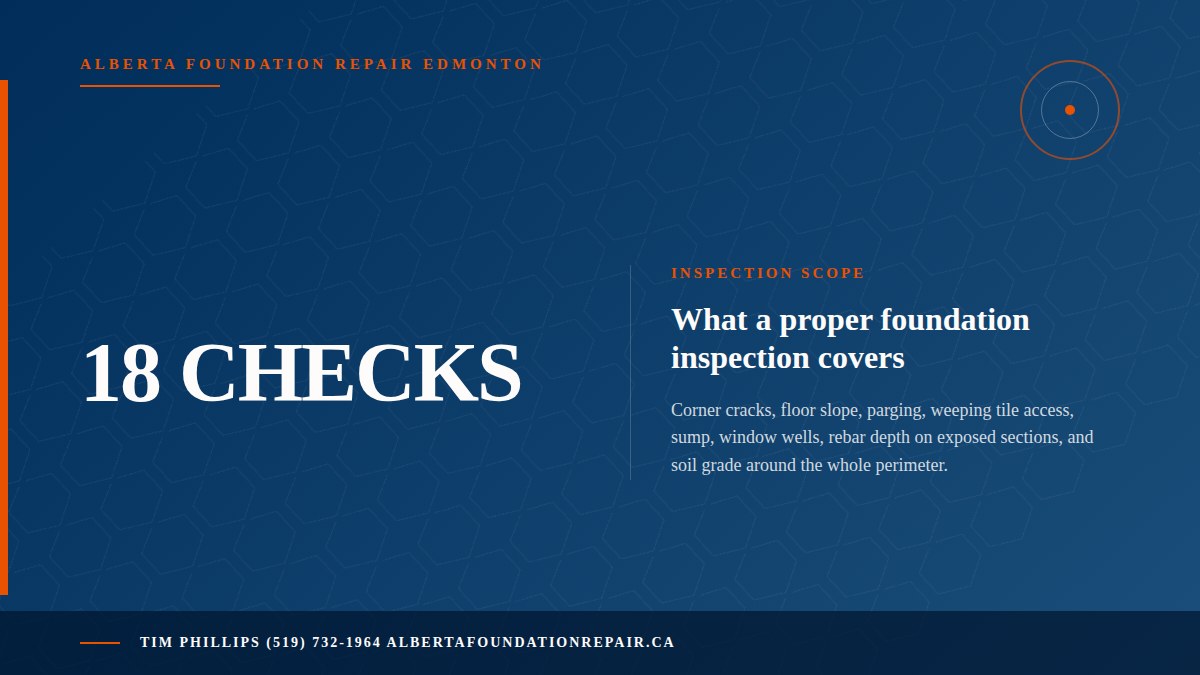
A consistent inspection checklist is what separates a professional assessment from a quick look. Tim checks the same 12 items on every Edmonton inspection regardless of why the call came in.
- Exterior foundation crack mapping: Walk the full perimeter, photograph and classify every visible crack by type (vertical, horizontal, diagonal, stairstep)
- Parging drum test: Tap parging every 0.5 metres around the foundation to find hollow sections indicating bond failure
- Window well inspection: Check each well for frost heave separation, drainage condition, cover presence, egress compliance for basement bedrooms
- Surface grading assessment: Verify positive slope away from foundation for minimum 3 metres, note any reverse grading driving water toward the house
- Downspout placement: Confirm all downspouts extend at least 2 metres from foundation, note any dumping water against the wall
- Foundation wall alignment: Sight along exposed foundation walls looking for bulges, bows, leans, or out-of-plumb sections
- Interior basement crack inspection: Walk every basement wall, photograph and classify interior cracks, test for active moisture with a simple touch test
- Cove joint condition: Check the wall-floor joint for efflorescence, staining, visible moisture, or evidence of cove-seeping leaks
- Sump pit and pump verification: Pour water into the pit to verify pump function, check discharge line, assess battery backup if present
- Efflorescence and staining: Map any white mineral staining on walls or floors indicating chronic moisture migration
- Door and window alignment: Check exterior and basement doors for racking, sticking, or gap changes indicating foundation movement
- Structural settlement signs: Look for stair-step cracks in brick, gaps at the porch or garage junction, tilted steps, uneven floor patterns
“The checklist is what keeps me honest. If I show up thinking ‘the customer said horizontal cracks, so that is what I will look at’, I miss the window well drainage problem that is actually driving the water. Every inspection gets the same 12 checks so nothing slips by. That is how I find the real cause instead of the first thing the homeowner noticed.”
Tim Phillips, Alberta Foundation Repair
Finding the Cause, Not Just the Symptom
If the inspection reveals a structural issue that falls outside Part 9 prescriptive repairs, the next step is a P.Eng assessment. Our guide on whether you need a structural engineer for foundation repair in Edmonton walks through when engineering is mandatory and what it costs.
A crack is a symptom. The real question is why the foundation is moving, and that answer is what determines the right repair. Tim inspects the foundation on site and reads the cause, whether it is Edmonton clay heave, settlement, frost, or water finding its way against the wall.
- Suspected voids behind the foundation wall: Visual cracks that might be caused by a hidden void pulling the wall outward
- Drainage and grading failures: Water pooling against the wall from reverse grading, short downspouts, or failed window well drainage
- Clay heave and frost movement: Seasonal patterns in Edmonton’s clay and 2.4 metre frost depth that lift and drop the foundation
- Settlement signs: Differential movement showing where the soil below has compressed or washed out
- Slab condition assessment: Identifying where subgrade voids sit before polyurethane polyjacking lifts the slab back to level
Once Tim knows the cause, he can match the right modern method to it: polyurethane polyjacking for sunken slabs, epoxy and polyurethane crack injection for foundation walls, and waterproofing or drainage corrections where water is the driver. For more on the repair side, see Edmonton foundation repair.
Home Inspector vs Foundation Specialist
A general home inspector and a foundation specialist are not the same thing. Both have value, but they serve different purposes. Most Edmonton general home inspectors hold InterNACHI (International Association of Certified Home Inspectors) certification, which covers a 202-hour pre-licensing course and proctored examination. InterNACHI inspectors are trained in overall home systems, not specifically foundations.
| Factor | General Home Inspector | Foundation Specialist |
|---|---|---|
| Primary purpose | Overall home condition report | Foundation-specific diagnosis |
| Foundation depth | Surface-level check, notes concerns | Full structural and waterproofing assessment |
| Crack classification | Notes presence | Identifies type, cause, severity |
| Repair recommendations | General or none | Specific repair options and costs |
| Tools used | Flashlight, moisture meter | Drum hammer, laser level, hands-on cause diagnosis |
| Typical cost | $400 to $700 | Free visual (AFR) |
| Best used for | Pre-purchase overall assessment | Known or suspected foundation issue |
The right workflow for buyers is: general home inspector first for the overall condition report, then foundation specialist if the inspector flags anything, then engineering review if the specialist finds structural concerns. Each layer zooms in on what the previous layer revealed.
What You Get After the Inspection
A proper foundation inspection ends with a written assessment, not a verbal handshake. Tim provides:
- Written summary of findings organized by the 12-point checklist
- Photos of visible cracks, drainage issues, or damage
- Severity classification for each finding (maintenance, recommended, urgent, emergency)
- Recommended repair scope if any work is needed
- Clear pricing for each recommended repair
- Notes on additional diagnostic work (camera, engineering) only if Tim believes it would change the recommendation
- Option to decline any recommendation without pressure
Pre-Purchase and Pre-Sale Inspections
Real estate transactions are the highest-stakes use of foundation inspections. For buyers, a foundation specialist visit after the general home inspection flags any concerns can save tens of thousands of dollars in post-purchase surprises. For sellers, knowing the foundation condition before listing lets you disclose honestly and price accurately, or fix issues that would blow up the sale during buyer inspection.
- Any home over 30 years old warrants a foundation-specific inspection separate from the general home inspection
- Homes with visible exterior cracks, parging damage, or efflorescence on foundation walls should be inspected before any offer
- Buyers should negotiate the inspection contingency to allow foundation specialist access if concerns arise during the general inspection
- Sellers who refuse foundation-specific inspection are telling you something worth hearing
Frequently Asked Questions
How much does a foundation inspection cost in Edmonton?
A visual foundation inspection from Alberta Foundation Repair is free. We walk the exterior and interior of your home, check for cracks, settlement, efflorescence, drainage, and foundation wall condition, and provide a written assessment. Tim inspects the foundation on site, identifies why it is moving, and gives an honest opinion at no charge.
When should I get a foundation inspection in Edmonton?
Get an inspection if you see new cracks, water in the basement, bowing walls, settling floors, sticking doors or windows, or are buying or selling a home. Annual inspections are also smart for older homes because Edmonton’s 91 freeze-thaw cycles create small problems every year that are cheaper to fix early.
Can a home inspector find foundation problems?
General home inspectors check foundations as part of their inspection but usually flag problems rather than diagnose them. If a home inspector finds anything concerning, a follow-up visit from a foundation specialist is the right next step to confirm what it is, how serious it is, and what it will cost to fix.
What does Tim check during a foundation inspection?
Tim walks the full exterior and interior of the home checking 12 key items: visible cracks and their type, drum-testing parging, window well condition, drainage and grading, downspout placement, foundation wall alignment, interior crack patterns, cove joint condition, sump pit function, visible efflorescence, door and window alignment, and structural signs of movement.
How does Tim find the cause of foundation movement?
Tim inspects the foundation in person and reads the cause on site. He looks at crack patterns, drainage and grading, settlement, and the seasonal effects of Edmonton clay and frost to identify whether the foundation is moving because of heave, settlement, frost, or water. Once he knows the cause, he recommends the modern method that fixes it, not just the symptom.
- Canadian Association of Home and Property Inspectors (CAHPI), Standards of Practice for Home Inspections.
- Association of Professional Engineers and Geoscientists of Alberta (APEGA), Guidelines for Residential Foundation Assessment.
- National Research Council of Canada, Building Science Insight: Assessing Foundation Condition in Existing Homes.
- Canadian Foundation Engineering Manual, 5th Edition (CFEM 2023).
- Alberta Building Code (NBC 2023 Alberta Edition), Part 9 Section 9.9: Egress Requirements.
If you have noticed a new crack, a damp spot, or anything that makes you wonder about your foundation, a free visual inspection is the right next step. No pressure, no upsell, just honest diagnosis. Tim has been doing Edmonton foundation work long enough to know what matters and what does not.
Call Tim at Alberta Foundation Repair to schedule a free visual inspection for your home in Edmonton, St. Albert, Sherwood Park, Spruce Grove, Fort Saskatchewan, Stony Plain, Leduc, or Beaumont.