
French Drain Edmonton: Exterior Drainage for Clay Soil Homes
A French drain is a gravel-filled trench that collects surface water and shallow groundwater and redirects it away from your foundation or out of low-lying areas in your yard. In Edmonton, where glacial till clay holds water against the surface instead of letting it percolate downward, French drains are one of the primary tools for managing the drainage problems that clay soil creates.
This guide explains what French drains do, how they differ from weeping tile, why Edmonton clay demands a specific design approach, and what installation costs look like in 2026.
A French drain is one tool we reach for, but it works best as part of the full approach to keeping Edmonton foundations dry, not as a standalone fix. With that broader goal in mind, here is what a properly built French drain actually does for your lot.
What a French Drain Is
A French drain is a trench filled with drainage gravel surrounding a perforated pipe. Water enters the trench from the surrounding soil, flows through the gravel into the perforated pipe, and is carried by gravity to an outlet (a dry well, a storm drain connection if permitted, or a daylighted surface outlet). The concept is simple, but the execution matters enormously in Edmonton clay.
- Trench: 300 to 600 mm wide, 450 to 1,500 mm deep depending on application
- Geotextile fabric: Lines the trench and wraps the gravel column to prevent clay fines from clogging the drainage stone
- Drainage gravel: Clean 20 to 40 mm crushed stone or washed river rock, providing high permeability for water flow
- Perforated pipe: 100 mm rigid PVC with perforations facing down, laid at minimum 1 percent slope
- Outlet: Discharge point at a dry well, daylight outlet, or permitted storm drain connection
- Cleanout ports: Access points for inspection and flushing, installed at bends and every 15 to 20 metres
French Drain vs Weeping Tile
Edmonton homeowners often confuse French drains with weeping tile. They are related but serve different functions at different depths.
| Factor | French Drain | Weeping Tile |
|---|---|---|
| Primary function | Yard and surface drainage | Foundation footing drainage |
| Typical depth | 450 to 1,500 mm | 2,000 to 2,500 mm (footing level) |
| Location | Yard, garden beds, along driveways | Directly at the foundation footing |
| What it collects | Surface runoff and shallow groundwater | Deep groundwater at the foundation |
| Outlet | Dry well, daylight, or storm drain | Sump pit inside the basement |
| Edmonton clay impact | Requires geotextile wrap | Requires filter sock and proper gravel |
| Typical cost/ft | $40 to $80 | $200 to $450 (see Weeping Tile Edmonton) |
Many Edmonton properties need both. The French drain handles surface drainage in the yard (preventing pooling, redirecting downspout water, protecting garden beds), while the weeping tile handles deep groundwater at the foundation level. Installing one without the other can leave a drainage gap that causes problems the homeowner did not expect.
Why Edmonton Clay Changes the Design
Standard French drain designs from sandier regions fail in Edmonton because the glacial till clay behaves differently from any other soil type most drainage guides assume.
- Standard assumption: Surrounding soil has some permeability and water filters through it into the drain. Edmonton reality: Clay is nearly impermeable. Water sits on the surface and enters the drain only from the top, not the sides.
- Standard assumption: Backfill around the drain will not migrate into the gravel. Edmonton reality: Montmorillonite clay produces extremely fine particles that infiltrate any unprotected gravel envelope within 5 to 10 years.
- Standard assumption: A shallow trench (300 mm) handles typical drainage. Edmonton reality: Clay holds water near the surface longer, so the drain needs more depth to capture the full saturated zone, especially during spring thaw.
- Standard assumption: Minimal slope required. Edmonton reality: Clay adjacent to the gravel can create enough back-pressure that sluggish flow allows sedimentation inside the pipe. Minimum 1 percent slope is critical.
Skipping the geotextile wrap. Without a complete geotextile envelope around the gravel column, Edmonton clay fines migrate into the drainage stone and clog it within 5 to 10 years. The drain looks fine from the surface but stops working underground. Replacing a clogged French drain costs the same as installing a new one. Use the fabric.
When You Need a French Drain
- Low spot in the yard that pools after rain: Water sits for days in Edmonton clay instead of draining. A French drain carries it away.
- Downspout water pooling near the foundation: Where extending downspouts is not sufficient, a French drain intercepts and redirects the water.
- Driveway or walkway drainage: Water running across hardscape toward the foundation can be intercepted by a linear French drain along the edge.
- Garden bed drainage: Raised or level garden beds in clay soil retain excess moisture that damages plants and saturates backfill against the house.
- Swale replacement: Where surface grading alone cannot redirect water, a French drain below the surface handles the same function without visible grading.
- Retaining wall drainage: Any retaining wall in Edmonton clay must have drainage behind it to prevent hydrostatic pressure buildup. French drains are the standard approach.
Design for Edmonton Clay
- Trench width: Minimum 300 mm, 450 mm preferred for residential exterior
- Trench depth: 450 to 600 mm for surface drainage; 900 to 1,500 mm for foundation-adjacent applications
- Geotextile: Non-woven polypropylene, minimum 150 g/m² weight, wrapped completely around the gravel column with 150 mm overlap at the top
- Drainage stone: Clean 20 to 40 mm crushed stone, no fines, no recycled concrete (which produces calcium carbonate that cements the stone over time)
- Pipe: 100 mm rigid PVC Schedule 40, perforations facing down (6 o’clock position), with filter sock on the pipe as a secondary barrier
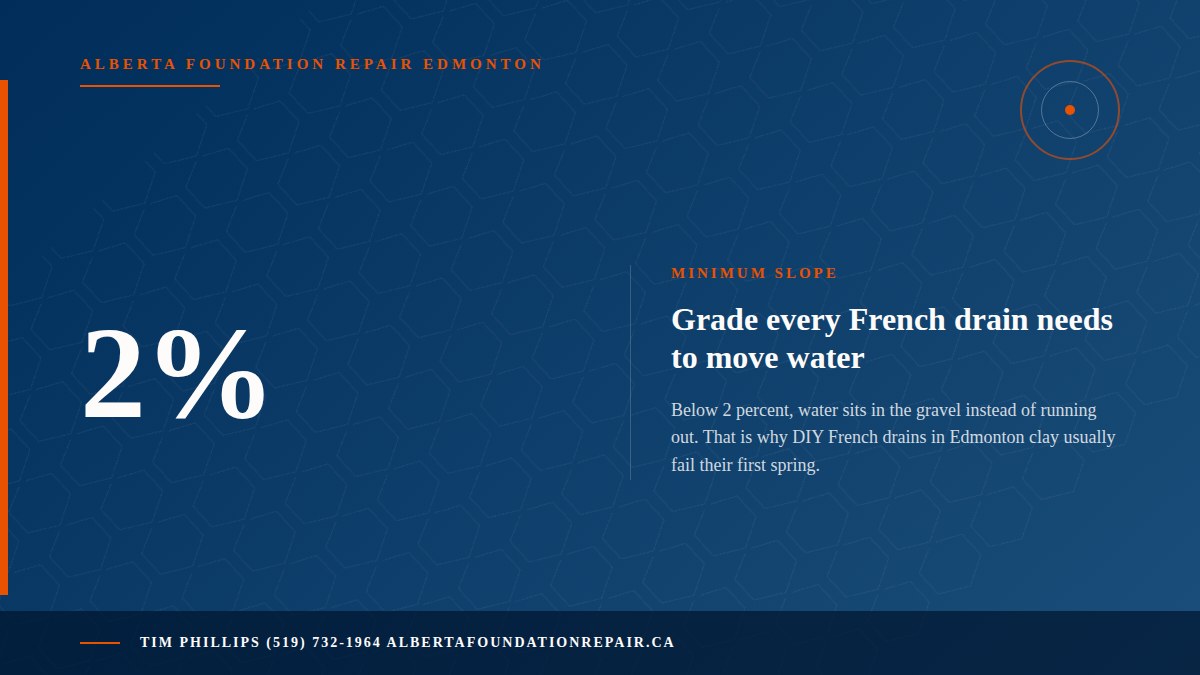
- Slope: Minimum 1 percent (10 mm drop per metre), 2 percent preferred
- Cleanout ports: At every change of direction and every 15 to 20 metres on straight runs
- Outlet: Daylight at grade (minimum 3 metres from any foundation), dry well, or permitted storm connection
Installation Process
- Plan the route: Mark the drain path from the problem area to the outlet, maintaining minimum slope throughout. Call Alberta One-Call for underground utility locates.
- Excavate the trench: Dig to specified depth and width, keeping the bottom smooth and on grade. Remove clay spoils (do not stockpile next to the trench or it will fall back in).
- Line the trench: Lay geotextile fabric along the full length of the trench, extending up both sides with enough overlap to wrap over the top of the gravel.
- Place base gravel: Pour 100 mm of drainage stone into the bottom of the lined trench.
- Place pipe: Lay the perforated pipe on the base gravel with perforations facing down. Verify slope with a laser level or string line.
- Fill with gravel: Cover the pipe with drainage stone to within 100 to 150 mm of the surface.
- Wrap the fabric: Fold the geotextile over the top of the gravel column, overlapping by at least 150 mm so clay from above cannot enter.
- Backfill to grade: Cover the wrapped gravel column with topsoil or native soil, restore surface grade.
- Install cleanout ports: Place vertical cleanout risers at bends and at the upstream end for future maintenance access.
- Verify flow: Run water into the upstream end and confirm it exits at the outlet within a reasonable time.
French Drain Cost Edmonton
| Application | Typical Cost |
|---|---|
| Exterior yard French drain (per linear foot) | $40 to $80 |
| Short run (5 to 10 metres) | $800 to $2,000 |
| Standard residential (15 to 30 metres) | $2,000 to $6,000 |
| Foundation-adjacent deep French drain | $60 to $120 per linear foot |
| Interior basement French drain (per linear foot) | $80 to $150 |
| Dry well (outlet) | $500 to $1,500 |
| Cleanout port (each) | $50 to $150 |
Edmonton metro area. Costs include labour, materials, geotextile fabric, gravel, pipe, and basic site restoration. Complex access, utilities crossing the path, or deep excavation add cost.
Interior French Drains
Interior French drains (also called interior perimeter drains) run inside the basement along the wall-floor joint, collecting water that has reached the foundation wall and directing it to the sump pit. They are part of the interior waterproofing system rather than a yard drainage solution.
Interior French drains cost $80 to $150 per linear foot and are covered in detail in Basement Waterproofing Edmonton: Interior vs Exterior Guide.
Maintenance and Lifespan
- Annual inspection: Check the outlet for blockage (leaves, ice, animal debris). Check cleanout ports for standing water that would indicate a clog.
- Spring post-thaw check: After the first major thaw, verify the drain is flowing by running water into the upstream cleanout and confirming outlet discharge.
- Cleanout flushing: Every 3 to 5 years, flush the pipe from each cleanout with a garden hose to clear any sediment that has made it past the geotextile.
- Root inspection: If trees or large shrubs are within 5 metres of the drain, check for root intrusion at cleanout ports every 2 to 3 years.
- Fabric replacement: After 15 to 25 years, the geotextile may need replacement as it degrades from UV exposure at cleanout ports and biological loading underground.
Frequently Asked Questions
How much does a French drain cost in Edmonton?
French drain installation in Edmonton costs $40 to $80 per linear foot for exterior yard drainage. A typical residential project covering 15 to 30 metres runs $2,000 to $6,000. Interior French drains along basement perimeters cost $80 to $150 per linear foot. The clay soil adds cost because trenches must be deeper and wider than in sandy ground.
Do French drains work in Edmonton clay soil?
Yes, but only if properly designed for clay conditions. Standard French drain designs for sandy or loam soils fail in Edmonton’s glacial till clay because the clay is nearly impermeable and produces fine particles that clog drainage gravel. Edmonton French drains need deeper trenches, geotextile filter fabric wrapping the entire gravel column, and coarse 20 to 40 mm clear stone for the drainage aggregate.
What is the difference between a French drain and weeping tile?
A French drain is a gravel-filled trench that collects and redirects surface and shallow groundwater. Weeping tile is a perforated pipe installed at the foundation footing level to collect water that has migrated down to the foundation. French drains handle yard drainage and surface water. Weeping tile handles deep groundwater at the foundation. Many Edmonton properties need both.
How deep should a French drain be in Edmonton?
Standard yard drainage French drains in Edmonton should be 450 to 600 millimetres deep to collect surface water and shallow subsurface flow. Foundation-adjacent French drains may need to be 900 to 1,500 millimetres deep depending on basement depth. The trench width should be at least 300 millimetres to accommodate proper gravel volume around the perforated pipe.
How long does a French drain last in Edmonton?
A properly installed French drain with geotextile wrap in Edmonton clay lasts 15 to 25 years before the fabric may need replacement. Without geotextile protection, clay fines clog the drainage gravel within 5 to 10 years. Annual inspection of outlets and cleanout ports extends lifespan significantly.
- National Research Council of Canada, Building Science Insight: Foundation Drainage Design.
- Canadian Foundation Engineering Manual, 5th Edition (CFEM 2023). Soil permeability and drainage design tables.
- Environment Canada, Canadian Climate Normals 1991-2020, Edmonton International Airport.
- Alberta One-Call, Excavation Safety and Utility Location Requirements.
- CivilWeb Spreadsheets, French Drain in Clay Soil: Design Considerations.
French drains in Edmonton clay are only as good as their design. Skipping the geotextile, using the wrong stone, or skimping on trench depth produces a drain that looks right but fails within 5 years. Tim designs drainage solutions for Edmonton clay based on the specific conditions of your property, not a generic template.
Alberta Foundation Repair installs French drains, weeping tile, and complete drainage systems across Edmonton, St. Albert, Sherwood Park, Spruce Grove, Leduc, and Beaumont. Call for a free visual inspection.