Radon Mitigation Edmonton: Why Alberta Has Canada’s Highest Risk
Radon is the leading cause of lung cancer in non-smokers according to Health Canada. It is a colourless, odourless radioactive gas that seeps from the ground into your home through cracks, joints, and penetrations in your foundation. You cannot see it, smell it, or feel it. The only way to know your family is being exposed is to test. And in Edmonton, the odds that your home needs mitigation are higher than anywhere else in Canada.
This guide explains why Alberta has the country’s highest residential radon levels, what testing and mitigation involve, what Edmonton homeowners should expect to pay, and why radon mitigation is foundation work: the entry path is your basement slab, and the fix starts there.
Radon and water both rise out of the same Edmonton soil, so dealing with the gas goes hand in hand with sealing and protecting an Edmonton basement from the ground up. Once the foundation is tight against moisture, here is how we tackle the radon coming through it.
What Radon Is and Why Edmonton Has So Much
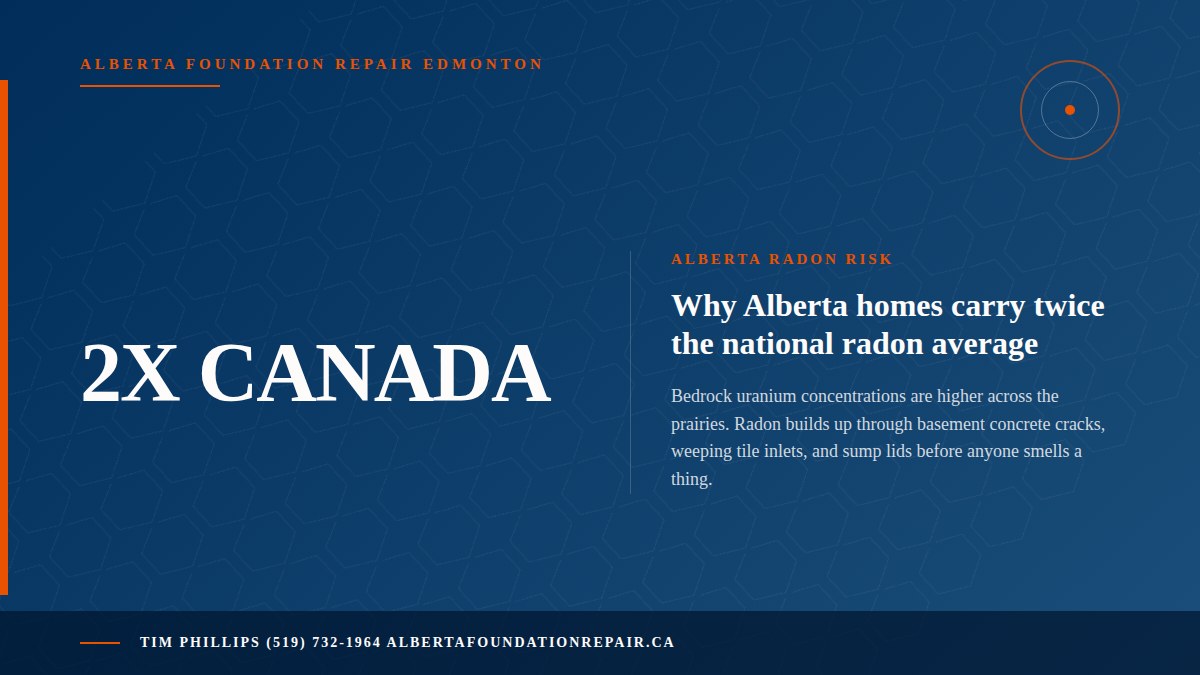
Radon is a naturally occurring radioactive gas produced by the radioactive decay of uranium in bedrock and soil. Uranium is present in trace amounts in almost all soil and rock, but some regions have significantly more than others. Uranium decays into radium, which then decays into radon gas. That gas migrates upward through soil pores, fractures in bedrock, and eventually into the air. Outdoors, radon disperses harmlessly. Indoors, it accumulates to levels that can become a serious health hazard.
- Uranium-bearing bedrock: The Paleozoic and Cretaceous sedimentary rocks under Alberta contain higher uranium concentrations than most other Canadian provinces
- Glacial till soil: Edmonton’s glacial till carries uranium-bearing rock fragments that continue to produce radon at ground level
- Long heating season: Edmonton homes stay closed up and heated for 6 to 8 months a year, trapping radon inside
- Tight modern construction: Post-1990 homes are built to higher air-tightness standards, which reduces natural ventilation that would otherwise dilute indoor radon
- Stack effect in winter: Heat rising through the home creates negative pressure in the basement, which actively pulls radon gas in through foundation penetrations
The Cross-Canada Residential Radon Survey conducted by Health Canada (2009-2011) found Alberta had the highest provincial average indoor radon concentration among Canadian provinces. The Evict Radon National Study, led by researchers at the University of Calgary, has published detailed Edmonton data: the average residential radon level in the Edmonton metro area is 106.4 Bq/m³, and approximately 1 in 6 Edmonton metro homes test above Health Canada’s 200 Bq/m³ action level. Some neighbourhoods test dramatically higher depending on local geology and housing stock.
Health Canada Guidelines and Cancer Risk
Radon is classified as a Group 1 human carcinogen by the International Agency for Research on Cancer. In Canada, it is the leading cause of lung cancer among non-smokers and the second leading cause overall after tobacco. Health Canada estimates radon causes roughly 3,200 lung cancer deaths in Canada per year.
| Level (Bq/m³) | Classification | Recommended Action |
|---|---|---|
| Under 100 | Low | WHO long-term target. No action required. |
| 100 to 200 | Moderate | Mitigation recommended over 2 years (WHO guideline) |
| 200 to 600 | Elevated | Health Canada action level. Mitigate within 2 years. |
| 600 to 1,000 | High | Mitigate within 1 year |
| Over 1,000 | Very High | Mitigate immediately |
Bq/m³ = Becquerels per cubic metre. Health Canada action level: 200 Bq/m³. WHO long-term target: 100 Bq/m³.
The cancer risk is cumulative and dose-dependent. A lifetime of exposure at 200 Bq/m³ carries approximately the same lung cancer risk as smoking half a pack of cigarettes a day for a non-smoker. At 800 Bq/m³, the risk rises to roughly the equivalent of a full pack a day. Smokers have dramatically higher risk at any radon level because smoke and radon effects multiply.
These numbers matter because they explain why “slightly elevated” radon is not trivial. An Edmonton home at 300 Bq/m³ is not dangerous to anyone visiting for a weekend. It is dangerous to the family that sleeps there for 20 years.
How to Test Your Edmonton Home for Radon
Testing is the only way to know your radon level. Every Edmonton home should be tested once, and retested any time major changes are made to the basement (new flooring, new HVAC, new foundation penetrations, completed basement renovation). Two testing options exist:
- Long-term alpha track test (recommended): A small passive detector placed in the lowest lived-in level of the home for at least 91 days during the heating season. Cost: $30 to $60. Accuracy: excellent. This is the Health Canada standard for reporting.
- Short-term electronic test (screening): A plug-in or continuous monitor that provides results over 3 to 7 days. Cost: $150 to $400 purchase, or $50 to $100 rental. Useful for quick screening but not the Health Canada standard.
- C-NRPP certified professional test: A certified technician deploys devices, retrieves them, and provides a formal report. Cost: $200 to $500 depending on home size. Recommended for real estate transactions.
Place the detector in the lowest lived-in level of the home. For most Edmonton houses with a finished basement, that means the basement. For unfinished basements that are not used, place the test on the main floor. Keep the detector at breathing height (0.8 to 2 metres above the floor), at least 30 centimetres from walls, and away from drafts, direct sunlight, fireplaces, and humidity sources.
Test during the heating season (October through April). Summer tests can underestimate winter peak levels because windows are open and ventilation is higher. Edmonton radon levels in the same home can be 30 to 60 percent lower in July than in January.
How Radon Enters Your Foundation
Radon gas migrates upward through soil pores, bedrock fractures, and voids in the glacial till under Edmonton homes. When it reaches the contact zone with your foundation, it enters through any available opening. This is where radon mitigation becomes foundation work: the entry path is through your basement, and the fix starts at the slab.
- Cracks in the concrete slab: Shrinkage cracks, frost-heave cracks, and settlement cracks all provide radon pathways
- Cove joint (wall-floor seam): The joint where the basement slab meets the foundation wall is almost always unsealed and is the single biggest entry point in most Edmonton homes
- Sump pits: Open sump pits without sealed lids are direct pipelines from the subgrade to your basement air
- Floor drains: P-traps that dry out allow radon to enter from the drainage system
- Utility penetrations: Water, sewer, electrical, and gas line penetrations through the slab or wall
- Foundation wall cracks: Every crack that lets water in also lets radon in. See Types of Foundation Cracks in Edmonton.
- Unfinished portions of the basement: Exposed gravel, crawl spaces, and dirt floors allow direct radon entry
Sealing these entry points alone is rarely sufficient to reduce radon to acceptable levels. Sealing is part of the mitigation strategy, but it is almost always combined with active depressurization.
Mitigation Methods Explained
Radon mitigation uses four main approaches, often in combination. The right method depends on your home’s foundation type, existing radon level, and basement finish state.
- Sub-slab depressurization (SSD): The gold standard. A small fan pulls air from beneath the basement slab and vents it above the roofline. This creates a negative pressure zone under the slab that captures radon before it enters the home. Typical reduction: 80 to 95 percent.
- Sub-membrane depressurization: Used for crawl spaces. A vapour barrier is laid over the crawl space floor and sealed, then depressurized with a fan. Typical reduction: 70 to 90 percent.
- Block wall depressurization: Used in homes with hollow concrete block foundations. A suction point is placed in the block cores, which are often connected and form a natural collection chamber. Typical reduction: 70 to 90 percent.
- Sealing and ventilation improvements: Sealing cracks, joints, and penetrations combined with HRV/ERV ventilation upgrades. Rarely sufficient as a standalone fix for elevated radon. Typical reduction: 10 to 40 percent.
For the vast majority of Edmonton homes with poured concrete or concrete block foundations, sub-slab depressurization is the correct approach. It is effective, affordable, has a long service life, and does not affect the livability or appearance of the basement.
Edmonton Radon Mitigation Cost
Radon mitigation pricing depends on home size, foundation complexity, and installation difficulty. Here are realistic 2026 Edmonton prices:
| Home Type | Typical Cost |
|---|---|
| Standard bungalow, single foundation zone, finished basement | $1,500 to $2,500 |
| Two-storey home, single foundation zone | $2,000 to $3,000 |
| Complex home with multiple foundation zones or crawl space | $3,000 to $4,500 |
| Home with poor sub-slab gravel or unusual foundation design | $3,500 to $5,500 |
| Post-mitigation re-test (Health Canada protocol) | $200 to $500 |
| Annual fan electricity cost | $30 to $80 |
Includes materials, labour, sub-slab fan, sealing, exterior venting, and 91-day post-mitigation re-test. Edmonton metro area.
The fan electricity cost is worth understanding. Radon fans run continuously, 24/7, 365 days a year. They pull about 60 to 90 watts, translating to roughly $30 to $80 per year on Alberta electricity rates. This is a small ongoing operational cost for a permanent fix.
The Sub-Slab Depressurization Process
A standard sub-slab depressurization installation takes 4 to 8 hours depending on complexity. The process follows a consistent sequence:
- Pre-installation diagnostics: The installer maps the foundation, identifies the optimal suction point location, tests for good sub-slab communication (whether suction at one point reaches the entire slab), and plans the vent routing.
- Core drilling: A 100 to 150 millimetre core is drilled through the basement slab at the optimal suction point. Typical locations are interior corners, utility rooms, or areas near the existing sump pit.
- Suction pit excavation: A small pit is dug in the gravel or soil beneath the slab. This becomes the air-collection chamber for the suction point.
- Suction pipe installation: A 75 or 100 millimetre PVC pipe is inserted into the pit, sealed to the slab with polyurethane sealant, and routed up through the basement.
- Fan installation: A specialized radon fan is installed outdoors or in an unconditioned attic space. Indoor installation inside the living space is not permitted because it would pressurize radon-contaminated air in occupied rooms if the seal fails.
- Exterior venting: The vent pipe runs above the roofline, typically at least 300 millimetres above the eave and 3 metres from any window or air intake. Health Canada and C-NRPP standards specify exact clearances.
- Sealing: All accessible foundation penetrations, the cove joint, sump pit lid (if present), and visible slab cracks are sealed with appropriate sealants to maximize suction effectiveness.
- System commissioning: The fan is started, pressure is measured at remote test points to verify sub-slab communication, and the system is tuned for optimal performance.
- Post-installation re-test: A 91-day alpha track test is placed after the system has been running for at least 24 hours. This confirms the mitigation is achieving the target level.
“Most Edmonton homeowners are surprised by how invisible a well-installed system is. A single pipe in a utility room running outside and up the exterior wall. That is it. You forget it is there after a week. But it runs for 20 years and takes your cancer risk down 90 percent. It is the highest-return health investment you can make in a basement.”
Tim Phillips, Alberta Foundation Repair
Lungs Matter: Alberta Radon Mitigation Grant
The Canadian Lung Association operates the Lungs Matter program, which provides up to $1,500 in grant funding toward radon mitigation for qualifying Alberta households. This is one of the few cost-assistance programs available for radon work in Canada and can cover roughly half of a typical Edmonton mitigation system.
- Income threshold: Total annual household income below the provincial median (Alberta median income, verified by Canada Revenue Agency Notice of Assessment)
- Certified test result: Long-term radon test of at least 91 days from a C-NRPP certified kit showing a result above 200 Bq/m³
- Certified contractor quote: Written quote from a C-NRPP certified radon mitigation professional
- Home ownership: Applicant must own the home where mitigation will be installed
- Reimbursement-based: Grant is paid after mitigation work is completed and verified
Apply through the Canadian Lung Association Lungs Matter program before starting mitigation work. Pre-approval ensures your contractor and test kit meet the grant requirements and reduces the risk of rejected claims. For full eligibility details, visit lung.ca.
Why C-NRPP Certification Matters
The Canadian National Radon Proficiency Program (C-NRPP) is the certification body for radon measurement and mitigation professionals in Canada. C-NRPP certification confirms that the technician has passed the required training, examinations, and continuing education to install systems that meet Canadian standards.
Radon mitigation done wrong can increase indoor radon levels rather than decrease them. A system with poor suction placement, inadequate fan capacity, improperly sealed core penetration, or undersized venting can redistribute radon through the home in ways that worsen the exposure.
Signs of an uncertified or poorly trained installer:
- No C-NRPP certification number provided
- No pre-installation sub-slab communication test
- Indoor fan installation inside the living space
- Vent termination below the roofline or near windows
- No post-installation 91-day verification test
- Dramatic same-day price changes or high-pressure sales
Tim Phillips works with C-NRPP certified installers on Edmonton radon mitigation projects and can coordinate the full scope including foundation crack sealing, sump pit lid installation, and any concrete repair needed to support the mitigation system. For homes where radon entry is complicated by existing foundation cracks or wall damage, addressing the foundation first is part of the correct sequence.
Frequently Asked Questions
How much does radon mitigation cost in Edmonton?
Edmonton radon mitigation typically costs $1,500 to $3,500 for a sub-slab depressurization system. Complex homes with multiple foundation zones, crawl spaces, or sump integration can run $3,500 to $5,500. A proper system should reduce indoor radon by 80 to 95 percent and last 20+ years with minimal maintenance.
Why does Alberta have Canada’s highest radon levels?
Alberta sits on uranium-bearing bedrock and glacial till that produces more radon gas as the uranium decays. The Cross-Canada Residential Radon Survey found the highest provincial average in Canada here. Edmonton specifically has a high percentage of homes exceeding Health Canada’s 200 Bq/m³ guideline. Tight modern construction and long heating seasons trap the gas indoors.
What radon level is dangerous in Edmonton homes?
Health Canada recommends mitigation above 200 Bq/m³ measured over at least 91 days. The World Health Organization recommends 100 Bq/m³ as a stricter target. Radon is the leading cause of lung cancer in non-smokers according to Health Canada, and lifetime exposure risk increases with concentration.
How is radon tested in an Edmonton home?
The gold standard is a long-term alpha track detector placed in the lowest lived-in level of the home for at least 91 days during the heating season (October through April). Short-term 3 to 7 day electronic tests are useful for quick screening but do not meet Health Canada’s reporting standard. C-NRPP certified testing services handle both.
Does radon mitigation damage my foundation?
A properly installed sub-slab depressurization system does not damage your foundation. The installer drills a small core through the basement slab, installs a suction pit in the gravel subgrade, and seals the penetration. The suction draws radon gas from beneath the slab and vents it above the roofline. No structural changes to the foundation wall are required.
Do I need to re-test after mitigation?
Yes. Health Canada and C-NRPP standards require a post-installation 91-day test to verify the system is achieving its target. Short-term tests (3 to 7 days) can confirm the fan is working immediately after installation, but the long-term test is the one that proves the system holds radon below the action level across a full heating season.
- Health Canada, Cross-Canada Residential Radon Survey (2009-2011). Reference report on provincial radon averages.
- Health Canada, Guide for Radon Measurements in Residential Dwellings. Publication H128-1/08-518E.
- Canadian National Radon Proficiency Program (C-NRPP), Mitigation Standards and Certification Requirements.
- World Health Organization, WHO Handbook on Indoor Radon: A Public Health Perspective, 2009.
- International Agency for Research on Cancer (IARC), Monographs on the Evaluation of Carcinogenic Risks to Humans, Volume 78: Ionizing Radiation, Part 2: Some Internally Deposited Radionuclides.
- Evict Radon National Study, University of Calgary. Radon Research Series: Radon Levels in Canada’s Six Largest Cities. Edmonton average 106.4 Bq/m³.
- Canadian Lung Association, Lungs Matter Radon Mitigation Support Program. Alberta household eligibility and grant application.
- Take Action on Radon Canada, Alberta Provincial Radon Resources.
- Cross-Canada Residential Radon Survey 2024. Updated provincial averages.
If you have never tested your Edmonton home for radon, that is the first step. Long-term alpha track test kits cost $30 to $60 and are the only reliable way to know your exposure. If your test comes back above 200 Bq/m³, mitigation is a straightforward one-day project with measurable health benefits for the next 20 years.
Tim Phillips and Alberta Foundation Repair coordinate radon mitigation with foundation crack sealing, sump pit sealing, and any concrete work needed to support the mitigation system across Edmonton, St. Albert, Sherwood Park, Spruce Grove, Leduc, and Beaumont. Call for a free visual inspection and quote.