Mudjacking Edmonton: Cost, Process, and Foam vs Traditional
Mudjacking is the old name for what most Edmonton homeowners now know as concrete lifting or slab raising. The Edmonton market has several established mudjacking contractors including OSCO Mudjacking, Projack, LvL Concrete Lifting, and ProLift Concrete Leveling. The process pumps a material under a settled concrete slab (a driveway, garage floor, sidewalk, or patio) to lift it back to its original elevation. Most Edmonton contractors no longer use actual mud. The industry has moved to polyurethane foam, but the name mudjacking stuck because it is what homeowners still search for.
This guide explains what modern mudjacking looks like in Edmonton, the differences between traditional cement slurry and polyurethane foam, realistic costs, which settled concrete problems it can fix, and which problems it cannot.
Mudjacking is just one way to bring a sunken slab back up, and it helps to see it next to the alternatives before you decide. For the wider view, including how polyurethane polyjacking compares, walk through the full range of concrete levelling methods we use across Edmonton.
What Mudjacking Actually Is
At its core, mudjacking is a pressurized injection process for lifting settled concrete back to grade. A technician drills small holes through the settled slab, pumps material underneath at controlled pressure, and the injected material expands or builds up in volume until it lifts the slab to the target elevation. Once the lift is complete, the holes are patched and the job is done.
The name comes from the original material used: a slurry mix of water, soil, sand, and portland cement. Pumped under pressure, this mud slurry would fill voids, compress loose subgrade, and hydraulically lift the slab. The method worked, and for decades it was the only option for Edmonton homeowners with sinking driveways and cracked garage floors.
- Original method (1930s-2000s): Cement and soil slurry pumped through 50 to 75 millimetre diameter holes. Slow cure. Added significant weight to subgrade.
- Modern method (2000s-now): Two-component polyurethane foam pumped through 15 to 20 millimetre holes. Cures in minutes. Much lighter and hydrophobic.
- What contractors call it: Polyjacking, slabjacking, concrete lifting, concrete raising. Most still accept “mudjacking” as the umbrella term because that is what homeowners search for.
Foam Mudjacking vs Traditional Slurry
The shift from cement slurry to polyurethane foam happened for real engineering reasons, not marketing. In Edmonton’s climate, the advantages of foam over traditional mudjacking are substantial.
- Hydrophobic: The foam resists water. Rain, snowmelt, and groundwater cannot wash out a foam injection, which traditional cement slurry often suffered from.
- Lightweight: Foam weighs 2 to 4 pounds per cubic foot. Traditional slurry weighs 100 to 120 pounds per cubic foot. Heavy slurry added load to weak subgrade; foam does not.
- Fast cure: Foam reaches full strength in 15 minutes. Slurry takes 24 to 72 hours before heavy loads can be applied.
- Smaller injection holes: Foam uses 15 to 20 millimetre holes vs 50 to 75 millimetres for slurry. Less visible patching and less slab damage.
- Precise control: Foam expansion is controllable to the millimetre. Slurry pressure is harder to meter precisely, making it easier to overlift with slurry.
- Better freeze-thaw behaviour: Foam is inert and does not absorb moisture. Cement slurry can absorb water and, over time, degrade through Edmonton’s 91 annual freeze-thaw cycles.
| Factor | Traditional Slurry | Polyurethane Foam |
|---|---|---|
| Cure time | 24 to 72 hours | 15 minutes |
| Weight | 100 to 120 lb/cu ft | 2 to 4 lb/cu ft |
| Hole diameter | 50 to 75 mm | 15 to 20 mm |
| Water resistance | Can wash out | Hydrophobic |
| Edmonton freeze-thaw resistance | Moderate | Excellent |
| Cost per square foot | $3 to $10 | $5 to $25 |
| Lift precision | Medium | High |
| Return to service | 24 to 48 hours | 1 to 2 hours |
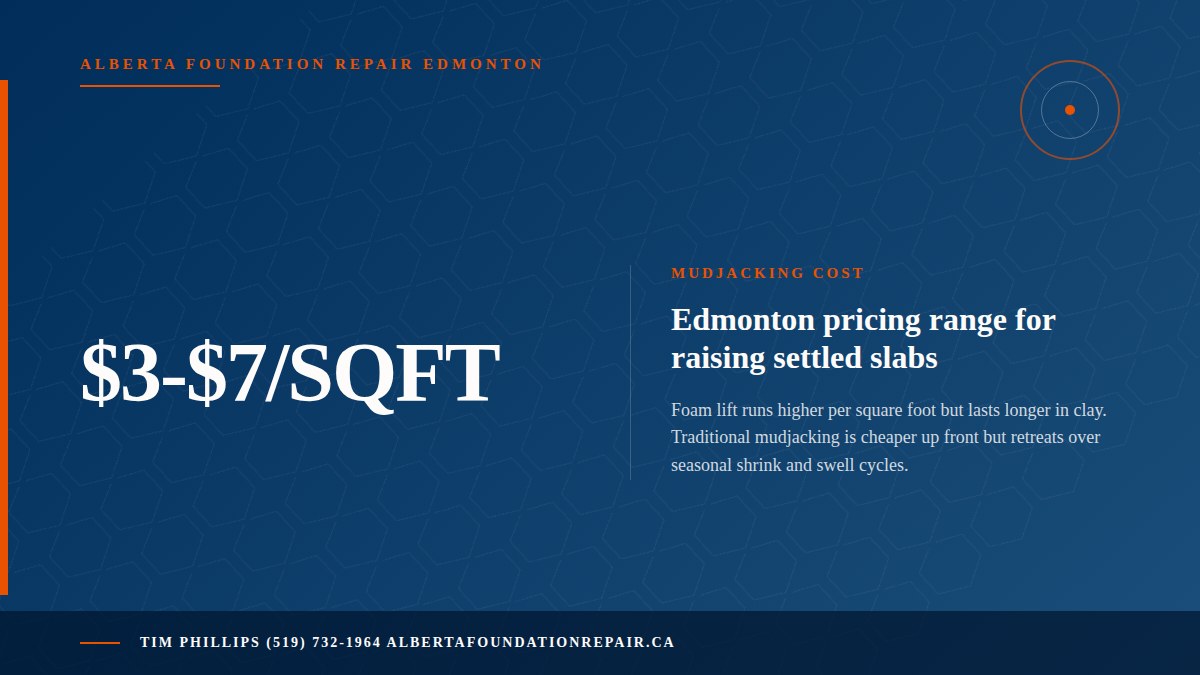
Foam does cost more upfront. The tradeoff is a repair that lasts significantly longer in Edmonton’s climate and returns your slab to service faster. For most residential applications, the total cost of ownership favours foam.
When Mudjacking Works and When It Doesn’t
Mudjacking is not a universal concrete repair method. It addresses one specific problem: a concrete slab that has settled because the ground underneath has compacted, eroded, or voided. When that is the actual problem, mudjacking is remarkably effective. When the problem is something else, mudjacking will not fix it.
- Sunken driveway sections creating trip hazards or water pooling
- Settled garage floors with frost-heave damage or edge drop-off
- Uneven sidewalk panels creating tripping hazards
- Sunken patio slabs draining toward the house
- Pool deck settlement
- Sunken porch or step landings
- Concrete walkways heaved by tree root growth (after root removal)
- Settled commercial loading dock aprons (see Commercial Concrete Levelling Edmonton)
- Structural foundation wall damage: Mudjacking lifts slabs, not foundation walls. Bowing walls, structural cracks, or displaced foundations need different repairs.
- Large-scale cracks in the slab itself: Lifting a cracked slab does not repair the cracks. You will still need crack sealing or, for severe cases, replacement.
- Spalled, crumbling concrete: If the slab is falling apart, lifting it just lifts a broken slab. Replacement is the only option.
- Active frost heave in winter: Injecting foam into frost-heaved subgrade does not fix the underlying frost problem. Wait for spring thaw.
- Slabs over moving clay (active settlement): If the subgrade clay is still consolidating, lifting now will lead to re-settlement later. Stabilize the subgrade first.
Mudjacking Cost Edmonton 2026
Mudjacking costs vary based on slab area, settlement depth, accessibility, and whether traditional slurry or modern polyurethane foam is used. Here are realistic Edmonton market prices for 2026:
| Application | Traditional Slurry | Polyurethane Foam |
|---|---|---|
| Single sidewalk panel (20 sq ft) | $150 to $300 | $200 to $500 |
| Two-car driveway (400 to 600 sq ft) | $600 to $1,800 | $1,200 to $3,500 |
| Standard garage floor (200 sq ft) | $400 to $1,200 | $800 to $2,500 |
| Patio slab (100 to 200 sq ft) | $300 to $800 | $500 to $1,500 |
| Pool deck (150 to 300 sq ft) | $400 to $1,200 | $800 to $2,000 |
| Per-square-foot rate | $3 to $10 | $5 to $25 |
Edmonton metro area. Accessibility, slab thickness, and void volume affect final pricing. Same-day return to service is standard with foam.
Minimum service fee: Most Edmonton mudjacking contractors charge a minimum of $300 to $700 per visit regardless of slab size, because the setup, mobilization, and material preparation are the same whether the job is one sidewalk panel or a full driveway. For small repairs, it is often worth combining multiple problem areas into one service call to make the minimum fee productive.
The biggest pricing variable is how much material the job requires. A slab that has settled 20 millimetres uniformly across its surface needs less foam than one with a deep void network. This is why a careful on-site inspection before quoting is valuable: when Tim inspects the slab and reads the settlement pattern, the quote is based on the real cause of the movement rather than guessing.
The Mudjacking Process
Modern polyurethane foam mudjacking follows a predictable sequence. Understanding the steps helps you evaluate whether a contractor is doing the job properly.
- On-site inspection and cause diagnosis: Tim inspects the slab, assesses the settlement pattern, and identifies why the ground has moved (clay heave, settlement, frost, or water) along with the likely void locations. He also notes any rebar, conduit, or utilities to avoid during drilling.
- Hole drilling: Small injection holes (15 to 20 millimetres) are drilled through the slab on a calculated grid pattern. Hole spacing is typically 0.5 to 1.5 metres apart depending on slab thickness and settlement depth.
- Foam injection: Two-component polyurethane foam is injected through each port. The components mix at the nozzle and begin expanding within seconds. The expansion drives the lift. Tim monitors slab elevation with a laser level and stops each port injection when the target elevation is reached.
- Sequential port injection: Injections typically work outward from the lowest settlement point, allowing the slab to rise evenly. Skipping around randomly risks cracking the slab from uneven lift forces.
- Cure check: Foam reaches 90 percent of full strength in 15 minutes. A quick wait allows confirmation that the lift holds before patching.
- Port patching: Holes are filled with high-strength patching mortar colour-matched to the existing slab. The finished patch is usually barely visible after a few weeks of weathering.
- Final elevation verification: Laser level survey confirms all target elevations are achieved and any final adjustments are made.
A typical residential mudjacking job for a driveway or garage floor takes 2 to 4 hours from start to finish. The homeowner is typically able to use the slab again within 1 to 2 hours of the last injection.
Warranty and What It Covers
Mudjacking warranties vary by contractor and method. Polyurethane foam mudjacking typically carries a 5 to 10 year warranty against re-settlement caused by the foam itself. Traditional cement slurry warranties are usually shorter, 1 to 5 years, because the material is more susceptible to water erosion and subgrade shifting over time. Both warranties normally exclude re-settlement caused by new drainage problems, new subgrade failure outside the repaired zone, or acts of nature.
Read the warranty carefully before committing. Key questions to ask: is the warranty transferable at resale, what is specifically excluded, is the material manufacturer backing the warranty or is it only the contractor, and what is the process for a warranty claim if re-settlement happens.
Common Edmonton Applications
Edmonton’s combination of glacial till clay, deep frost penetration, and 91 annual freeze-thaw cycles makes certain slab settlement patterns extremely common. These are the mudjacking jobs we see most often.
- Sunken driveway edges: Especially where the driveway meets the garage slab or the sidewalk. Frost heave under one surface and not the other creates a lip.
- Settled garage floors: Garage slabs poured over poorly compacted subgrade, or slabs exposed to full frost penetration because the garage is unheated. See Garage Foundation Repair Edmonton.
- Sidewalk panel differential: Individual panels settle at different rates, creating trip hazards and pedestrian liability concerns.
- Patio slab settlement: Backyard patios poured over backfilled soil settle as the backfill consolidates over 5 to 15 years.
- Driveway crown loss: Original centre-crowned driveways flattening or reversing slope toward the garage, channelling water into the garage and foundation.
- Front steps and porch slabs: Small concrete landings settling differently than the main foundation they are attached to.
“The most common Edmonton call we get is the sunken slab where the driveway meets the garage. The frost pushes the garage slab up, the driveway settles, and you get a lip you can catch a shovel on. That is a 2-hour foam lift for about $800 to $1,500, and it lasts years. People put it off because they think it is a replacement job. It almost never is.”
Tim Phillips, Alberta Foundation Repair
Why Tim Inspects the Cause First
A proper on-site inspection is the diagnostic step that separates professional mudjacking from guesswork. Tim inspects the slab and reads the cause of the movement before recommending foam injection on every residential job. The goal is to understand what is actually happening under the slab, not what we assume is there.
- Why the slab settled: Whether the cause is clay heave, consolidating subgrade, frost, or water, so the repair fixes the cause and not just the symptom
- Void location and extent: Where the supporting subgrade has failed, not just where the slab looks settled
- Slab thickness: Varies more than homeowners expect, from 100 mm to 200+ mm depending on original build
- Rebar and utilities: Avoiding rebar, conduit, and lines during drilling preserves slab integrity
- Subgrade to stable soil: Determines whether foam alone will hold or if subgrade treatment is needed first
- Moisture zones: Wet subgrade areas that need drainage correction before or alongside the lift
Mudjacking without a careful inspection is not wrong, but it is less efficient. Contractors working blind often over-drill, use more material than necessary, and occasionally over-lift or under-lift sections because they have not pinned down what is driving the settlement. For more on how Edmonton soil and frost cause foundations and slabs to move, see Foundation Repair Edmonton.
Seasonal Scheduling in Edmonton
Polyurethane foam mudjacking requires subgrade temperatures above 0 C for reliable results. Injecting foam into frozen or frost-heaved subgrade does not address the underlying frost issue and can produce unpredictable lift results.
- Subgrade or air temperature below 0 C
- Active frost heave (the slab is still moving from seasonal frost cycles)
- Spring thaw with saturated subgrade (wait for drainage to stabilize)
- Before addressing active drainage or water intrusion causes
The practical Edmonton mudjacking season runs from May through October. Late May and June are typically the best windows because spring thaw has completed, subgrade has drained, and summer dry-cycle consolidation has not yet created new voids. Fall jobs work fine as long as overnight temperatures stay above freezing and the ground is not heaved.
The same seasonal dynamics apply to winter foundation work. For the full Edmonton freeze-thaw cycle and why February is the worst month for foundation damage, see Why Edmonton Foundations Crack in February.
Mudjacking vs Replacement
The financial case for mudjacking over slab replacement is strong for most residential applications in Edmonton. Replacing a standard two-car driveway costs $8,000 to $20,000 including demolition, new concrete, forming, and finishing. Mudjacking the same driveway costs $1,200 to $3,500. The math is obvious when the slab is otherwise in good condition.
| Slab Condition | Recommendation |
|---|---|
| Settled but structurally sound | Mudjack (70-80% cost savings) |
| Settled with minor hairline cracks | Mudjack + crack seal |
| Settled with large structural cracks | Evaluate case by case |
| Spalling surface, crumbling edges | Replace |
| Rebar corrosion visible, concrete delamination | Replace |
| Slab is over 40 years old and deteriorating | Replace |
| Active subgrade settlement (still moving) | Stabilize first, then mudjack |
A thorough on-site inspection usually answers this question clearly. If the slab is sound and the problem is just subgrade settlement, mudjacking is the right call. If the slab itself is failing, replacement is unavoidable.
Frequently Asked Questions
How much does mudjacking cost in Edmonton?
Mudjacking in Edmonton typically costs $5 to $25 per square foot. A standard two-car driveway ranges from $800 to $2,500. A single sunken sidewalk panel costs $200 to $500. Modern polyurethane foam mudjacking typically runs 20 to 30 percent more than traditional cement slurry but lasts significantly longer in Edmonton’s freeze-thaw climate.
What is the difference between mudjacking and polyjacking?
Mudjacking traditionally used a cement and soil slurry pumped under a slab to raise it. Polyjacking uses expanding polyurethane foam instead. The foam is lighter, cures in minutes instead of days, is hydrophobic (won’t wash out), and lasts longer in Edmonton freeze-thaw conditions. Both methods are commonly called mudjacking, but most Edmonton contractors now use foam.
Is mudjacking permanent in Edmonton?
Polyurethane foam mudjacking is durable if the subgrade problem is resolved. The foam itself is inert and does not break down, but if water infiltration, drainage problems, or clay movement continue to undermine the slab, re-settlement can happen. Tim addresses the underlying cause before injecting foam so the repair actually lasts.
Can mudjacking fix a cracked driveway?
Mudjacking lifts settled slabs back to their original elevation. It does not repair cracks in the concrete itself. If your driveway has both settlement and cracking, you will need crack sealing or panel replacement in addition to mudjacking. For hairline cracks, polyurethane crack filler applied after the lift works well. For large structural cracks, replacement is usually the right call.
How long does mudjacking take in Edmonton?
A typical residential mudjacking job takes 2 to 4 hours depending on slab size. Foam mudjacking cures within 15 minutes and can handle foot traffic immediately. Vehicle traffic is typically safe within 1 to 2 hours. Traditional cement slurry mudjacking takes longer to cure and may require 24 to 48 hours before heavy loads can be applied.
Can you mudjack a garage slab that has frost-heaved?
Yes, after the ground has thawed and drainage has stabilized. Mudjacking a frost-heaved garage slab during active frost conditions is not recommended because the injected foam would sit against moving ice lenses. Wait until late spring or early summer, verify the subgrade has settled back, then mudjack to restore the slab to its original elevation.
- Environment Canada, Canadian Climate Normals 1991-2020, Edmonton International Airport. Freeze-thaw cycle data.
- National Research Council of Canada, Building Digest CBD-26: Frost Heaving of Foundations.
- Polyurethane Foam Association, Material Properties and Application Guide for Concrete Lifting.
- American Concrete Institute, ACI 302.1R: Guide to Concrete Floor and Slab Construction.
- Canadian Foundation Engineering Manual, 5th Edition (CFEM 2023). Frost depth and subgrade assessment.
Settled driveways, garage floors, sidewalks, and patios are almost always fixable with modern foam mudjacking at a fraction of replacement cost. The key is a proper diagnosis first. Tim inspects every Edmonton slab on site and identifies the cause of the movement before quoting so the repair addresses the actual subgrade problem, not just the symptom on the surface.
Call Tim at (519) 732-1964 for an inspection and quote on any settled concrete across Edmonton, St. Albert, Sherwood Park, Spruce Grove, Leduc, and Beaumont.