Foundation Repair vs Replacement in Edmonton: When to Replace
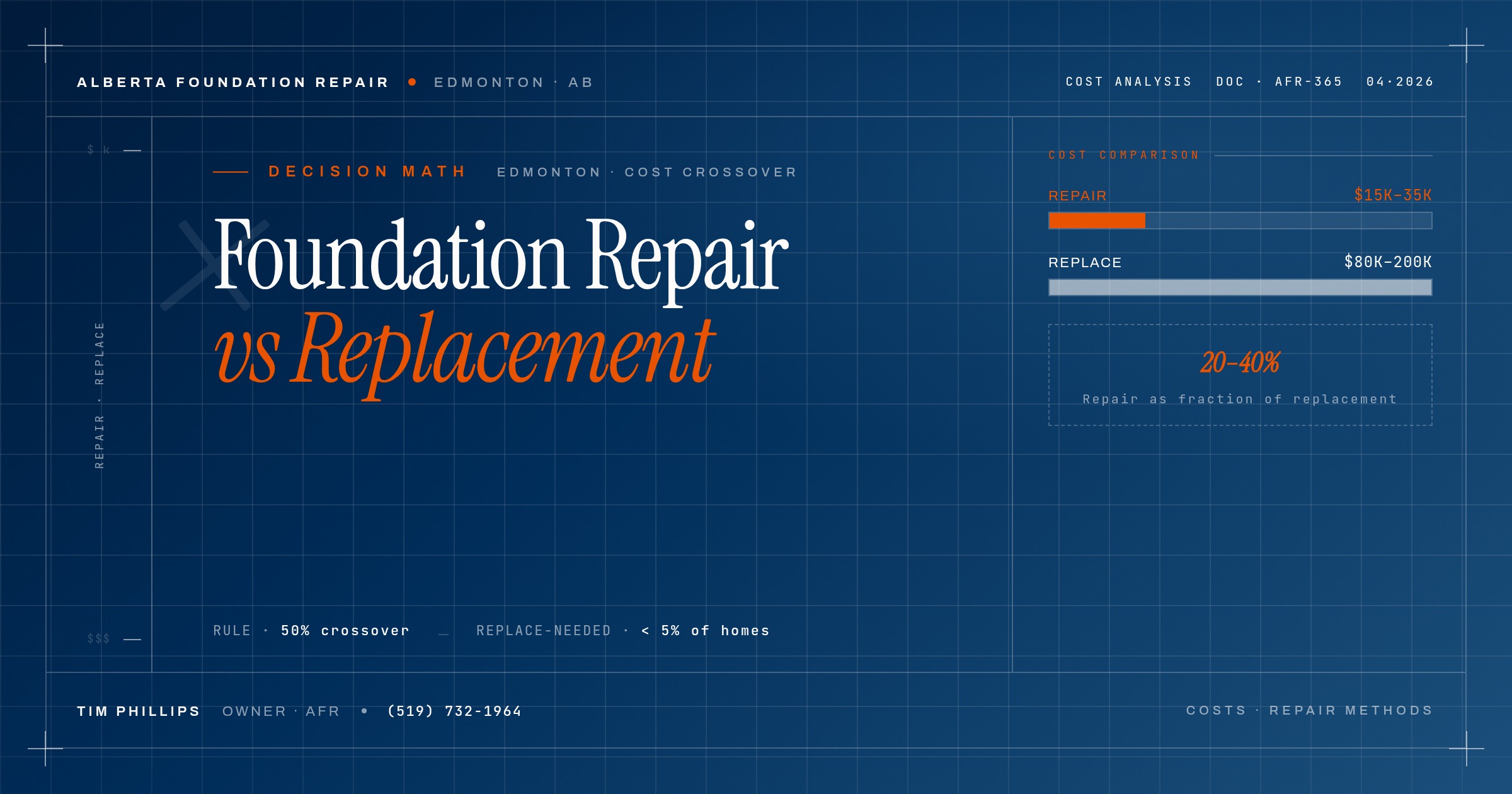
Quick Answer: Foundation replacement is rarely the right answer in Edmonton. Most cracks, leaks, and even significant settlement repair successfully for $5,000 to $30,000 versus $80,000 to $200,000 for full replacement. Replacement makes sense only when the foundation has fundamental construction defects, severe rot in preserved wood foundations, or repairs would cost more than 50% of replacement. Multiple repair attempts that have already failed often signal the wrong repair was done, not that the foundation is beyond saving.
In This Guide
- The Cost Comparison That Settles Most Decisions
- When Repair Is the Right Answer
- When Replacement Becomes Necessary
- The 50% Cost-Crossover Rule
- Multiple Failed Repairs: Replacement or Wrong Diagnosis?
- What Foundation Replacement Actually Involves
- Three Alternatives Most Contractors Skip
- Frequently Asked Questions
Reading time: 11 minutes
Deciding between a targeted fix and a complete rebuild is one of the bigger calls a homeowner makes, and it lands squarely inside the full picture of foundation repair in Edmonton. Before we weigh repair against replacement, it helps to understand where this choice sits among all the options on the table.
The Cost Comparison That Settles Most Decisions
Before any decision framework, the dollar figures. Foundation replacement in Edmonton is a 2 to 4 week project that involves jacking the entire home, demolishing the existing foundation, excavating and re-pouring footings, then lowering the home back onto the new walls. The price reflects that.
| Scope | Repair Cost (Edmonton 2026) | Replacement Cost (Edmonton 2026) |
|---|---|---|
| Single vertical crack | $1,500 to $3,500 (injection) | Not applicable, not a replacement scenario |
| Multiple cracks + settlement | $15,000 to $35,000 (underpinning + injection) | $80,000 to $150,000 |
| Bowing wall + waterproofing failure | $25,000 to $60,000 (anchors + excavation) | $100,000 to $180,000 |
| Severe settlement + structural compromise | $40,000 to $80,000 (full underpinning + interior leveling) | $120,000 to $200,000 |
| Preserved wood foundation with rot | Often not feasible | $80,000 to $150,000 |
The pattern: repair is 20 to 40% of replacement cost in almost every category. The exceptions are wood foundations with rot and homes with original construction defects so severe that piecemeal repair cannot stabilize them.
When Repair Is the Right Answer
Almost every Edmonton foundation issue is repair territory. Tim has handled hundreds of homes that other contractors quoted for replacement and successfully repaired them at 20 to 40% of the replacement quote. The reason is that “replacement” is sometimes the easiest sale: it is high-margin, simple to scope, and looks comprehensive.
Conditions That Reliably Repair
- Vertical and stair cracks of any width on plumb walls. Polyurethane or epoxy injection from interior, $1,500 to $3,500 per crack. Even cracks over 6 mm respond to professional injection if the wall has not bowed.
- Horizontal cracks with under 25 mm of bowing. Carbon fibre straps or steel wall anchors, $4,000 to $8,000 per wall. Stops the bowing without excavation.
- Localized settlement under one corner or wall section. Helical pile underpinning of the affected area, $12,000 to $25,000. Foundation continues using the original footing for unaffected sections.
- Exterior waterproofing failure. Excavation, membrane installation, drainage repair, $15,000 to $30,000 per wall. Foundation itself remains intact.
- Slab settlement and garage floor cracking. Polyurethane foam levelling, $1,500 to $8,000. Lifts and stabilizes without rebuilding.
When Replacement Becomes Necessary
Three conditions genuinely require replacement, not repair. Each has a structural or material reason that piecemeal repair cannot solve.
1. Preserved Wood Foundation With Confirmed Rot
Wood foundations are legal in Alberta and were popular in the 1970s and 1980s. Once moisture has penetrated the wood and rot has begun (visible darkening, soft spots, mushroom growth), structural integrity is compromised in a way that cannot be selectively repaired. The wood must come out and concrete must go in. Cost: $80,000 to $150,000. Inspection signal: musty smell + visible wood-grain darkening + soft spots when probed.
2. Original Construction So Defective That Targeted Repair Cannot Stabilize
Rare but real. Homes built without proper rebar, on inadequate compaction, or with concrete batched too lean fail across the entire foundation rather than in localized spots. Visible signal: cracks on every wall, no plumb wall remaining, multiple settlement points active simultaneously. Diagnostic: Tim’s on-site inspection finds inadequate or corroded rebar showing throughout the structure. Cost: $100,000 to $180,000.
3. Repair Cost Approaches or Exceeds 50% of Replacement
The economic line. If the repair quote is $90,000 and replacement is $150,000, the repair gets you a partially-restored foundation with limited warranty. Replacement gets you a fully-modernized foundation with new code compliance and a full warranty cycle. At the 50% threshold and above, replacement often wins on lifetime value despite the higher upfront cost. Below 50%, repair almost always wins.
The 50% Cost-Crossover Rule
This is the rule Tim uses when a quote sits in the grey zone between obviously-repair and obviously-replace. The math is simple: divide the repair quote by the replacement quote. The answer tells you which makes economic sense.
The Cost-Ratio Decision Rule
- Repair / Replacement < 30%: Repair is clearly the right answer. Lifetime value strongly favours fixing what is there.
- 30-50%: Repair is usually right but get a second-opinion quote. Some contractors over-quote repairs; others under-quote replacements. Comparison reveals which side of the line you are actually on.
- 50-70%: Grey zone. Decision depends on home age, expected ownership length, and warranty considerations. New owners staying long-term may prefer replacement; older owners may prefer repair.
- > 70%: Replacement usually makes sense. The premium is small relative to the certainty of a fully-modernized foundation with new warranty coverage.
Tim Phillips, Alberta Foundation Repair: “I have walked away from replacement quotes that were not necessary. I have also recommended replacement to homeowners who came in expecting a $5,000 fix. The honest answer comes from running the cost-ratio math, not from what the homeowner wants to hear. Most Edmonton foundations are repair territory. The few that are not deserve a clear-eyed conversation, not a contractor talking either of you into the bigger ticket.”
Multiple Failed Repairs: Replacement or Wrong Diagnosis?
The most common path to a “replacement” recommendation is two or three failed prior repairs. The homeowner has spent $10,000 fixing the same crack that keeps reopening, and the contractor pitches replacement as the final answer. Sometimes that is correct. Often it is not.
Failed repairs in Edmonton fall into three categories, only one of which justifies replacement.
Wrong diagnosis at original repair. The contractor injected a crack on a wall that was actually bowing from heave, not settlement. The injection was technically perfect; it just addressed the wrong mechanism. This is a re-diagnosis problem, not a replacement problem. A different contractor who inspects on site and reads the actual cause (moisture survey, plumb verification, checking what the foundation is really doing) often resolves it for similar money to the original repair.
External cause that was never addressed. Drainage, grading, or weeping tile failure has been continuously feeding moisture to the foundation. The repairs work, but the cause keeps creating new problems. Replacement does not solve this; the new foundation will fail too. Fixing the external cause is the actual solution.
Genuine structural failure across the entire foundation. The homeowner has had three contractors look at three different walls, each found something wrong, and the wrongs are unrelated to each other. This is the rare case where replacement is right because the foundation has multiple uncorrelated failure modes that piecemeal repair cannot keep ahead of.
What Foundation Replacement Actually Involves
If replacement is the right answer, here is what the project actually entails. Buyers and homeowners often underestimate the disruption.
The Replacement Project Sequence
- Engineering and permits (2 to 4 weeks). APEGA-stamped drawings, City of Edmonton building permit, neighbour notifications. $3,500 to $8,000 in engineering plus $500 to $2,000 in permits.
- Utility disconnection (1 week). Water, sewer, gas, electrical. Must be coordinated with EPCOR and ATCO.
- Structural lift (3 to 5 days). Hydraulic jacks lift the entire home off the foundation. Steel beams and cribbing support the structure during demolition. Cost: $25,000 to $50,000 for this stage alone.
- Demolition and excavation (1 week). Old foundation removed, soil excavated to engineered depth, drainage installed.
- New footings and walls (1 to 2 weeks). Pouring, curing, waterproofing membrane installation.
- Lowering and reconnection (1 week). Home set onto the new foundation, utilities reconnected, interior trim and finishes restored where needed.
- Total disruption window: 6 to 10 weeks during which the home is uninhabitable for at least 4 weeks. Hotel/rental costs of $4,000 to $8,000 add to the total.
Three Alternatives Most Contractors Skip
Before accepting either repair or replacement, three alternatives are worth checking because they sometimes resolve the problem at a fraction of the cost of either.
The first is targeted exterior excavation of just the affected wall section instead of the full perimeter. If only one wall has waterproofing failure, exterior membrane replacement on that wall costs $8,000 to $20,000 instead of the $40,000+ of full perimeter excavation. Most contractors quote the full perimeter because it is simpler to price.
The second is bench footing instead of full underpinning when the basement floor needs to be lower or the foundation is too shallow. Bench footing extends the foundation downward by adding new perimeter footings inside the existing wall. Cost: $15,000 to $30,000, versus $40,000 to $70,000 for traditional underpinning. See our underpinning guide for the comparison.
The third is exterior drainage and grading correction with no foundation work at all. If the foundation is structurally sound but moisture-cycling is causing recurring cracks, fixing the moisture source can stabilize the foundation without any direct foundation work. Cost: $5,000 to $15,000 for grading, downspout, and sometimes a French drain. Tim has resolved homeowner-reported “foundation problems” with this approach when the actual issue was a single failed downspout flooding one corner.
Get an Honest Read Before Approving Replacement
If a contractor has quoted replacement and the price is over $80,000, get a second opinion before signing. Tim’s free visual inspection takes fifteen minutes and tells you whether replacement is genuinely necessary or whether a $20,000 to $40,000 targeted repair will solve the same problem. Call: (519) 732-1964.
Frequently Asked Questions
How often does an Edmonton home actually need foundation replacement?
Rarely. Tim sees genuine replacement-required cases in fewer than 5% of inspection calls. The remaining 95% are repair territory, often at 20 to 40% of the cost of the replacement that another contractor quoted. The replacement-frequency number is much higher in some areas of the US (expansive clay regions, hurricane zones) but Edmonton’s foundations, while challenged by clay heave and frost, are typically built with enough rebar and depth to repair successfully.
Will my insurance cover foundation replacement?
Almost never. Replacement is treated as betterment, which is excluded from most homeowner policies in Alberta. Even if the failure was caused by a covered peril (burst pipe, vehicle impact), insurance typically funds repair to pre-loss condition, not full replacement to current code. Specific policies may differ; confirm with your broker.
How long does foundation replacement take in Edmonton?
6 to 10 weeks total project time, with 4 to 6 weeks during which the home is uninhabitable. Engineering and permits add 2 to 4 weeks before construction begins. Plan for hotel or rental costs of $4,000 to $8,000 during the uninhabitable period in addition to the construction cost.
Should I replace the foundation before selling an older home?
Almost never. The cost of replacement rarely recovers in selling price, especially in a market where most buyers expect a foundation that is the original age of the home. Targeted repairs of specific issues, with documentation, typically recover at higher rates than full replacement. The exception is a wood foundation with rot, which can affect the home’s saleability enough that replacement may be necessary to sell at all.
Sources
- National Research Council Canada (2023). National Building Code of Canada 2023, Alberta Edition, Part 9. Link
- Alberta Geological Survey. Surficial Geology of the Edmonton District, ESR 1962-06. Link
- US Army Corps of Engineers. TM 5-818-7: Foundations in Expansive Soils. Link
- American Concrete Institute. ACI RAP-1: Structural Crack Repair by Epoxy Injection. Link
- City of Edmonton. Building Permit Requirements for Foundation Work. Link
Get the Real Number Before You Decide
Replacement quotes over $80,000 deserve a second opinion. A fifteen-minute visual inspection costs nothing and often reveals that targeted repair can resolve what was being pitched as a full replacement. No pressure either way.
Alberta Foundation Repair, Edmonton and surrounding areas, (519) 732-1964.