Foundation Settlement vs Heave in Edmonton: Which One Is It?
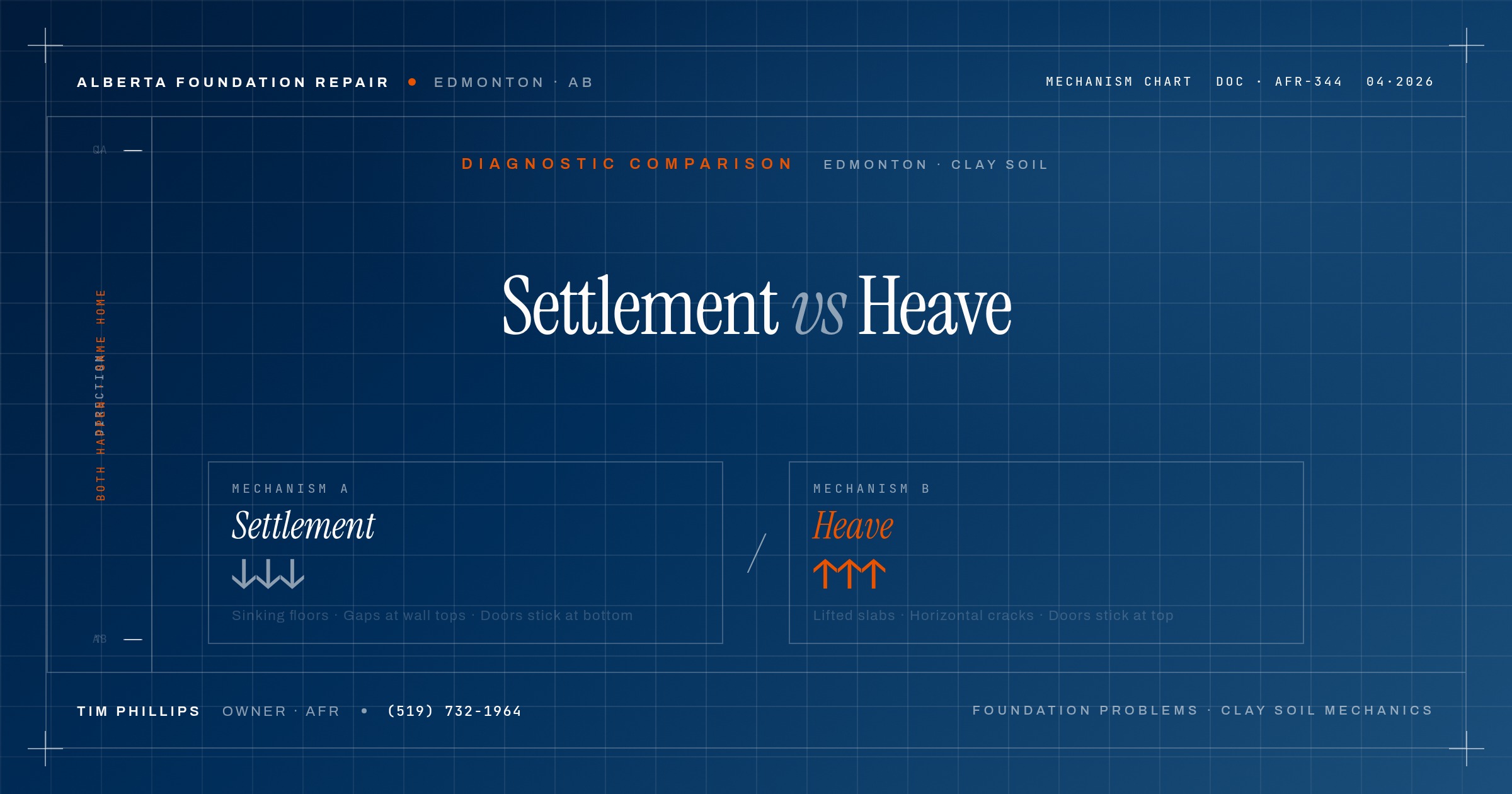
Quick Answer: Foundation settlement is the ground sinking under part of the house. Heave is the ground pushing up. Edmonton’s clay soil causes both, often in the same home during the same year. Settlement shows as sinking floors and widening cracks at the top of walls; heave shows as lifted slabs and cracks that close at the top and open at the bottom. The fix differs entirely.
Tim Phillips, Alberta Foundation Repair: “Most Edmonton homes I inspect are dealing with both. The front footing settled two decades ago during a dry summer. The back slab heaved last April when the clay behind the deck saturated. The symptoms look contradictory until you realize they are two different mechanisms acting on two different parts of the same house. Diagnosis has to account for both.”
Settlement and heave are the two ways soil moves a foundation, and they are opposites. One sinks, one lifts. Repair methods for each are different. Misdiagnosing one as the other is one of the most expensive mistakes a homeowner can make, because the wrong repair will not just fail, it will make the underlying problem worse.
This guide compares the two mechanisms side by side, walks through the diagnostic signals for each, and explains why Edmonton’s clay soil creates the unusual situation where both can be happening to the same home at the same time.
Settlement and Heave Side by Side
The symptoms most homeowners notice first are doors and floors. See our companion guide on sticking doors and uneven floors in Edmonton to read the slope pattern and figure out whether settlement or heave is driving what you feel underfoot.
Before the details, here is the comparison most homeowners are looking for.
| Settlement | Heave | |
|---|---|---|
| Direction of movement | Downward (foundation sinks) | Upward (ground lifts the foundation) |
| Primary cause in Edmonton | Clay shrinkage during drought, soil compression, poor compaction, plumbing leaks | Clay expansion from moisture, frost heave from freezing groundwater |
| When it happens | Summer drought (June–August) and gradually year-round | Winter frost (December–March) and saturated spring thaw (March–May) |
| Visible symptoms | Sinking floors, gaps at top of walls, doors sticking at top, cracks wider at top | Lifted interior slabs, doors rubbing at bottom, cracks wider at bottom, raised exterior walkways |
| Crack pattern | Vertical or diagonal, opening toward the top | Vertical or diagonal, opening toward the bottom; horizontal cracks possible |
| Typical repair | Underpinning with helical piles or push piers, polyurethane void fill, grade correction | Moisture control, drainage correction, removal of heaved slab sections, in severe cases re-pouring footings deeper |
| Residential cost range | $8,000 to $25,000 for helical pile underpinning | $3,000 to $15,000 depending on affected area |
How Settlement Happens in Edmonton
Settlement is the intuitive failure mode. Gravity acts on the foundation, the soil underneath is not strong enough to resist, and the foundation sinks. In Edmonton the three main causes are clay shrinkage, poor original compaction, and plumbing leaks that wash soil away.
The Clay Shrinkage Mechanism
Edmonton glacial till is up to 65% clay by mass with a plasticity index reaching 44%. When moisture leaves the clay during dry summers, it contracts. Volume changes of 5% to 10% are common; in highly expansive solonetzic pockets on the east and north sides of the city, contractions reach 15%. As the clay shrinks, gaps open beneath the footing, and the weight of the house pushes the footing down into those gaps. This is why a house can sit level for twenty years, survive a drought summer, and have a corner settlement Tim finds the following spring.
The second Edmonton settlement cause is original construction quality. Homes built before the 2006 revision of Alberta’s building code often sit on compaction that would not meet current standards. Disturbed fill under the basement, backfilled around the foundation too loose, or footings poured on frozen ground all produce decade-delayed settlement that appears fifteen to twenty-five years after the home was built. Newer areas built on graded fill, like Terwillegar, see this pattern most often. Much of the settlement Tim sees in mature Edmonton neighbourhoods like Garneau, Strathcona, and Glenora traces to original construction, not anything the current homeowner did.
The third cause is plumbing leaks washing soil away. A slow leak in a water supply line or sewer below the slab can erode a void under the footing over years. The homeowner sees no visible water; the foundation just starts to drop in one spot. Sewer-line leaks are particularly dangerous because they are often discovered only after significant settlement has already occurred.
How Heave Happens in Edmonton
Heave is the one most competitors miss because it runs against intuition. The ground should sink under weight, not push up. But in the right soil, water acts as a lever, and the force it generates is enormous.
The Clay Expansion Mechanism
Clay minerals, especially montmorillonite (smectite) found in Edmonton’s glacial till, absorb water between their sheet-like molecular layers. Each layer of absorbed water expands the clay. A 10% volume expansion can generate swelling pressures of 200 to 500 kPa, which is enough to lift a footing. In solonetzic soils with higher sodium content (common on Edmonton’s east side), the pressures can reach 700 kPa. The foundation footing becomes a bathroom scale the clay pushes on from below.
The Frost Heave Mechanism
Frost heave is a separate upward-movement cause but the result is similar. Water expands 9.05% when it freezes. Frozen lenses of ice in the soil beneath shallow footings or unheated slabs exert upward pressures that can reach 50,000 kPa. Edmonton’s design frost depth is 2.4 metres, below which the ground does not freeze, but shallow footings or older homes with footings at only the 1.2 m ABC minimum sit within the frost zone. This is why frost heave is mostly a garage slab, exterior walkway, and older-home problem.
The two mechanisms compound. Fall rains saturate the clay before winter arrives. The expanded clay gets caught by freezing temperatures. The frozen ice lenses inside the already-expanded clay push up twice as hard as either mechanism would alone. This is why Edmonton’s February peak-damage window exists: by February the soil has been saturated for six months and frozen for two, and the cumulative upward force on shallow foundation elements is near its maximum.
How to Tell Which One You Have
Three diagnostic tests distinguish settlement from heave without professional equipment. Run all three, because each catches one mechanism the others can miss.
The Three Homeowner Diagnostics
- Read the crack direction of taper. Find a diagonal wall crack. Is it wider at the top or wider at the bottom? Wider at the top usually means settlement (the bottom of the wall is still in its original position while the top has rotated toward the sink point). Wider at the bottom usually means heave (the bottom has been pushed up relative to the top). Horizontal cracks are primarily a heave/pressure signal.
- Check the door-sticking pattern. Which edge of the door is rubbing? If doors stick at the top and the latch has risen toward the strike plate, the frame has been lifted on one side, suggesting heave. If doors stick at the bottom and the latch has dropped, one side of the frame has sunk, suggesting settlement.
- Walk the exterior perimeter. Are any walkways, patios, or garage aprons visibly higher against the house than they were? Lifted exterior slabs are a heave tell-tale. Are any exterior walls showing gaps where siding meets trim or where the house meets the sidewalk? Those gaps are settlement signatures.
Why Edmonton Homes Often Show Both
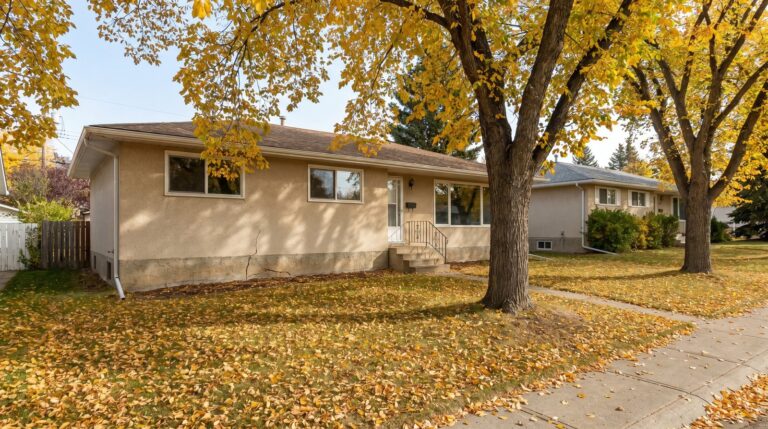
A single Edmonton home can have one foundation corner settling while another corner heaves, and both at the same time. The mechanism is that different parts of the home sit on different soil conditions, drain differently, and experience different moisture regimes. The north-facing wall with a downspout discharging next to it saturates and heaves. The south-facing wall exposed to summer sun and less moisture shrinks and settles. This is the “mixed signal” home Tim sees most often in Millwoods, Glastonbury, and north-side neighbourhoods where solonetzic soil concentration is highest.
Repair Methods Are Different (and Wrong Ones Make It Worse)
Misdiagnosing settlement as heave (or vice versa) is the most common cause of “the repair did not hold, do we need to replace?” calls. Before accepting a replacement quote, see foundation repair vs replacement in Edmonton.
Settlement and heave need opposite interventions, which is why diagnosis matters before repair begins.
Settlement Repairs
- Helical piles or push piers installed to stable soil or bedrock, transferring the foundation load below the shrinking clay. $12,000 to $25,000 residential, always engineer-required. See the underpinning guide for methods.
- Polyurethane void fill for settled slabs where structural underpinning is not required.
- Grade and drainage correction to prevent continued moisture loss that drives the shrinkage cycle.
Heave Repairs
- Moisture control first. The clay is expanding because water is reaching it. Fix downspouts, regrade the soil away from the house, and reduce irrigation near the foundation before any structural work.
- Remove and repour heaved slab sections where an interior basement slab has lifted against a supporting wall.
- In severe cases, re-pour footings at engineered frost depth (2.4 m) with expanding-soil mitigation like slip-sleeves or void forms under the new footings.
The Underpinning-on-Heave Mistake
Installing helical piles under a heaving foundation is the most expensive misdiagnosis in this category. Underpinning anchors the structure deeper. If the clay above the pile tops is still heaving, the piles cannot resist it; the foundation tears between the pile cap and the lifting clay above, creating a second failure mode worse than the first. Any underpinning proposal on an Edmonton home should begin with a moisture survey and explicit confirmation that settlement, not heave, is the driver.
What Makes Edmonton Different From Other Markets
Most settlement-vs-heave articles are written for US markets where one mechanism dominates. Dallas and Houston deal with expansive clay heave almost exclusively. Pittsburgh and Atlanta deal with settlement almost exclusively. Edmonton deals with both because of two overlapping conditions.
The first is Edmonton’s glacial till composition. Unlike the Chinook clays of Calgary or the alluvial soils of the Fraser Valley, Edmonton’s till contains enough active clay minerals to heave meaningfully and enough variability in fines content to settle meaningfully. Different neighbourhoods, and sometimes different corners of the same lot, sit on different behaviours.
The second is Edmonton’s continental climate. A 60°C annual temperature swing combined with a dramatic moisture cycle (dry summers, saturated autumns, frozen winters, wet springs) drives both mechanisms hard. Milder climates with less seasonal variation do not test foundation soil the way Edmonton does.
The practical consequence: Edmonton homeowners cannot assume “foundation problem” means settlement, which is still the default assumption in a lot of contractor quotes. Symptom diagnosis has to consider both mechanisms, and the repair has to match.
Frequently Asked Questions
Can my Edmonton home have both settlement and heave at the same time?
Yes, and it is common, especially in homes on lots with variable soil conditions or directional drainage patterns. One corner draining well and drying out through summer can settle while another corner staying wet expands and heaves. Tim inspects this mixed pattern roughly one in three site visits.
Why do contractors so often default to underpinning when I might have heave?
Settlement has been the industry-standard assumption for decades, and underpinning is a well-priced, well-understood repair. Heave was historically treated as a US Texas/Oklahoma problem, not a Canadian one. Edmonton’s soil behaviour includes heave in ways most national contractor training programs do not cover. Ask your contractor to confirm the direction of movement before accepting any underpinning quote.
Does fixing the drainage stop heave without structural repair?
Sometimes, yes. If the heave is recent and caused by a specific moisture source (failed downspout, grading that directs water toward the foundation, leaking hose bib), fixing the source can stabilize the clay and stop further movement. Existing heave damage does not reverse, but it can stop progressing. This is why moisture survey is the first diagnostic step on any heave-suspected home.
How long does it take for settlement damage to become visible?
In Edmonton, visible settlement typically appears 15 to 25 years after original construction if driven by compaction or gradual clay shrinkage, and within 1 to 5 years if driven by a specific failure like a plumbing leak. Heave damage is usually faster, often visible within one seasonal cycle of the triggering moisture change.
Will my homeowner’s insurance pay to fix settlement or heave?
Almost never for either. Both are classified as “earth movement” or “gradual wear” in most Alberta homeowner policies, which are standard exclusions. The exception is damage caused by a sudden covered peril like a burst water main that undermines a footing, which some policies will cover. Confirm specific coverage language with your broker before assuming anything.
Sources
- Alberta Geological Survey. Surficial Geology of the Edmonton District, ESR 1962-06. Link
- US Army Corps of Engineers (1983). TM 5-818-7: Foundations in Expansive Soils. Whole Building Design Guide. Link
- British Geological Survey. Shrink-Swell Soils (Jones), Geological Society Engineering Geology Special Publication. Link
- National Research Council Canada. Canadian Building Digest: Frost Action and Foundations. Link
- National Research Council Canada (2023). National Building Code of Canada 2023, Alberta Edition, Part 9. BILD Alberta. Link
Get the Direction of Movement Confirmed Before You Accept a Quote
If a contractor has quoted underpinning without explaining whether you have settlement or heave, pause. A fifteen-minute visual inspection will tell you which mechanism is driving the movement, which changes the right repair and often the cost. Tim provides that visual assessment at no charge.
Alberta Foundation Repair, Edmonton and surrounding areas, (519) 732-1964.