Buying a House With Foundation Problems in Edmonton: What to Do
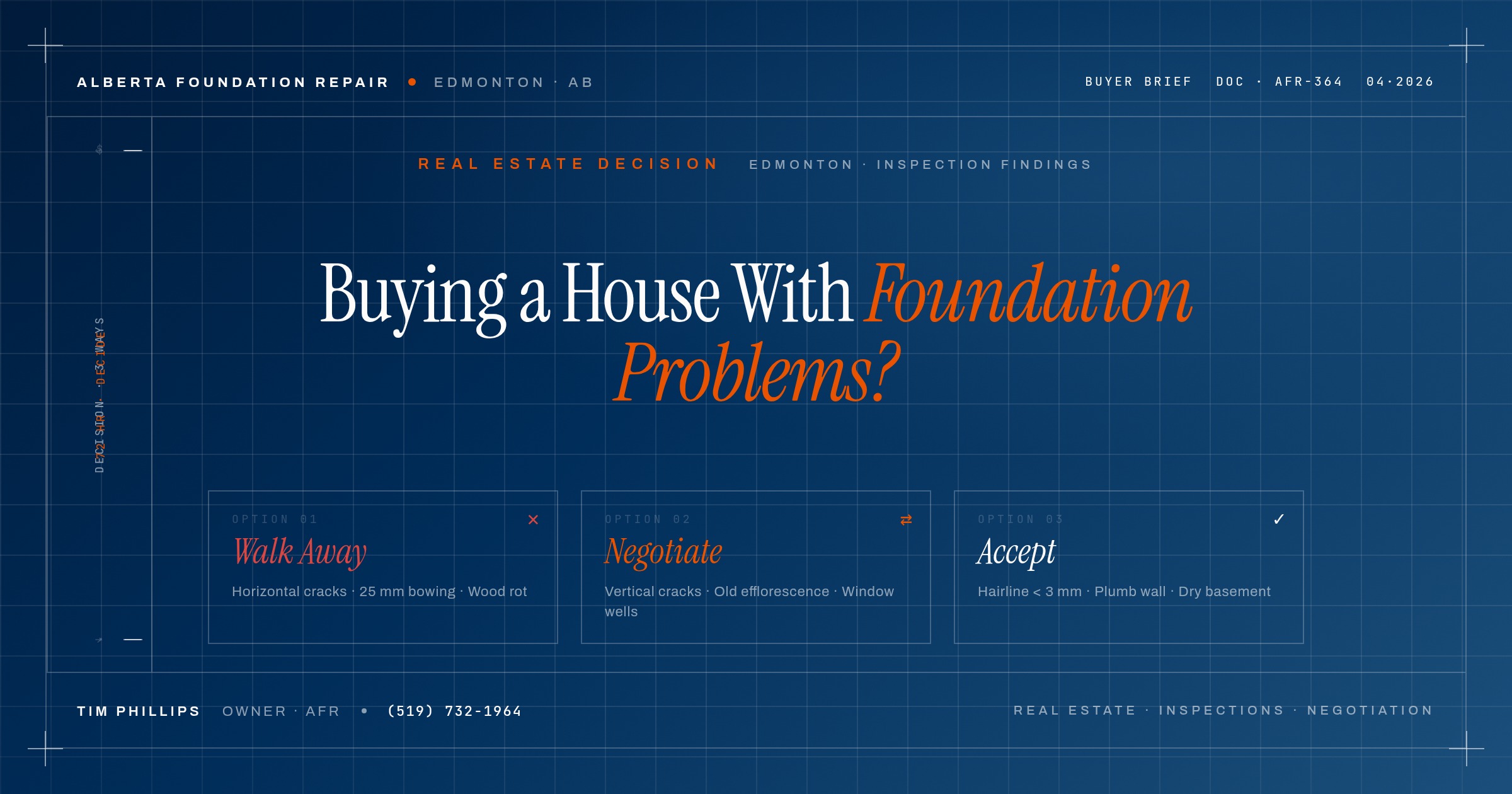
Quick Answer: A foundation crack on an Edmonton home inspection report rarely warrants walking away by itself. Walk away if you see horizontal cracks, bowing walls over 25 mm, or active structural settlement. Negotiate price-down if you see Tier 2 vertical cracks, water staining, or weeping tile concerns. Accept and proceed for cosmetic hairline cracks under 3 mm in a plumb, dry foundation, which is most homes built after 2000.
You found the house. The offer was accepted conditional on inspection. The report came back with three lines about the foundation that you did not understand, and now you have 72 hours to decide whether to walk, negotiate, or proceed. Most buyers are looking at this question for the first time in their lives.
This guide gives you the framework Tim uses when buyers call him from the kitchen table at 9pm with a phone full of inspector photos. Three options, clear thresholds, and the language to take to your realtor or back to the seller. None of this replaces a paid foundation assessment, which we recommend on any borderline case, but it lets you decide whether you are looking at a walk-away, a negotiation, or a “go ahead and buy it” before spending another dollar.
Spotting foundation trouble during a home purchase is far easier once you grasp what Edmonton foundation repair involves and what a fix typically costs. With that context, let’s go through how to assess a house before you sign.
Walk Away, Negotiate, or Accept: The Three-Option Framework
Every foundation finding on an Edmonton inspection report falls into one of three buyer-side responses. The mistake most first-time buyers make is treating any foundation note as a walk-away signal, when most are negotiation signals at most.
The Three Options
- Walk away. The repair cost, the engineering complexity, or the unknowns are too high to be worth the property. Reserved for severe structural conditions where the underlying soil or construction quality means problems will continue regardless of repair.
- Negotiate price-down. The condition is real, the repair is known, and the cost is finite. The asking price drops to reflect either the cost of repair or the diminished value going forward. Most foundation findings warrant this response.
- Accept and proceed. The condition is cosmetic, common, and inexpensive to address. The home is otherwise what you wanted. Buying with the original offer makes financial sense.
When to Walk Away
Five conditions warrant walking away from an Edmonton home regardless of how much you love it. These are the cases where the underlying problem is structural, ongoing, or expensive enough that no negotiation recovers the cost.
Horizontal cracks running across the foundation wall. A horizontal crack indicates lateral soil pressure or frost heave actively pushing the wall inward. The fix usually requires engineer-stamped wall anchors or excavation, costing $15,000 to $40,000. The pressure causing the crack does not stop after the repair, so the warranty risk is real.
Visible wall bowing over 25 mm. A wall that has moved 25 mm or more from plumb is in active failure. Underpinning plus wall anchors plus exterior excavation can run $30,000 to $80,000. Walking away is often cheaper than buying.
Water entry from multiple cracks during inspection. A single leaking crack can be repaired for $1,500 to $3,500. Multiple leaking cracks usually mean exterior waterproofing has fully failed, requiring excavation around the entire perimeter ($25,000 to $50,000).
Sloping floors over 25 mm across a single room. Settlement that severe usually requires underpinning ($12,000 to $25,000) plus interior leveling work ($5,000 to $15,000). Combined with the time and disruption, often a deal-breaker.
Foundation type is preserved wood and shows moisture. Wood foundations are legal in Alberta but vulnerable. Once moisture has reached the wood and rot has started, repair is not always possible without full replacement, which Edmonton contractors estimate at $80,000 to $150,000.
When to Negotiate
Most foundation findings on Edmonton inspection reports are negotiation territory. The condition is real, the repair is known, and the price drop should match the cost of fixing it (or 1.2x the cost to account for the buyer’s risk and time).
Vertical cracks under 6 mm with no displacement are typical negotiation signals. Repair cost is $1,500 to $3,500 per crack professionally; ask the seller to credit that amount or drop the price equivalently. Stair cracks in concrete block foundations are similar, often needing $3,000 to $6,000 of work.
Old efflorescence with no current water entry is a sign that the foundation has experienced moisture in the past but is not actively leaking. Negotiate for a $2,000 to $5,000 credit to install proper drainage or weeping tile maintenance, which closes the historical risk.
Window wells holding standing water at inspection are usually a $500 to $2,000 fix per well. Multiple failed wells across the home can run $4,000 to $8,000 if the well drains have collapsed or the discharge path needs reworking. Our window well guide covers what each fix actually involves.
A sump pump that did not run during the inspection but should have (visible discharge buildup, basement humidity) is a $1,500 to $3,500 replacement plus possible upgrade to battery backup, which is more important on Edmonton spring-thaw schedules than buyers often realize.
Tim’s working rule for negotiating: ask for the full repair quote in writing from a third-party contractor, then negotiate for that amount minus 10% (which is reasonable to the seller because they would face the same disruption if they did the repair before listing). If the seller refuses to credit at least 60% of the repair cost, treat the home as priced too high regardless and consider walking.
When to Accept and Proceed
Three foundation conditions appear on most Edmonton inspection reports and are not negotiation signals. They are the baseline normal of Alberta foundations and accepting them does not put the buyer at material risk.
The Accept-and-Proceed Conditions
- Single hairline vertical cracks under 3 mm in poured concrete. Universal in poured foundations. Stable, dry, and structurally inert. Optional DIY injection if you want belt-and-suspenders, but not negotiation worthy.
- Surface parging cracks or flakes on the exterior. The cement coating cracks before the structural concrete. Cosmetic fix at $400 to $1,200, but rarely worth negotiating over.
- Surface crazing on the basement slab. Map-pattern hairline cracks in the floor concrete. Cosmetic, not structural. Sealing optional.
If the foundation report contains only conditions from this list, the home does not have a meaningful foundation problem. Proceed at the agreed price.
In Tim’s experience the largest single error first-time buyers make is over-weighting cosmetic foundation findings, walking away from a structurally sound home, and ending up in a different home with more serious issues that the next inspector did not flag because they were less observant. The right response to a hairline crack is “noted” not “panicked.”
When to Pay for a Second Opinion
Home inspectors are generalists. They cover thirty systems in a four-hour visit, and foundation findings get a paragraph or two with photos. For borderline cases, paying for a foundation specialist’s opinion is the cheapest insurance available.
Pay for a foundation specialist visit if any one of the following is true: the inspector flagged “structural concerns” without specifying severity, more than two foundation findings appear on the report, the home is over 30 years old and on solonetzic soil (east or north Edmonton), the seller has refused to provide previous repair documentation, or the asking price is at the top of comparable homes in the neighbourhood (small repair costs disappear in big-margin homes; small repair costs become deal-breaking in tight-margin ones).
A foundation specialist visit during a real-estate condition period typically runs $300 to $600 for a written assessment, and the assessment becomes leverage in the negotiation regardless of which option you choose. Engineer-stamped reports are more expensive ($1,500 to $3,500) but warranted when the listing is in the $1M+ range or the inspector specifically flagged structural concerns.
The Inspector’s Disclaimer Trap
Every Alberta home inspection report includes language to the effect of “this report identifies observable conditions but does not guarantee the absence of latent defects.” That clause is real. It means foundation problems hidden behind drywall, behind paint, or below the slab may not appear in the inspection. Buyers in tight budgets who are betting the entire purchase on the inspection are leveraging more than the inspection actually covers. Foundation specialist visits are the cheapest way to fill this gap.
What Paperwork to Demand From the Seller
Before closing on any Edmonton home with a foundation note on the inspection, request these documents from the seller through your realtor.
Original construction permits and any subsequent renovation permits. The City of Edmonton building permit history shows whether prior foundation work was permitted, which matters for warranty and resale. Unpermitted foundation work is a future-cost time bomb.
Any foundation repair invoices from prior owners, including warranty paperwork. A 2019 polyurethane injection on a vertical crack with a transferable warranty is a positive signal; an undocumented repair is worse than no repair at all because it suggests problems were hidden rather than fixed.
Insurance claims history if available. The Property Information Statement does not always include foundation-related claims; ask explicitly. A history of basement water claims signals drainage or foundation problems that the current condition might not show.
Builder warranty documentation if the home is under 10 years old. Alberta’s New Home Warranty covers structural defects for 10 years; if the home is within that window and has any foundation issue, the warranty should be the first source of repair funding before any negotiation. This matters most in newer areas like Terwillegar, where many homes are still inside the warranty window.
Frequently Asked Questions
Should I walk away from any house with a foundation crack in Edmonton?
No. Most Edmonton homes have at least one hairline foundation crack and walking away from all of them would mean walking away from most of the inventory. The crack pattern matters far more than crack presence: horizontal cracks are walk-away signals, hairline vertical cracks under 3 mm are usually accept-and-proceed signals, and the middle zone is negotiation territory.
How much should I deduct from my offer for a foundation crack?
Deduct the full professional repair quote from a third-party contractor, plus a 10 to 20% buffer for the buyer’s time and risk. For a typical vertical crack injection at $1,500 to $3,500, a $3,000 to $4,500 price drop or seller credit is reasonable. Insist on written quotes, not estimates, and include them in your conditional removal documentation.
Will a mortgage lender refuse to fund a home with foundation problems?
Sometimes. Major Canadian lenders (CIBC, RBC, TD, Scotiabank) generally fund homes with documented and quoted foundation issues, but may require the repair to be completed before funding or may hold back funds in escrow. Lenders refuse outright on homes with structural concerns serious enough to affect habitability, which is rare. Talk to your mortgage broker before assuming a foundation issue automatically kills financing.
Can I get a foundation specialist to visit during the inspection condition period?
Yes, and it is the most cost-effective insurance available for borderline findings. Most Edmonton foundation contractors will provide a written assessment for $300 to $600 within 48 hours, which fits standard 5- to 10-day condition-removal timelines. Confirm scheduling availability before signing the offer if foundation issues are likely.
Does the seller have to disclose past foundation repairs in Alberta?
Yes. Alberta’s Real Estate Council requires sellers to disclose known material latent defects, which includes past foundation issues and repairs. Failing to disclose can void the sale or create grounds for a damages claim post-purchase. Always ask explicitly through your realtor and request documentation, even if the Property Information Statement does not mention foundation work.
Sources
- National Research Council Canada (2023). National Building Code of Canada 2023, Alberta Edition, Part 9. Link
- Real Estate Council of Alberta. Real Estate Act and Mandatory Disclosure Rules. Link
- Alberta New Home Warranty Program. Coverage and Claims Process. Government of Alberta.
- City of Edmonton. Residential Inspections and Permit History. Link
- Alberta Geological Survey. Surficial Geology of the Edmonton District, ESR 1962-06. Link
Get a Specialist Read Before You Remove Conditions
If your inspection report flagged foundation findings and the condition removal date is approaching, Tim can do a same-day or next-morning visual assessment in the home you are considering. Written assessment in 48 hours, sufficient to use in negotiation or condition removal.
Alberta Foundation Repair, Edmonton and surrounding areas, (519) 732-1964.