Battery Backup Sump Pump Edmonton: Why Power Outages Flood Basements
A primary sump pump is only as reliable as the electricity powering it. In Edmonton, the storms that flood basements and the storms that knock out power are the same storms. Spring thaw events combined with late snowstorms, summer thunderstorms with lightning and wind, and winter ice events all produce simultaneous flooding risk and grid failure. A sump pump that only runs on AC power is a sump pump that fails during precisely the weather you need it most.
A battery backup sump pump solves this problem for $800 to $2,000. It is the highest-return single upgrade in an Edmonton basement waterproofing system. This guide covers how the systems work, what battery type to use, how long they actually run during a real outage, and what proper installation looks like.
A battery backup isn’t a standalone gadget, it’s an add-on to the pump and pit you already have, so it pays to understand where a backup fits into a properly built sump setup. With that context, let’s look at what a backup does and when it earns its keep.
Why Battery Backup Is Critical in Edmonton
The correlation between bad weather and power outages is not an accident. Wind drives branches into power lines, lightning strikes transformers, ice loads snap distribution conductors, and heavy wet snow overloads circuits. Every one of these events coincides with conditions that drive water into basements. Edmonton’s geography and storm patterns mean power outages during flood conditions are frequent, not rare.
- Spring thaw coincides with late snowstorms: Wet heavy snow on April and May branches brings down power lines during the peak clay-saturation flooding window
- Summer thunderstorms: Lightning strikes transformers, wind topples poles, and 50 mm of rain falls into already-saturated clay in under an hour
- Winter ice events: Freezing rain loads power lines, causing widespread outages just as ice damming drives water into basements
- Alberta grid vulnerability: Large rural service territory and overhead distribution mean Edmonton has more weather-related outages than most Canadian cities of similar size
- Clay subgrade release: After a storm, saturated clay slowly releases water for 12 to 48 hours, keeping sump pumps running long after the storm ends
If you have ever stood in a flooding basement with a dead sump pump while the lights are out, the math of battery backup becomes obvious: $1,200 for a backup system versus $15,000 to $50,000 for flood cleanup and restoration.
How a Battery Backup System Works
A battery backup sump pump is a secondary pumping system that operates independently of the primary pump and grid power. It has its own motor, float switch, and control circuit powered by a dedicated deep-cycle battery kept charged by an AC charger that runs whenever grid power is available.
- Backup pump: 12 V DC motor pump installed in the same pit as the primary or in a secondary pit. Typically 1/3 HP equivalent flow, sometimes lower.
- Deep-cycle battery: 75 to 120 Ah battery (AGM or flooded lead-acid), sized for 4 to 12 hours of run time depending on capacity
- Float switch: Activates the backup when water rises above the primary pump’s on-level or when the primary fails
- AC charger: Float charger that maintains the battery at full capacity during normal grid operation
- Control panel: Monitors battery voltage, pump operation, and AC power status, with audible and visual alarms
- Automatic activation: Engages backup pump when AC power fails or when the primary pump fails to clear water
The backup pump does not replace the primary. It runs in addition to the primary when needed. In typical operation, the primary pump handles all the water and the backup sits dormant with its battery fully charged. When the grid fails or the primary fails, the backup engages automatically within seconds.
AGM vs Flooded Lead-Acid Batteries
Two main battery types are used in sump backup applications. The choice matters for Edmonton basements.
| Factor | Flooded Lead-Acid | AGM (Absorbent Glass Mat) |
|---|---|---|
| Cost | $150 to $250 | $250 to $450 |
| Lifespan | 3 to 5 years | 5 to 8 years |
| Maintenance | Monthly water topping | None |
| Mounting orientation | Upright only | Any orientation |
| Vents hydrogen gas | Yes (ventilation required) | No (sealed) |
| Cold tolerance | Poor below -10 C | Excellent to -40 C |
| Self-discharge rate | Faster | Slower |
| Edmonton recommendation | Budget option only | Preferred choice |
AGM batteries are the correct choice for Edmonton basements. They are sealed so they do not vent hydrogen into the living space, they can be mounted in any position, they tolerate the cold temperatures of an unfinished basement, and they require zero maintenance for the 5 to 8 years of their expected service life. The 30 percent cost premium over flooded lead-acid is easily justified over the battery lifespan.
Runtime and Capacity Calculation
Battery backup runtime depends on battery capacity, pump draw, and how often the pump cycles during the outage. Understanding the real numbers helps set expectations and size the system properly.
- Battery capacity: 100 Ah at 12 V = 1,200 watt-hours
- Backup pump draw: Approximately 20 amps at 12 V = 240 watts when running
- Continuous runtime (pump running constantly): 1,200 ÷ 240 = 5 hours
- Intermittent runtime (pump on 20 percent of the time): 25 hours total elapsed time, 5 hours actual pumping
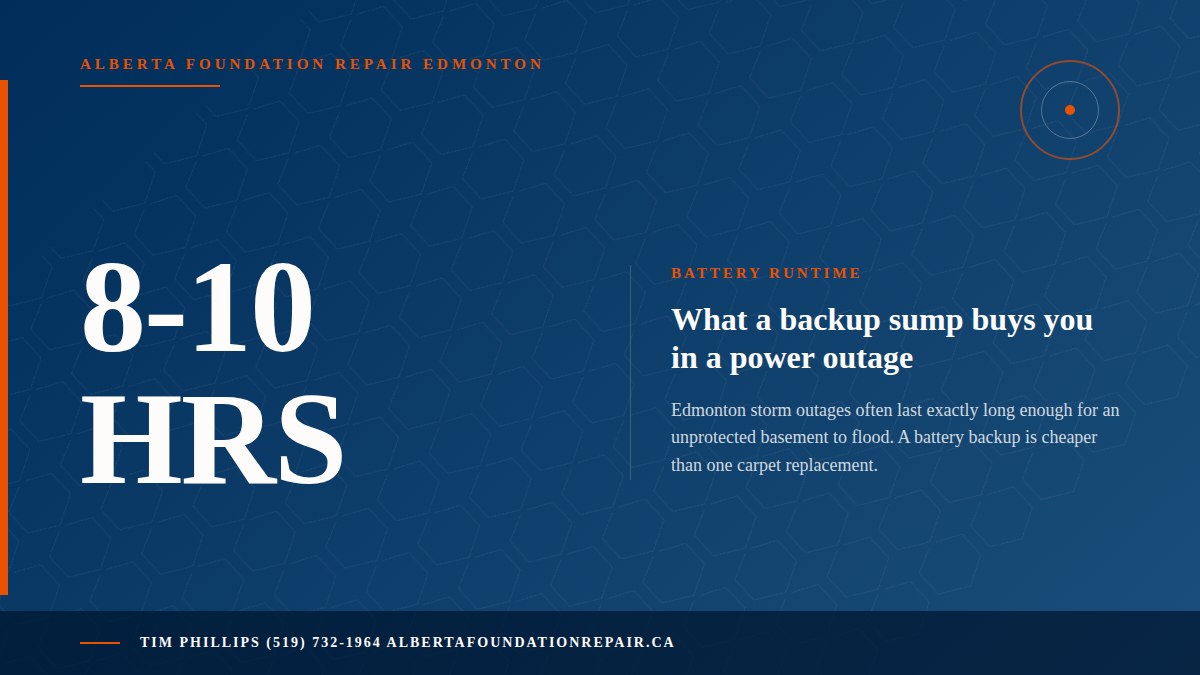
- Real-world Edmonton flood storm: Pump cycles every 2 to 5 minutes, producing 6 to 10 hours of elapsed coverage
For homes with known severe flooding conditions, extended runtime batteries (150 to 200 Ah) or dual-battery configurations are available and can extend coverage to 12 to 24 hours. These are appropriate for homes in ravine areas, high water tables, or properties that have experienced long power outages during previous floods.
Dual-Pump vs Combined Systems
Two installation approaches exist for battery backup in Edmonton:
- Dual-pump (two separate pumps in one pit): Primary pump on AC power, separate backup pump on battery. Each pump has its own float switch. If primary fails or power is out, backup activates. Redundant, proven, higher capacity during simultaneous failure.
- Combined system (single pump with dual power): A single pump that switches between AC and DC power automatically. Lower total cost, less pit space used, but single point of failure if the pump itself breaks.
- Secondary pit installation: Backup pump in a second pit adjacent to the primary, connected through a drainage manifold. Uncommon in residential work but used on commercial sites or high-volume applications.
For most Edmonton residential installations, the dual-pump approach is the better choice. The redundancy protects against pump mechanical failure as well as power failure, and the cost difference is small compared to the flood cost it prevents.
“I have seen homes where the primary pump was fine but the float switch stuck during a thunderstorm. The power stayed on, the pump did nothing, and the basement flooded. A dual-pump battery backup with a separate float catches that failure and still pumps the water out. That is the scenario that makes me tell every Edmonton homeowner to install backup, not just the power outage angle.”
Tim Phillips, Alberta Foundation Repair
Battery Backup Cost Edmonton
| Scope | Typical Cost |
|---|---|
| DIY kit (Basement Watchdog or similar, self-install) | $400 to $800 |
| Professional dual-pump installation (standard) | $800 to $2,000 |
| Premium dual-pump with AGM battery and smart monitoring | $1,500 to $3,000 |
| Extended-runtime dual-battery system | $2,500 to $4,500 |
| Full system retrofit (new pit, primary, backup, discharge) | $4,500 to $7,500 |
| Replacement AGM battery (every 5 to 8 years) | $250 to $450 |
Edmonton metro pricing. Installation cost includes control panel, wiring, battery charger, and system commissioning.
Smart Monitoring and Alarms
Modern battery backup systems support Wi-Fi monitoring and smart alarms that notify you of problems before they become floods.
- Power loss notifications: Alert when grid power fails, letting you check the pump remotely
- High water alarm: Alert when water in the pit rises above normal operating levels
- Pump failure alarm: Alert when the primary pump fails to respond to the float switch
- Battery voltage monitoring: Alert when battery voltage drops below threshold, indicating charge or battery health issues
- Cycle counting: Tracks how often the pump runs over time, helping identify gradual drainage problems
- Alexa or Google Home integration: Some systems announce alarms through smart speakers in the house
Testing and Maintenance
A battery backup sump pump that has never been tested is no better than no backup at all. Monthly testing catches problems before they cause a basement flood.
- Monthly test: Disconnect the primary pump at the breaker, pour a bucket of water into the pit, verify the backup activates and pumps the water out within 30 seconds
- Quarterly battery check: Measure voltage at battery terminals with a multimeter. Full charge is 12.7 to 13.0 V. Low voltage indicates charger or battery issues.
- Annual full discharge test: Run the backup pump through multiple cycles until the battery voltage drops to the automatic cutoff point, verifying runtime matches expectations
- Every 5 to 8 years: Replace AGM battery proactively, even if it still seems to work. Batteries fail suddenly, not gradually.
- Every 10 to 15 years: Replace the backup pump itself if it has accumulated significant run hours
Frequently Asked Questions
How much does a battery backup sump pump cost in Edmonton?
A complete battery backup sump pump system in Edmonton costs $800 to $2,000 installed, including the backup pump, deep-cycle battery, automatic charger, and control panel. Standalone kits start around $400 for self-install. Premium systems with extended runtime batteries or dual-pump configurations run $2,000 to $3,500.
How long does a battery backup sump pump run in a power outage?
A standard battery backup sump pump runs for 4 to 12 hours during continuous operation on a full charge, depending on how often it cycles and battery capacity. Typical Edmonton storms causing basement flooding produce enough water that the pump cycles every 1 to 5 minutes. Plan for 6 to 8 hours of real operation during active flooding.
AGM or flooded lead-acid battery for sump pump backup?
AGM (Absorbent Glass Mat) batteries are the better choice for Edmonton sump backups. They are sealed, maintenance-free, cold-tolerant, and can be mounted in any orientation. Flooded lead-acid batteries need regular water topping up and vent hydrogen gas, which is unsafe in a sealed basement. AGM costs roughly 30 percent more but lasts longer and requires zero maintenance.
Do I need a backup sump pump if I have a whole-house generator?
Yes. A whole-house generator takes 15 to 45 seconds to start and transfer power to the sump pump after a grid outage. During severe flooding, that delay can allow enough water to rise above the basement slab. A battery backup provides instant switchover with zero delay, which is what actually keeps your basement dry during a storm.
How often should I test my battery backup sump pump?
Test monthly. Disconnect the primary pump at the breaker, pour a bucket of water into the pit, and verify the backup activates and discharges properly. Also test the battery charger by checking voltage at the battery terminals. An untested backup system is no backup at all. Many control panels include a test button that simulates a power outage.
- Government of Canada, Get Prepared: Sump Pumps and Flood Prevention.
- Environment Canada, Canadian Climate Normals 1991-2020, Edmonton International Airport. Storm and wind event data.
- Canadian Electrical Code Part I, Section 26: Low-Voltage DC Installation Requirements.
- Basement Watchdog, Battery Backup Sump Pump Installation Guide.
- Zoeller Pump Company, Residential Battery Backup System Specifications.
A battery backup sump pump is the cheapest flood insurance money can buy for an Edmonton basement. One $1,200 upgrade prevents one $30,000 flood. The math is not close.
Alberta Foundation Repair installs battery backup sump pump systems with AGM batteries and smart monitoring across Edmonton, St. Albert, Sherwood Park, Spruce Grove, Leduc, and Beaumont. Call Tim for a free visual inspection.