Water Leaking Through A Foundation Crack In Edmonton: What To Do
Quick Answer: If water is coming through a foundation crack during Edmonton snowmelt, dry the wall, set a bucket, photograph the crack with a ruler, and call a foundation repair specialist the same day. A polyurethane injection typically costs $1,500 to $3,500 and holds for 20+ years when done before the crack widens.
What This Guide Covers
Reading time: 9 minutes.
You went downstairs to grab something from storage and there is a dark wet line tracing down the concrete. Maybe a puddle on the floor. The snow in the yard is soft, the downspouts are running, and the basement wall is suddenly telling you what the outside already knows: the ground around your foundation is saturated, and water has found the path of least resistance.
This guide is written for an Edmonton homeowner who just discovered the leak and needs to make good decisions in the next hour. Not a six-month renovation plan. Not a sales pitch. The facts about what is happening, what it costs to fix, and when you can wait versus when you absolutely cannot.
A crack that leaks is telling you two things at once: there is a gap, and there is water under pressure behind it. Before we get into stopping that leak, it is worth seeing how we approach foundation crack repair across Edmonton, since the sealing method depends on what kind of crack you are dealing with.
The First Hour: What To Do Right Now
Active water through a foundation crack is a Tier 1 event in our Edmonton foundation crack emergency framework. Confirm the tier before you decide between a same-day call and a scheduled visit.
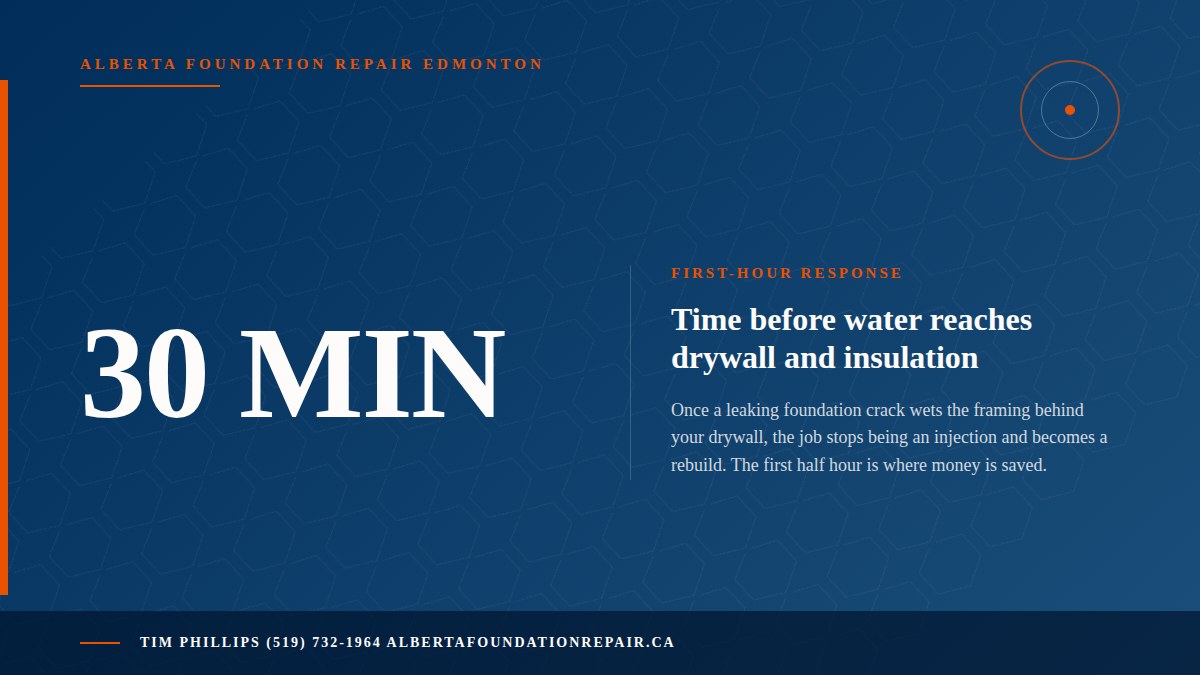
Foundation leaks during snowmelt rarely stop on their own. The soil is saturated for weeks once a thaw starts, and every warm afternoon pushes more water against your wall. What you do in the first 60 minutes protects the finished side of the basement and gives a repair crew something useful to work with.
Six Steps Before You Call Anyone
- Move belongings away from the wet wall. Anything cardboard, fabric, or electronic. Lift off the floor onto a stool or shelf. Mould starts within 24 to 48 hours on damp drywall and carpet.
- Pull back carpet or insulation if you can. Water trapped behind vapour barrier or under carpet underlay continues wicking into wood framing for days. Exposing the concrete lets it dry and lets a repair tech see the full crack.
- Set a container under the drip. A bucket, shallow pan, or towel. This is not a fix, it is triage. The goal is a dry floor until a pro sees the crack.
- Photograph the crack with a ruler next to it. Take three photos: full wall context, close-up of the crack with a tape measure showing width, and a close-up of any staining above or below. These photos save you from explaining the problem by phone and let the repair tech prepare before arriving.
- Walk outside and look at the grade and downspouts. Is snow piled against the foundation? Is a downspout dumping water into a pool six inches from the wall? These are the two biggest contributors to the leak you are looking at indoors, and they are free to fix today.
- Do not fill the crack with hardware store sealant yet. Surface patches trap water inside the crack, make the concrete harder to inject properly later, and can push water sideways into the floor joint instead. A polyurethane injection works better when the crack is open and wet.
When To Stop Reading And Call 911 Or EPCOR First
If water is entering fast enough to cover the floor in under an hour, if it is clearly sewage (grey, brown, smell), or if the wall is visibly bulging or bowing inward, this is not a standard crack injection call. Sewage backup goes to EPCOR at 780-412-4500. A bowing wall with active water behind it is a structural emergency and you should move people out of the basement before calling a foundation crew. A standard vertical crack that is weeping slowly is not this, but it is worth knowing the line.
Tim Phillips, Alberta Foundation Repair: “The homeowners who save the most money are the ones who call the afternoon they notice the leak. Once water has been running behind drywall for two weeks you are not just fixing the crack, you are replacing framing and flooring. The crack itself costs about the same whether we inject it Thursday or three weeks from Thursday. Everything else gets more expensive.”
Why Edmonton Cracks Leak In April, Not January
The same April-thaw mechanism is why April is the best month for proactive foundation inspection. The four-weekend walk in spring foundation inspection Edmonton catches most leaks while they are still small.
A crack that stayed dry all winter is now weeping. Homeowners often assume the crack just appeared. It probably did not. In Edmonton, the physics of spring thaw turn quiet cracks into active ones for three specific reasons.
Frozen ground acts like a seal. From November to late March, the ground around your foundation is frozen solid, usually well past the Alberta Building Code minimum footing depth of 1.2 metres. Water in the soil is ice, not liquid, and ice does not flow through a hairline crack. The crack was there. It was just plugged.
The thaw is uneven and fast. Edmonton’s design frost penetration depth is 2.4 metres, according to City of Edmonton geotechnical standards referencing the Canadian Foundation Engineering Manual. The top foot of soil thaws first while the deeper ground is still frozen. That frozen layer below acts like a bathtub floor. Meltwater has nowhere to drain downward, so it builds up horizontally against your foundation wall.
Edmonton clay swells when it gets wet. Our local soil is roughly 65 percent glacial till and 25 percent lacustrine clay, with a plasticity index reaching 44 percent in some areas. When saturated, that clay swells by five to ten percent of its volume and presses against the wall. A crack that was a passive hairline under dry pressure becomes an active channel under swelling pressure.
Why Your Neighbour Is Fine And You Are Not
Two houses on the same street can have the same crack and only one leaks. The variables that matter are grading (soil sloping toward or away from the wall over the first 10 feet), downspout placement, whether the weeping tile is clogged with root matter or silt, and the exact clay composition in your yard. East Edmonton neighbourhoods near the Cooking Lake moraine (Millwoods, Glastonbury, Clareview) sit on solonetzic clay, which holds water longer and moves more than the clay on the west side. North-side neighbourhoods like Castle Downs show similar patterns. If you are east or north of the river and you are leaking this week, you are not alone.
How Bad Is It? Reading Your Own Crack
A crack that is leaking right now fails gate four of the Edmonton DIY test. The injection will seal the interior surface, but the water finds the next weakness unless the exterior cause is fixed first.
Not every leaking crack is a structural problem. Most are not. But the difference between “inject it and move on” and “we need an engineer to look at this” comes down to four things you can check yourself before anyone shows up.
The Four-Minute Self-Assessment
- Direction. Vertical or diagonal cracks, narrower than a nickel, are usually shrinkage or minor settlement. These inject well. Horizontal cracks, especially ones running along the middle third of the wall height, suggest lateral soil pressure and often need more than injection.
- Width. A business card fits in most hairline cracks. A nickel (1.95 mm) should not. If a nickel slides in easily, you are past the “simple injection” range and should have an engineer-aware contractor assess before choosing a repair.
- Pattern. One crack is a crack. A stair-step pattern through concrete block, or multiple parallel cracks on the same wall, indicates the wall is moving. Injection stops water, it does not stop movement.
- Companion signs. Sticking doors upstairs, drywall cracks above doorways on the main floor, gaps between baseboards and floors, a chimney pulling away from the house, basement floor cracks that line up with wall cracks. Any of these shift the conversation from “repair this crack” to “understand what the foundation is doing.”
What Causes The Crack In The First Place
Most vertical cracks in Edmonton poured-concrete foundations appear within the first two years after the house is built, from concrete shrinkage as it cures. These are the cracks that leak every spring for 20 years without structural consequence. Horizontal cracks are different. They usually come from lateral earth pressure exceeding the wall’s capacity, which in Edmonton is often driven by clay swell combined with hydrostatic pressure during spring thaw. The National Building Code of Canada 2025 (Division B, Part 4) sets the engineering standards for foundation wall design, but most Edmonton houses built before 1990 were designed to older codes that did not fully account for the pressure our clay can generate when fully saturated.
What The Repair Actually Costs In 2026
Most foundation repair companies in Edmonton will not put a price on their website because every crack is genuinely a little different. That is honest. It is also not very useful when you are standing next to a wet wall trying to budget. Here is a straight read on what you will actually be quoted this month.
| Repair Type | Edmonton Price Range 2026 | When It Applies | Typical Lifespan |
|---|---|---|---|
| Polyurethane crack injection | $1,500 to $3,500 per crack | Vertical or diagonal cracks, under 6 mm wide, actively leaking | 20+ years |
| Epoxy crack injection | $1,800 to $4,000 per crack | Structural repair where the crack needs to be bonded back to full strength | Lifetime of the concrete |
| Exterior dig and seal | $6,000 to $15,000 per wall section | Large cracks, failed previous injection, or wall that needs waterproof membrane | 25+ years |
| Interior perimeter drain plus sump | $8,000 to $18,000 | Multiple leak points, weeping from floor joint, failed weeping tile | 20+ years |
| Free visual inspection | No charge | First look, general assessment, written quote for injection work | n/a |
Two cost notes that save homeowners real money. First, an actively leaking crack is cheaper to inject than a dry crack that leaks seasonally, because polyurethane reacts with moisture and expands to fill the full depth of the crack. Second, if a company quotes you $800 for an interior injection, ask what product they are using and what the warranty covers. Proper two-component polyurethane injection with a written transferable warranty is not a $800 job in Edmonton in 2026, and the difference usually shows up the following spring.
The Insurance Question
Most Alberta home insurance policies do not cover foundation repair itself. They sometimes cover water damage to finishes (drywall, flooring, belongings) once a repair has been completed, especially if you have an overland water or sewer backup endorsement. Two practical steps: photograph everything before you touch it, and call your broker before you start tearing out carpet. If the source is a broken weeping tile or an exterior plumbing line, the coverage picture changes. Document first, demolish second.
Foundation Repair vs Plumber vs EPCOR vs Your Builder
Water entry is one of twelve symptoms Tim maps against three urgency tiers in the foundation symptom diagnostic guide. Reading your full symptom profile often reveals whether the crack is the cause or just the most visible part of a larger issue.
Water in a basement is not always a foundation problem. The fastest way to waste a weekend is calling the wrong trade first. Here is how to tell, in the order most Edmonton homeowners encounter it.
Who Handles What
- Foundation repair contractor. Water coming through a visible crack in the concrete wall, through the cove joint where the wall meets the floor, or through a tie-rod hole. Seasonal patterns (dry in summer, wet in spring). Visible staining on the concrete.
- Plumber. Water at a fixture, under a laundry tub, from a hot water tank, from a water softener line, or a continuous flow that does not correlate with weather. If the water is clean and warm, it is plumbing until proven otherwise.
- EPCOR (780-412-4500). Sewage backup from a floor drain or toilet, water coming up through the floor drain, city main issues. Also the right first call if your whole street is flooding.
- City of Edmonton 311. Questions about lot grading bylaws, storm sewer backup on your street, or if you think a neighbour’s grading or downspout is directing water into your yard.
- Your builder (if under new home warranty). Houses under 10 years old in Alberta are covered by the Alberta New Home Warranty for major structural defects. Foundation cracks that appear within the first five years can sometimes be warranty events, depending on width and whether the home was built to code.
- APEGA-licensed structural engineer. If you see horizontal cracks, stair-step cracks, bowing walls, or the crack is wider than a nickel. A foundation repair crew can inject a leaking crack, but structural movement requires an engineer-stamped assessment before major repairs, and the City of Edmonton requires engineered drawings for underpinning or wall anchors.
Tim Phillips, Alberta Foundation Repair: “I tell people the honest version on the phone. If I come out and see a clean vertical crack weeping water, I can quote a polyurethane injection on the spot and usually have it done the same week. If I see horizontal cracking or a wall that is moving, I tell you to bring in a structural engineer before we spend your money, because injecting a moving wall is throwing money at the wrong problem. When I am on site, I am reading the foundation to find out why it is moving in the first place, so we fix the cause and not just the symptom.”
Frequently Asked Questions
Will my foundation crack leak forever if I do nothing?
Most untreated cracks leak every spring for as long as they exist, and they slowly get worse. Water running through concrete carries calcium out of the mix (the white efflorescence stain you see) and freeze-thaw cycles widen the crack each winter. A hairline crack today is often a 3 to 4 mm crack in 10 years, and the repair cost scales with the width.
Can I just use hydraulic cement or caulk from Home Depot?
It will usually stop the leak for a season or two, occasionally less. Surface patches do not reach the full depth of the crack, they fail from the back as water pressure builds, and they make a proper polyurethane injection harder to do later because the surface is no longer clean. If you are two weeks from moving or cannot schedule a repair before a rainy forecast, a temporary patch is reasonable. As a long-term fix, it is not.
How long does a polyurethane injection actually take?
A single crack injection is usually a one to three hour visit, start to finish. The material cures in about 15 minutes. You can use the basement normally the same day. Most Edmonton injections are done from the inside, which means no digging in the yard and no excavator on the lawn. If you are dealing with multiple cracks or a structural issue, plan on a longer job and a different quote.
Do I need a permit to repair a foundation crack in Edmonton?
A standard crack injection does not require a City of Edmonton building permit. Structural work like underpinning, helical piers, wall anchors, or rebuilding a section of wall does require a permit, and usually requires engineer-stamped drawings from an APEGA-licensed engineer. A reputable foundation repair contractor will tell you which category your job falls into before quoting.
How does Tim figure out why my foundation is leaking?
For a simple vertical crack injection, the free on-site inspection is enough to quote the work. Tim visits, inspects the foundation in person, and reads the cause on site: he looks at the crack direction and width, the grading and downspouts outside, the cove joint, and the signs of clay heave, settlement, frost, or water pressure. That tells him whether you need a straightforward injection or a larger fix, and you get an honest opinion at no charge.
How fast can someone actually come out in April?
Spring is the busy season in Edmonton foundation repair. A small local operator can often do a visual inspection within 24 to 72 hours in April and schedule the injection within a week or two. Larger companies may book out two to four weeks. If the leak is active and fast, ask explicitly when they can quote and when they can fix. Those are two different dates.
Sources
- National Research Council of Canada. (2025). National Building Code of Canada 2025, Division B, Part 4: Structural Design. National Research Council Canada. nrc.canada.ca
- City of Edmonton. (2015). Preliminary Geotechnical Report, Ogilvie Ridge Development. Design frost penetration depth of 2.4 m for Edmonton; mean annual frost penetration of 1.8 m; 50-year return period depth of 2.1 m (referencing Canadian Foundation Engineering Manual, 2006). edmonton.ca
- Canadian Geotechnical Society. (2006). Canadian Foundation Engineering Manual, 4th edition. Clay swell potential classifications (Table 15-1); recommended removal depths for high-plasticity clay beneath slab-on-grade foundations.
- Association of Professional Engineers and Geoscientists of Alberta (APEGA). Practice Standards for Structural Engineering Services on Residential Buildings. Requirement for engineer-stamped drawings on underpinning, helical pier, and wall anchor work. apega.ca
- EPCOR. Basement Flooding Emergency Reporting. Sewer backup reporting line 780-412-4500. epcor.com
- City of Edmonton. Drainage Bylaw C18093 and Residential Lot Grading. Homeowner responsibilities for surface drainage and grading away from foundation walls. edmonton.ca
Get Your Leaking Crack Looked At This Week
If you are reading this with a bucket under a wet spot, the useful next step is a visual inspection by someone who does this every day in Edmonton clay. Most leaking vertical cracks are straightforward to quote and quick to fix if you catch them before the finished wall, carpet, and framing behind it start to rot. Tim Phillips runs Alberta Foundation Repair out of Edmonton and books visual inspections at no charge.
Alberta Foundation Repair, serving Edmonton, St. Albert, Sherwood Park, Spruce Grove, Leduc, Fort Saskatchewan, Beaumont, and surrounding areas. Call Tim directly at (519) 732-1964.
Tim comes out himself, inspects the foundation in person, and identifies why it is moving before he quotes anything. For a leaking crack, the first visit is a visual inspection at no charge, and you get a written quote before anything starts.