How Do I Know If My Foundation Needs Repair? Edmonton Guide
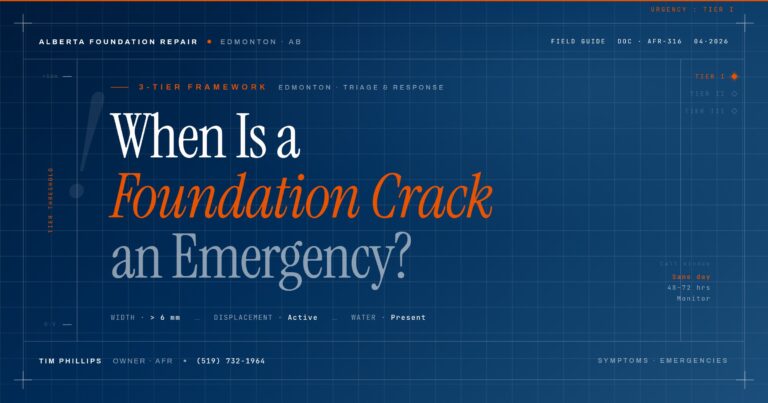
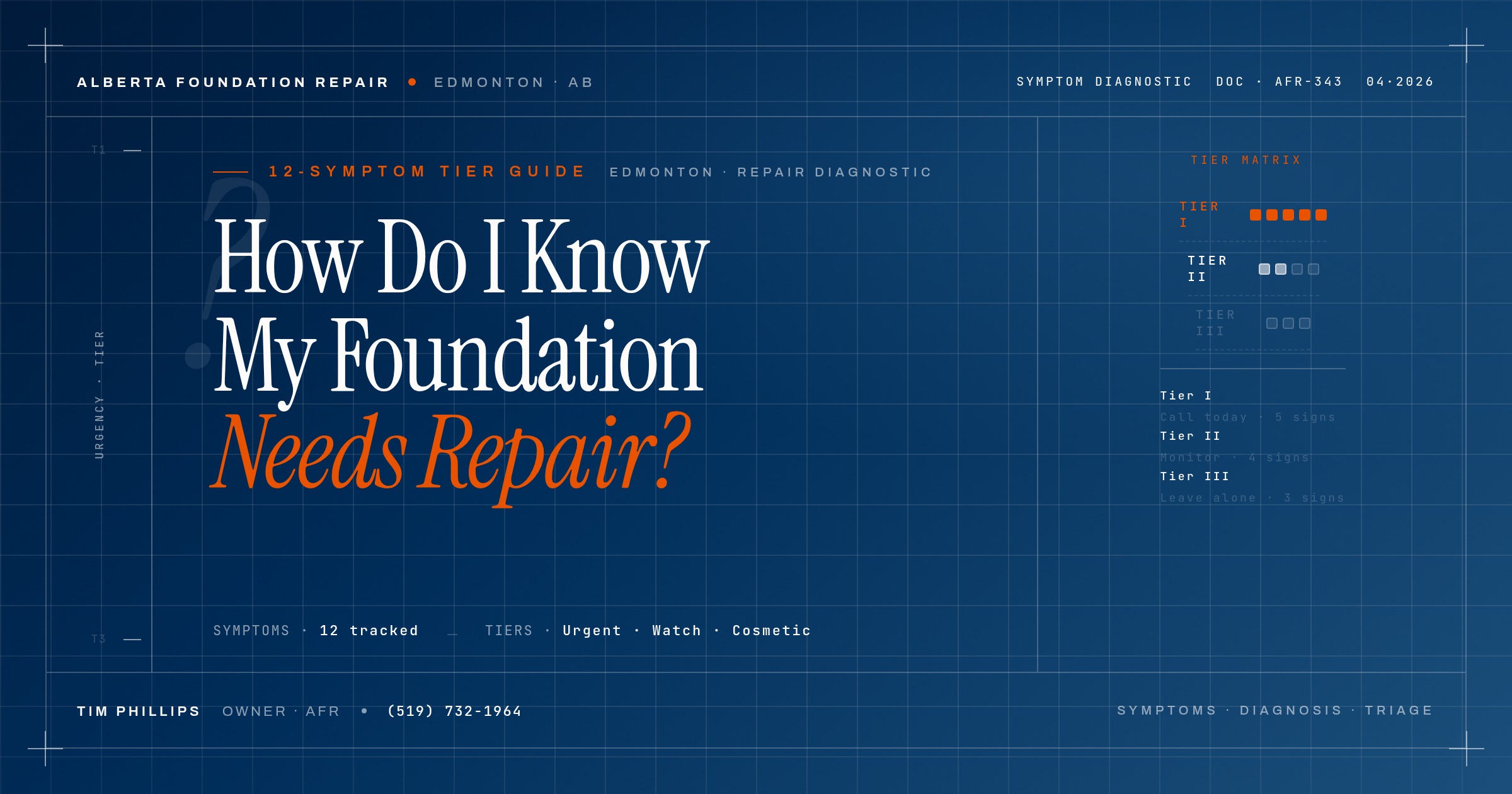
Quick Answer: Your foundation likely needs repair if you see horizontal cracks, bowing walls, sudden door or window misalignment, active water entry, or sloping floors. Cosmetic hairline cracks and small parging flaws usually do not. Twelve specific Edmonton-home symptoms sort into three tiers below: urgent (call today), watch (monitor and document), and cosmetic (leave alone).
In This Guide
Reading time: 12 minutes
Catching trouble early is where every fix really begins, and it ties straight into reading the early warning signs before a repair turns urgent. Let’s walk through the symptoms that tell you your foundation is asking for a closer look.
The Three-Tier Symptom Table
Most articles give you a flat list of “10 warning signs” and leave the urgency ranking to you. That is not helpful when you are standing in your basement at 9pm on a Sunday trying to decide whether this can wait until Monday. Here is the working table Tim uses on every site visit, sorted the way he actually triages.
| Tier | Symptom pattern | Action |
|---|---|---|
| Urgent | Horizontal cracks, bowing walls, active water entry, sloping floors, sudden door misalignment | Call today. Same-day response warranted. |
| Watch | Widening vertical cracks, step cracks in block, drywall cracks above windows, efflorescence, musty basement smell | Document with photos and dates. Book within 30 days. |
| Cosmetic | Hairline shrinkage cracks under 3 mm, parging flakes, surface crazing, old efflorescence with no active water | Photograph and re-check next season. No repair urgency. |
Below, each tier expands into the specific symptoms with what they actually mean. Four symptoms per tier, twelve total.
Tier 1 Urgent Signs (Call Today)
These five symptoms warrant a same-day or next-morning call. Each is a load-bearing signal that something beyond routine cracking is happening to the structure.
1. Horizontal cracks running across the foundation wall. A horizontal crack indicates lateral pressure from soil pushing the wall inward, most commonly hydrostatic pressure from saturated clay or frost heave. Horizontal cracks rarely stabilize on their own because the force causing them continues to act. See our horizontal foundation crack guide for the full failure sequence.
2. Visible wall bowing or inward deflection. Hold a long level or straight edge against the basement wall. If you can see a gap at the top or bottom, the wall has moved. Deflection beyond 25 mm usually requires wall anchors or carbon fibre straps, which are always engineer-required repairs.
3. Active water entry through a crack during rain or snow melt. Water moving through a crack means the exterior waterproofing has failed or the soil around the foundation is saturated enough to overwhelm the drainage. Tier 1 regardless of crack width. Our guide on what to do when a crack is leaking covers the first-hour response.
4. Floors that have sloped noticeably since last year. Roll a marble or drop a small round object in the middle of a room. If it rolls more than it did twelve months ago, the foundation has settled or heaved under that section of the home. This is not a DIY fix. Book a professional inspection within the week.
5. Doors or windows that suddenly stop latching. Not the slow drift of a 1970s house. A door that closed fine in December and will not latch in April has had its frame racked by foundation movement. When combined with any visible wall crack, treat as Tier 1.
Tier 2 Watch Signs (Monitor and Document)
Tier 2 symptoms are real but not same-day. Photograph them today, mark the ends of any crack with a pencil and dated line, and book a visual inspection within 30 days. These are the patterns that can move from Tier 2 to Tier 1 over a single freeze-thaw cycle.
6. Vertical cracks that have widened measurably since last year. If a crack you photographed in summer is measurably wider in spring, it is active, not static. Stable cracks stay the same width for years. Active cracks move with the soil underneath.
7. Step cracks running diagonally through mortar joints. Concrete block foundations show movement along the weakest plane, which is the mortar. Diagonal zigzag cracks indicate either differential settlement or heave. The crack pattern is the wall’s own stress diagram.
8. Drywall cracks above windows or doors that reopen after patching. The wall sheet flexes when the framing behind it shifts. A single drywall crack in a new home is usually cosmetic framing movement. A crack that keeps coming back after paint-and-patch is telling you the movement is ongoing.
9. Fresh efflorescence (white crystalline deposits) on basement walls. The white powder is mineral salt left behind when water has moved through the concrete. Old, dry deposits from a long-ago leak are fine; fresh moist efflorescence means water is actively moving through the wall right now. Tim has pulled efflorescence samples from dry-looking walls that turned out to have active seasonal leaks.
Tier 3 Cosmetic Signs (Usually Leave Alone)
These three symptoms are what most of Edmonton’s foundation walls show and what most homeowners worry about unnecessarily. They are usually not repair-worthy on their own. Photograph them anyway for comparison next year.
10. Single hairline vertical cracks under 3 mm in poured concrete. Shrinkage cracks are universal in poured foundations. They form as the concrete cures and stabilize within the first 1 to 5 years. If the crack is dry, non-widening, and the wall is plumb, it is almost always cosmetic. A DIY injection kit is optional, not urgent.
11. Parging flakes and surface spalling on the exterior. The cement coating on the outside of a foundation wall cracks and flakes before the structural concrete does. Ugly, not dangerous. Our parging repair guide covers the cosmetic fix.
12. Surface crazing patterns on slab floors. Fine map-like cracks across garage floors and basement slabs are usually just the concrete’s top layer curing unevenly when the slab was poured. Not structural. Sealing is optional.
Edmonton-Specific Signals Most Guides Miss
Generic foundation articles miss four signals that matter a lot in Edmonton specifically. Watch for these in addition to the twelve above.
Basement feels different in spring than in fall. Edmonton clay heaves up in winter and settles back in summer. A basement that felt level in October and feels “off” in March is responding to seasonal soil movement. By itself not a crisis; combined with any Tier 1 or Tier 2 symptom, it becomes confirming evidence.
Sump pump runs more often than it used to. Not every spring. If your sump cycles more frequently than in prior years, groundwater has changed around the foundation. Could be a new drainage failure, a weeping tile clog, or a neighbouring construction project changing how water moves. Clogged weeping tile is one of the most common hidden causes Tim finds.
Window wells holding standing water after rain. Wells are supposed to drain within an hour. Standing water 24 hours after rain means the well drain tile has failed, and that water is now pressing on your foundation wall all winter.
Musty basement smell that was not there a year ago. A new musty smell is the olfactory version of efflorescence. Moisture has moved into materials that were dry a year ago. Combined with any visible crack or efflorescence, treat as a water-entry investigation.
Not Sure Which Tier Your Symptoms Are In?
A free visual inspection takes fifteen minutes and tells you in plain English whether you are looking at cosmetic, watch, or urgent. No quote pressure. Call Tim: (519) 732-1964, Edmonton and surrounding areas.
How to Document What You Are Seeing
For a structured four-weekend version of this documentation work, see spring foundation inspection Edmonton, which walks through what to check each weekend of April.
Before you call anyone, spend fifteen minutes building a photo record. Every professional will ask for the same information, and good documentation often gets you a free phone triage that saves a site visit fee.
Take a wide shot of each crack or affected area showing the full wall with ceiling and floor for scale. Then a close-up with a Canadian dime beside the crack (a dime is 18 mm across, which is a better scale than a ruler because any photo viewer can measure it against the coin). Mark the ends of each crack with a pencil line and write today’s date on the wall above it. Check the exterior side of the same wall and photograph there too. Last, hold a level against the wall full height and photograph any gap at top or bottom.
This five-minute record is the difference between “the crack is bigger” as a feeling and “the crack grew from 2 mm to 4 mm between October 2025 and April 2026” as a fact. Tim works from facts.
Tim Phillips, Alberta Foundation Repair: “Homeowners call me panicked about hairline shrinkage cracks and silent about sloping floors they have learned to live with. The pattern reverses the actual risk. The crack you notice because it is ugly is usually fine. The condition you do not notice because it changed gradually is the one worth investigating. Document everything, including what you have gotten used to.”
When the Signs Do Not Match the Cause
The most common reason symptoms and causes do not line up is that Edmonton homes can exhibit settlement on one corner and heave on another simultaneously. See settlement vs heave in Edmonton for how to tell which mechanism is acting where.
One of the reasons foundation diagnosis is hard is that the symptom and the cause are often on different parts of the house. A door sticking on the second floor can be caused by foundation movement under a different wall entirely. A basement leak on one side can be driven by drainage failure on the opposite side. A crack above a kitchen window can reflect settlement under the back deck.
Three patterns Tim sees often in Edmonton:
Multiple symptoms, one cause. Sticking upstairs door + drywall cracks above hallway + slight floor slope often trace to a single point of foundation movement. Twelve visible symptoms, one underlying issue.
One symptom, many possible causes. A wet basement floor can be foundation crack water entry, plumbing failure, condensation, sump failure, or frozen discharge. Starting with “which crack is leaking” often misses the real cause.
Compounding symptoms that amplify each year. Expanding clay shifts the wall; the shift creates micro-cracks; water finds the cracks; freeze-thaw widens them; the wall shifts more. This is why a symptom you dismissed last spring can be bigger this spring without anyone doing anything.
This compounding effect is why the decision framework in the foundation crack emergency guide looks at the progression year-over-year, not just today’s width.
Buyers evaluating a home where the inspection report flagged the foundation should also read buying a house with foundation problems in Edmonton, which translates the same tier framework into a walk-vs-negotiate-vs-accept decision.
Symptom-specific deep dives: bowing or bulging basement wall, sticking doors and uneven floors, and stair-step cracks in brick or block walls.
Frequently Asked Questions
Can I tell if my foundation needs repair without a professional?
For the clear cases, yes. A horizontal crack or a visibly bowed wall is Tier 1 and does not need a professional to confirm. For the grey zone, which is where most homeowners sit, no, because mixed signals where the symptom does not match the cause are the pattern a trained eye catches fastest. A free visual inspection is the cheapest way to resolve the grey zone.
How old is too old for a foundation to still be fine?
Age alone does not determine whether a foundation needs repair. Edmonton has 1960s homes that are still plumb and 2010s homes that have cracked badly. What matters more is soil condition, original construction quality, drainage, and maintenance. A 60-year-old foundation with no water entry, no settlement, and no wall movement does not need repair just because of its age.
What is the cheapest foundation problem to fix?
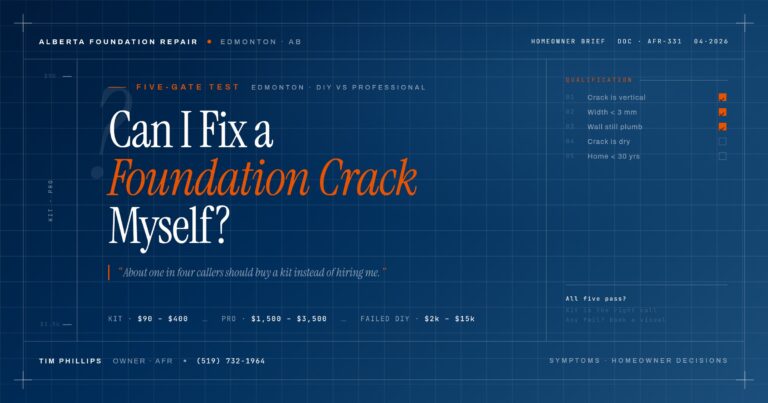
A single hairline vertical crack under 3 mm in a plumb, dry wall is the cheapest, often repairable for $90 to $400 as a DIY or $1,500 to $3,500 professionally. Parging repairs and garage floor crack sealing are also inexpensive. The most expensive problems are underpinning ($12,000 to $25,000 residentially) and exterior excavation waterproofing ($8,000 to $15,000 per wall).
Does homeowners insurance cover foundation repair in Alberta?
Usually not for gradual soil-movement or clay-heave damage, which is specifically excluded in most Alberta policies. Insurance generally covers sudden, accidental damage (a burst pipe causing foundation water intrusion, a vehicle striking the house) but not wear-and-tear movement. Call your broker and ask about “earth movement” and “wear and tear” exclusions specifically.
How fast does a Tier 2 symptom become Tier 1?
Edmonton’s freeze-thaw cycles drive most tier escalation. A Watch-level vertical crack widening 1 mm per year in a climate-stable region might stay Watch for a decade. In Edmonton, the same crack can reach 6 mm in three to five winters if the underlying soil movement continues. This is why documentation with dated photos matters so much.
Should I fix foundation problems before selling my house?
Usually yes, but the specific answer depends on the problem. Cosmetic cracks can be left and disclosed. Tier 1 structural issues almost always get flagged during the buyer’s inspection anyway, and a fix with paperwork (engineer sign-off, warranty) often recovers more than the repair cost. Transferable warranties on the repair protect the sale.
What if I have multiple symptoms at once?
Multiple symptoms occurring together are a Tier 1 condition even if each individual symptom would be Tier 2 alone. A sticking door plus a drywall crack plus a slightly sloping floor is a different situation than any one of those in isolation. The combination usually indicates a single underlying cause that has progressed far enough to show on multiple surfaces, which raises the urgency.
Sources
- National Research Council Canada (2023). National Building Code of Canada 2023, Alberta Edition, Part 9: Houses and Small Buildings. BILD Alberta. Link
- Alberta Geological Survey. Surficial Geology of the Edmonton District, ESR 1962-06. Link
- National Research Council Canada. Canadian Building Digest: Frost Action and Foundations. Link
- US Army Corps of Engineers. TM 5-818-7: Foundations in Expansive Soils. Link
- Canada Mortgage and Housing Corporation. Moisture and Air Problems: Householder’s Guide. Link
Get a Tier Confirmation Before You Spend
If you have read this and still cannot tell whether what you are seeing is Tier 1, Tier 2, or Tier 3, that is the grey zone a fifteen-minute visual inspection is designed for. Tim will walk the foundation, photograph what matters, and tell you honestly which tier the symptoms fall into.
Alberta Foundation Repair, Edmonton and surrounding areas, (519) 732-1964.