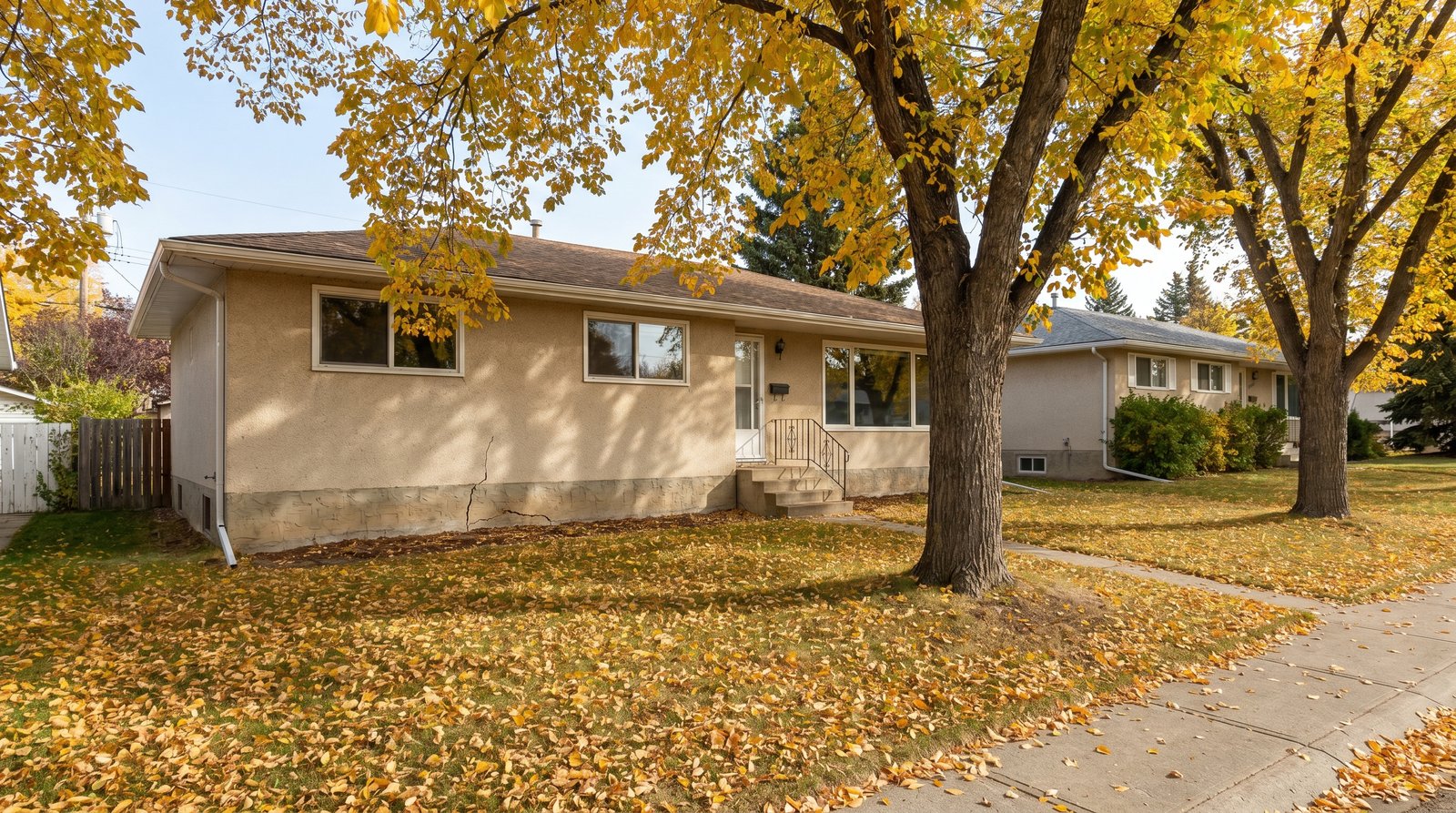
Millwoods Foundation Problems: The Soil Story Under a 1970s Community
Quick Answer: Millwoods foundation problems come from the ground the community was built on. A 1970 survey mapped Solonetzic clay and sodium sulfate directly under the subdivision. The clay swells and shrinks with the seasons, and the sulfate slowly attacks older concrete. Most Millwoods homes are now 45 to 55 years old.
Millwoods is one of the few Edmonton communities where the soil was studied in detail before the first house went up. In 1970 the City was assembling roughly nine square miles of farmland southeast of the river, and the ground underneath got surveyed for urban development. What that survey found explains a lot of the Millwoods foundation problems we get called out to look at today: difficult clay, salty subsoil, and a lot of concrete that was poured a long time ago.
If you own a home in Sakaw, Menisa, Lakewood, Ekota, or any of the other Millwoods neighbourhoods, here is what is actually going on under your floor, and how Tim approaches it.
Mill Woods is one of the southeast Edmonton communities we visit regularly, and the swelling-clay behaviour described in this guide is something we account for differently here than in the river-valley or acreage areas we also cover.
The Soil Under Millwoods Was Mapped Before the Houses Went Up
When the Mill Woods Development Concept was approved in 1971, a soil survey had already been run across the subdivision. It identified four different soil associations sitting under the future neighbourhoods, and the names tell the story.
What the 1970 Millwoods Soil Survey Found
The survey mapped four soil associations across the subdivision: Ellerslie (Chernozemic, the better-behaved black soil), Mill Woods (Solonetzic), Argyll (Alkaline Solonetz), and Hercules (Humic Gleysol, poorly drained wet ground). Two of the four are Solonetzic. There is literally a Solonetzic soil association named after Mill Woods. The survey flagged shrink-swell potential and concrete corrosion as construction concerns. This sits on the old glacial Lake Edmonton lake bed, which is why the clay runs deep and fine.
That matters because most of Edmonton sits on glacial till and lacustrine clay already, but Solonetzic ground adds a second problem on top of ordinary clay heave. You are dealing with the swelling, and you are dealing with the salt.
Why Solonetzic Clay Is Hard on Foundations
Solonetzic soils form on saline parent material that is high in sodium, much of it weathered from the Cretaceous Bearpaw shale that underlies this part of Alberta. The sodium does two things. It makes the clay disperse and hold water, and it creates a dense hardpan layer in the subsoil that is rock-hard when dry and nearly waterproof when wet.
The Shrink-Swell Cycle Under a Millwoods Home
Edmonton lacustrine and Solonetzic clay can reach a Plasticity Index around 44%, which puts it in the highly expansive range. The clay takes on water and swells 5 to 10% in wet seasons, then contracts during summer drought. That repeated movement lifts and drops different corners of a foundation by different amounts, which is what cracks concrete. The hardpan also traps water against the footing instead of letting it drain, so a Millwoods basement often stays wetter, longer, than the homeowner expects. This is the same mechanism behind settlement versus heave, just concentrated by the salty subsoil.
This is the part generic foundation pages miss. They talk about “Edmonton clay” as if it is all the same. On the east and southeast side, in Millwoods and out toward the Cooking Lake moraine, the Solonetzic concentration is the highest in the city. The clay here is not just expansive. It is chemically aggressive.
The Sulfate Problem Most Millwoods Homeowners Never Hear About
Here is the deal with salty soil and concrete. Solonetzic ground carries soluble sulfates, mostly sodium sulfate. When sulfate-rich groundwater sits against a concrete foundation, the sulfate works its way into the concrete and reacts with the cement paste. It forms a mineral called ettringite that takes up more space than what it replaced. That internal pressure cracks the concrete from the inside out. Engineers call it sulfate attack, and it is slow, which is why a lot of homeowners never connect it to the soil.
How the Building Code Handles Sulfate Soil
Canadian concrete standard CSA A23.1 sets sulfate exposure classes based on how much soluble sulfate is in the soil: S-3 moderate (0.10 to 0.20%), S-2 severe (0.20 to 2.0%), and S-1 very severe (over 2.0%). For the severe classes, the standard requires sulfate-resistant cement (Type HS) and a low water-to-cement ratio of 0.40 or less. The catch for Millwoods: a lot of these homes were poured in the 1970s and early 1980s, when residential foundations were not always specified for the local sulfate conditions. Whether your particular foundation is at risk depends on the actual soil chemistry at your lot and the mix that was used, which is exactly the kind of thing we want to know before recommending a repair.
Tim Phillips, Alberta Foundation Repair: “When I am under a Millwoods house and the concrete is flaking or crumbling at the base of the wall rather than cracking in a clean line, that is usually the soil chemistry talking, not just movement. I inspect the wall closely on site to read how far the deterioration goes before anyone decides on a fix. You do not want to inject or patch a wall that is actually being eaten from the outside. That is good money after bad.”
How the Age of Your Millwoods Home Changes the Picture
Millwoods was not built all at once. It filled in over about two decades, and the build year of your specific neighbourhood tells you roughly how long your foundation has been fighting the clay and the salt.
Millwoods Neighbourhoods by Build Era
- Sakaw: developed mostly through the 1970s. Foundations here are around 50 years old.
- Menisa: residential build ran 1976 to 1980. Classic late-70s concrete.
- Lakewood: built late 1970s into the early 1980s, community league established in 1978.
- Tawa: a newer pocket, built mostly in the early 1990s, so the concrete is younger and more likely to meet modern specs.
The older the pour, the more freeze-thaw and shrink-swell cycles it has been through, and the less likely it was specified for sulfate soil. A 1977 Menisa foundation has seen close to fifty Edmonton winters.
Age is not a death sentence for a foundation. Plenty of original Millwoods homes are perfectly sound. But it does change what we look for. On an older home we are checking for the combination of clay-movement cracking and surface deterioration, because in this soil you often get both.
What to Watch For in a Millwoods Foundation
You do not need special tools to catch most of this early. You need to know what the clay and the salt actually do to a house.
Five Things to Check Around a Millwoods Home
Walk your basement and your exterior once each spring and fall. Look for: diagonal or stair-step cracks at the corners of windows and the top of the wall, doors and windows that stick worse in spring than in late summer, a damp or salty white crust on the lower basement wall (efflorescence, a sign sulfate-laden water is moving through the concrete), concrete that crumbles or flakes when you scrape it near grade, and gaps opening between a garage slab or front step and the house. Photograph anything you find and date the photos so you can see if it is moving.
When It Is Not a Watch-and-Wait Situation
Call sooner rather than later if you see a horizontal crack running along the middle of a basement wall, a wall that is visibly bowing inward, cracks wider than a quarter inch, or a crack that is clearly growing month over month. Those point to real pressure on the wall, not just cosmetic movement. Our guide on horizontal foundation cracks explains why that one direction is the serious one.
How We Approach a Millwoods Repair: Inspect the Cause, Fix It Right
Because Millwoods soil throws two problems at once, guessing is expensive. The whole reason Tim leads with a careful on-site inspection is to separate clay movement from soil chemistry before quoting a repair, so the fix actually addresses the cause.
What a Millwoods Assessment Looks Like
- On-site inspection (no charge): Tim looks at the cracking pattern, the grade, the downspouts, and the condition of the concrete, identifies why the foundation is moving, and gives you a straight opinion on site.
- Reading the cause: Tim works out whether the trouble is clay movement, saturated ground holding water against the footing, or sulfate deterioration eating the concrete, so the diagnosis matches what is actually happening under that house.
- The repair: for active cracks that are still sound, polyurethane or epoxy injection runs about $1,500 to $3,500 per crack. For corners that have settled into soft clay, helical piers or underpinning stabilise the footing, generally $4,000 and up per area. Structural work needs an APEGA-stamped plan and a City of Edmonton permit.
- Verify: we check the work after it is done so you can see the void is filled or the wall is holding, instead of taking our word for it.
Tim Phillips, Alberta Foundation Repair: “Every house in Millwoods is a little different, even on the same street, because the soil pockets change. I have inspected two homes three doors apart where one had a void the size of a beach ball under the corner and the other was bone dry. I would never quote a Millwoods foundation off a photo. We need to see what the clay is doing under that specific house first.”
If you want a sense of what repairs run before you call, our Edmonton foundation repair cost guide lays out the 2026 ranges in plain numbers.
Frequently Asked Questions
Why are foundation problems so common in Millwoods specifically?
Millwoods was built on the old glacial Lake Edmonton lake bed, where the clay is fine, deep, and partly Solonetzic. A 1970 soil survey of the subdivision flagged shrink-swell movement and concrete corrosion before the houses were built. Add 45 to 55 years of Edmonton freeze-thaw, and you get more foundation movement here than in many other parts of the city.
What is sulfate attack and should I worry about it on my Millwoods home?
Sulfate attack is when soluble sulfate in the soil, common in Solonetzic ground, soaks into concrete and reacts with the cement to form expansive crystals that crack it from within. It is slow and not every Millwoods foundation is affected. The way to know is to check the actual concrete condition near grade and, if needed, test the soil. An on-site inspection will tell you a lot.
My Millwoods house is from the 1970s. Is the foundation at the end of its life?
Not usually. Plenty of original Millwoods foundations are still sound at 50 years. Age just changes what we look for, mainly the mix of clay-movement cracking and surface deterioration. A visual inspection is free, and it is the fastest way to find out where your specific foundation actually stands.
Is the white crusty stuff on my basement wall a problem?
That white residue is efflorescence, left behind when water carrying dissolved salts moves through the concrete and evaporates. On its own it is cosmetic, but in Millwoods it is also a signal that sulfate-bearing water is moving through the wall, so it is worth having the source of the moisture looked at.
Do I need a permit to repair my foundation in Millwoods?
For crack injection and sealing, usually not. For structural work like underpinning, helical piers, or wall anchors, yes. The City of Edmonton requires a building permit and APEGA-stamped engineering drawings for structural foundation repairs. We handle that process as part of the job.
Sources
- Alberta Institute of Pedology / Alberta Research Council (1972). Soil Survey for Urban Development, Edmonton, Alberta. Alberta Geological Survey, ESR-1972-07. Link
- Arshad, M.A. and Pawluk, S. (1966). Characteristics of Some Solonetzic Soils in the Glacial Lake Edmonton Basin of Alberta. Journal of Soil Science, 17(1). Link
- CSA Group. CSA A23.1, Concrete Materials and Methods of Concrete Construction (sulfate exposure classes S-1, S-2, S-3). Link
- National Research Council Canada. National Building Code of Canada (frost depth and footing design provisions). Link
- City of Edmonton. Building Permits for Foundation and Structural Repair. Link
- Mitchell, J.K. and Soga, K. (2005). Fundamentals of Soil Behavior, 3rd ed. Wiley (expansive and saline clay behaviour).
Get Your Millwoods Foundation Inspected
If you have noticed cracking, sticking doors, or that salty white crust on the basement wall, it is worth getting a straight answer before it grows. A visual walkthrough costs nothing and tells you whether you are watching or fixing.
Alberta Foundation Repair, serving Millwoods and communities across the Edmonton region, (519) 732-1964
Tim inspects every foundation on site and identifies the cause before starting any repair. In Millwoods soil, that means separating clay movement from concrete deterioration before anyone touches your foundation.