Garage Floor Crack Repair Edmonton: Which Cracks Need Fixing?
Quick Answer: Edmonton garage floor cracks fall into two categories: cosmetic hairline cracks from concrete curing, and active cracks from frost heave under the slab. The difference is vertical displacement. A level crack can be sealed. A displaced crack needs polyjacking to address the subgrade movement driving it. Sealing alone won’t hold.
In This Guide
- Garage Floor Crack Types: Cosmetic vs. Active
- Why Edmonton Garage Floors Crack: The Three Causes
- When DIY Sealing Works (and When It Doesn’t)
- Professional Repair Options for Edmonton Garage Cracks
- Salt Damage: Edmonton’s Hidden Garage Floor Threat
- How to Monitor Cracks Between Inspections
- Frequently Asked Questions
Reading time: 7 minutes
A garage floor crack in Edmonton can mean anything from “completely normal concrete behaviour” to “there is a void under your slab and it will get worse every winter.” Getting the distinction right determines whether you spend $20 on a tube of crack filler or $1,500 on professional repair. This guide explains the difference.
A cracked garage floor is usually a sign the slab underneath has dropped, so a crack fix on its own rarely solves the real problem. To understand what is moving beneath the pad, step back and look at the broader picture of levelling sunken concrete around Edmonton properties.
Garage Floor Crack Types: Cosmetic vs. Active
Slab cracks rarely reach Tier 1 emergency status, but a slab crack paired with a wall crack or foundation-footing crack can. For the full decision framework, see when a foundation crack is an emergency in Edmonton.
The most important thing to assess when you find a garage floor crack is not the crack itself. It is the relationship between the two sides of the crack.
How to Classify Your Garage Floor Crack
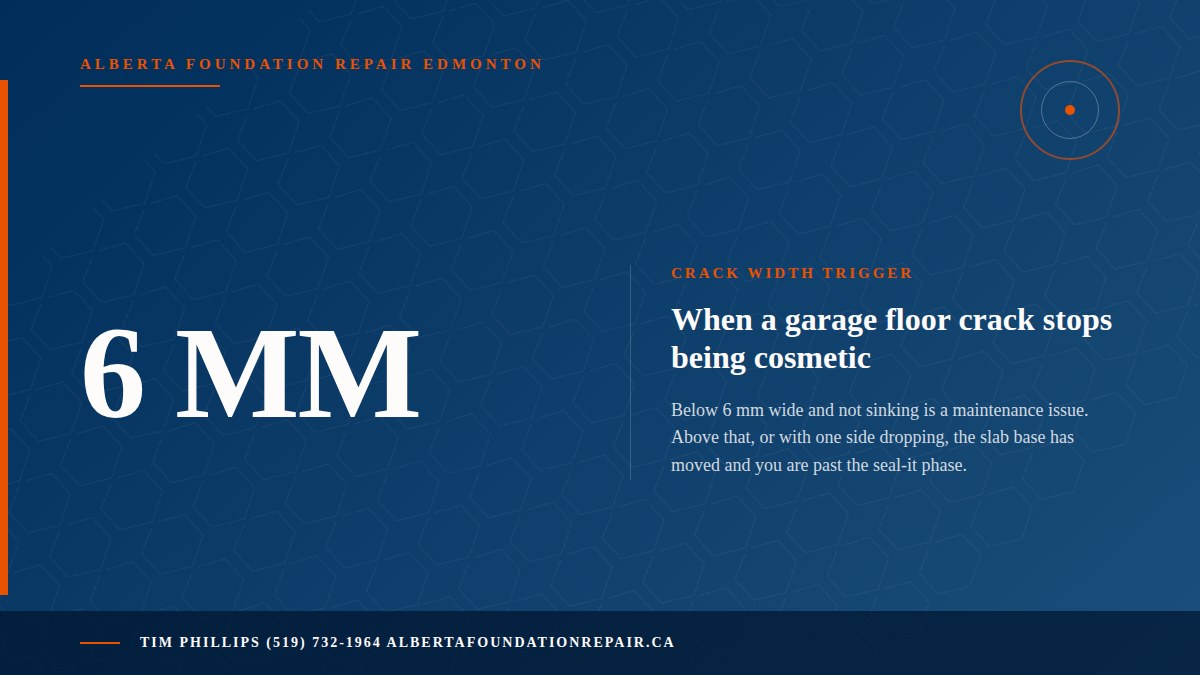
- Hairline crack, level, under 1 mm wide, no displacement: Cosmetic. Almost certainly curing shrinkage or minor early freeze-thaw. Both sides of the crack are at the same level. You can seal this yourself if you want to prevent water and salt infiltration.
- Crack wider than 3 mm, still level with no displacement: Monitor it. It is likely a working joint that has opened from seasonal movement, but no subgrade movement is indicated yet. Could seal it to prevent water entry. Check it each spring.
- Crack with vertical displacement (one side higher than the other): Active. This means the two slab sections on either side of the crack are at different elevations, indicating differential movement of the subgrade beneath them. One section has heaved or settled relative to the other. Surface sealing will not hold. The underlying movement needs to be addressed.
- Crack that is wider each spring than the previous year: Active and progressing. Ice wedging is widening it every winter. The gap is filling with water, freezing, and expanding repeatedly. Professional assessment is needed.
- Crack running to the wall, plus a visible gap at the wall-floor junction: The wall or footing below may be moving. This could be a perimeter problem, not just a slab problem. Tim inspects this junction on site to distinguish between slab movement and wall/footing movement.
- Crack at the garage door threshold, with a step or lip: The interior slab and exterior apron are separate pours moving independently. Polyjacking can restore the flush level between them. This is the most common polyjacking application in Edmonton garages.
Run your fingers along any crack you find. If you feel a lip, a ridge, or a step between the two sides, one section has moved vertically relative to the other. That is the indicator of active subgrade movement, not just concrete shrinkage.
Why Edmonton Garage Floors Crack: The Three Causes
Edmonton garage floors crack from three separate causes, and each requires a different response.
1. Curing shrinkage (cosmetic). All concrete shrinks by 0.04 to 0.08% of its length as water evaporates during curing. For a 6-metre garage, that is up to 4.8 mm of shrinkage at full cure. That movement produces hairline cracks, typically within the first few years after pour. These cracks are a normal byproduct of the chemistry of concrete curing. They do not indicate a structural problem. Control joints cut into the slab at pour are intended to direct these cracks to invisible locations, but if the joint spacing was too wide or the depth insufficient, cracks appear between joints rather than within them.
2. Frost heave (active). Edmonton’s unheated garage slabs sit on soil that experiences approximately 91 freeze-thaw cycles per year. Edmonton’s glacial till clay freezes to 2.4 metres depth by late February. As the soil beneath the slab freezes, it heaves upward. As it thaws, it settles. Each cycle is rarely perfectly uniform, meaning some sections of the slab move more than adjacent sections. The crack between them is the result of differential movement. Unlike curing shrinkage cracks, frost heave cracks often show vertical displacement and tend to grow wider each spring as ice wedging progressively opens the gap during winter. For more context on why Edmonton freeze-thaw produces this effect, see our guide on why Edmonton foundations crack in February.
3. Vehicle load settlement (active). A 2-tonne vehicle parked in the same spots daily compresses and consolidates the soil beneath those tire contact zones over years. Adjacent areas, not subject to the same load, remain at their original elevation or heave from frost. Differential movement between the loaded zone and the unloaded zone produces cracks at the transition. These cracks often appear roughly parallel to the long axis of the parked vehicle and are most visible in the centre of the garage bay.
Edmonton Clay Soil and Garage Floor Cracks
Edmonton sits on glacial till clay with a high smectite and montmorillonite fraction. This clay swells up to 20% by volume when saturated with water, and contracts when it dries in summer. The swell-shrink cycle beneath an unheated garage slab is the same mechanism that produces frost heave damage, but it also operates during summer drought events when the clay desiccates and shrinks, creating gaps beneath the slab edge. Water enters these gaps in autumn, saturating the clay before freeze-up. Maximum moisture at freeze-up means maximum frost heave in winter. The cycle repeats each year. Edmonton’s 91 average freeze-thaw cycles, combined with the seasonal wet-dry clay movement, make garage floors among the most frequently damaged elements of any Edmonton home. For the full picture on Edmonton soil behaviour, see our Edmonton clay soil guide.
When DIY Sealing Works (and When It Doesn’t)
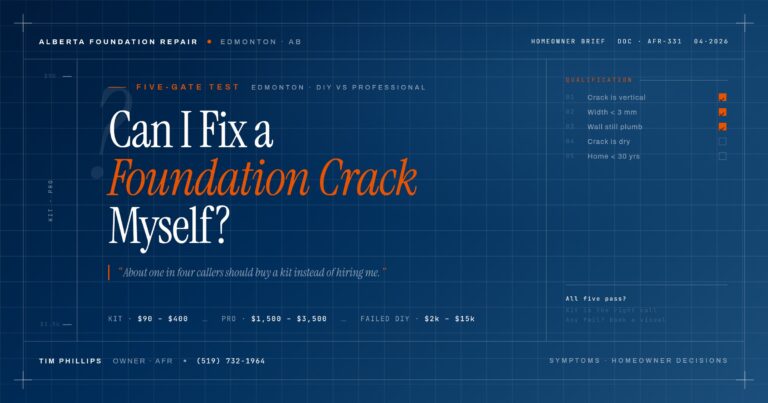
The same qualification logic applies to wall cracks, just with different thresholds. If you are weighing a DIY wall repair, read the five-gate DIY test for Edmonton foundations before buying anything.
Hardware-store concrete crack fillers work in a specific and limited scenario: a hairline crack under 1 mm wide, with no vertical displacement between the two sides, that has not grown since you first noticed it.
In that scenario, polyurethane crack filler (available at any building supply store) can be used to:
- Prevent water from infiltrating the crack during spring meltwater events
- Prevent road salt brine from entering the crack and accelerating concrete deterioration beneath the surface
- Prevent debris from filling the crack and preventing natural movement from opening it further
DIY sealing does not work for cracks with vertical displacement, cracks that are actively growing, or cracks associated with a heaved or tilted slab section. Applying flexible sealant to an active crack is like putting a bandage over a moving joint. The sealant tears on the next freeze-thaw cycle and the gap is now filled with a torn strip of sealant instead of open crack faces. It is harder to assess and harder to repair professionally after unsuccessful DIY attempts.
Why Rigid Crack Fillers Fail in Edmonton Garages
Rigid two-part epoxy fillers are sometimes marketed for garage floor crack repair. They bond the crack faces and restore compressive strength across the gap. This approach works for cracks in stable foundations where no further movement is expected. In Edmonton garages, where frost causes seasonal slab movement every year, a rigid epoxy fill will re-crack at the same location or adjacent to it within one winter cycle. The repair looks like it worked in October and is open again by April. If the slab is still moving, the repair material must either be flexible (polyurethane) or the underlying movement must be stopped first (polyjacking). Epoxy alone solves neither problem.
Professional Repair Options for Edmonton Garage Cracks
When DIY sealing is not the right answer, three professional repair methods address garage floor crack problems in Edmonton:
Polyurethane crack injection. A low-viscosity polyurethane is injected into the crack under controlled pressure using surface ports spaced along the crack. The material penetrates the full depth of the crack, bonds to both faces, and cures flexible. This flexibility is critical in Edmonton garages: the slab continues to experience small seasonal movements, and flexible polyurethane accommodates that movement without re-cracking the way epoxy would. Best for active cracks where slab sections are still level or nearly level (under 3 mm of vertical displacement).
Polyjacking to address the subgrade movement. When the crack is associated with a heaved or settled slab section, the crack cannot be sustainably sealed without first addressing the movement. Polyjacking injects expanding polyurethane foam beneath the slab through small drilled holes to fill voids, compact loose subgrade, and restore the slab to level. Once the slab sections are back at the same elevation and the subgrade is supported, crack injection or flexible sealant can then be applied to the repositioned crack faces. This two-step approach (polyjack first, seal second) produces durable results because it addresses the cause before sealing the symptom. Read more about this process in our full guide on garage foundation repair in Edmonton.
On-site inspection before any injection. Tim inspects every garage floor in person before recommending either crack injection or polyjacking. He reads the crack pattern, checks for vertical displacement, sounds the slab for hollow sections, and identifies whether a void has likely formed beneath the slab at the crack location. If a crack has a void beneath it, crack injection seals the surface but the unsupported slab section will flex and re-crack under vehicle loads. The inspection determines which repair is appropriate. The alternative is injecting blind and hoping the result holds. Learn more about how Tim diagnoses the cause at our Edmonton foundation repair guide.
Typical costs for professional garage floor crack repair in Edmonton:
| Repair Type | Best For | Typical Cost (Edmonton) |
|---|---|---|
| Flexible polyurethane crack sealant (DIY) | Cosmetic hairline cracks, no displacement | $20 to $80 materials |
| Professional polyurethane crack injection | Active cracks with minimal displacement, water infiltration | $150 to $500 per crack |
| Polyjacking (slab lifting + void fill) | Displaced cracks with subsurface voids or slab heave | $800 to $3,000 per garage |
| Polyjacking + crack injection combined | Heaved slab with active cracking and water entry | $1,200 to $3,500 per garage |
| Partial or full slab replacement | Severely deteriorated concrete; deep spalling; rebar corrosion throughout | $4,000 to $9,200+ |
Salt Damage: Edmonton’s Hidden Garage Floor Threat
Edmonton applies road salt heavily from November through March. Every vehicle parked in a garage deposits salt brine on the floor from its tires and undercarriage. On bare, uncoated concrete, this brine:
- Penetrates the porous concrete surface
- Reacts chemically with concrete (calcium chloride forming calcium oxychloride, which expands internally)
- Combines with freeze-thaw cycling to accelerate surface spalling and pitting
- Reaches reinforcing steel where present and initiates corrosion-driven concrete fracture
Salt damage appears as surface pitting, popouts, and the gradual exposure of aggregate. The surface feels rough and sandy rather than smooth. This is not the same as frost heave cracking, but in Edmonton garages it often occurs simultaneously. A heaved slab that is also salt-damaged requires both levelling and surface protection to be durable after repair.
After Repair: Protect the Slab Against Salt
Once a garage floor has been polyjacked and any cracks sealed, applying an epoxy or polyurea floor coating seals the concrete surface against brine infiltration. This extends the service life of the repair significantly in Edmonton’s winter vehicle environment. Penetrating concrete sealers (silane or siloxane-based) are a lower-cost alternative that reduce porosity without coating the surface. Either approach is far less expensive than another round of crack repair in three years from continued salt damage to unsealed concrete.
How to Monitor Cracks Between Inspections
Whether you have DIY-sealed a crack or are waiting for a professional assessment, monitoring gives you an objective record of what is happening.
For each crack you find:
- Mark the ends with pencil and write today’s date beside each mark
- Measure the width at the widest point and write it beside the crack (a coin, a toothpick, or a feeler gauge works)
- Check whether the two sides of the crack are at the same level by sliding your finger across
- Photograph the crack with a reference object (a ruler or a coin) for scale
- Repeat this check in October before winter, and again in April after spring thaw
Any crack that extends beyond your pencil marks, widens measurably, or develops vertical displacement between October and April is actively progressing. Bring that documented history to any professional assessment; it eliminates guesswork about whether the crack is historic or recent.
Tim Phillips, Alberta Foundation Repair: “The homeowners who come in with dated photos and written measurements are my favourite conversations. It takes me five minutes to understand what a crack has been doing for two years. Without that record, I am making educated guesses based on what I can see today. A crack that moved 3 mm in two springs tells a very different story than one that has been stable since 2018.”
Frequently Asked Questions
Are cracks in my Edmonton garage floor normal?
Hairline cracks from concrete curing shrinkage are common in any garage floor. In Edmonton, virtually every older garage has additional cracking from freeze-thaw movement because unheated garage slabs experience the full cycle of Edmonton’s approximately 91 annual freeze-thaw events. Hairline cracks under 1 mm wide that are level (no vertical displacement between the two sides) are typically cosmetic. Cracks that are displaced, wider than 3 mm, or growing each spring indicate active frost heave or soil movement and should be assessed professionally.
Can I fill garage floor cracks myself?
For hairline shrinkage cracks under 1 mm wide with no vertical displacement, a polyurethane concrete crack filler from a building supply store can stop water infiltration and salt entry on a cosmetic level. However, if the crack is wider, displaced, or associated with a heaved or tilted slab section, surface filling will not address the underlying cause. The crack will return, often wider, the next spring. Professional assessment determines whether the crack is cosmetic or the surface sign of active subgrade movement that needs polyjacking or void filling.
How do I know if my garage floor crack is getting worse?
Mark the ends of the crack with pencil and write the date. Check it each spring after the thaw. If the crack has extended beyond your marks or the vertical displacement between the two sides has increased, it is actively progressing. You can also measure the width at the widest point with a coin or ruler. A crack that is wider in April than it was in October has been widened by winter ice wedging and likely has water or voids beneath it.
What causes garage floor cracks specifically in Edmonton?
Edmonton garage floors crack primarily from three causes: initial curing shrinkage (normal, cosmetic), frost heave from Edmonton’s approximately 91 annual freeze-thaw cycles acting on an unheated slab with no thermal buffer, and differential settlement under repeated vehicle loads. Edmonton’s glacial till clay soil, which can swell 20 percent when wet and contract when dry, amplifies all three mechanisms. Most Edmonton garage slabs also have footings at only 1.2 metres depth in a city where frost penetrates to 2.4 metres, meaning the footings heave every winter and the slab moves with them.
How much does garage floor crack repair cost in Edmonton?
Surface crack sealing for cosmetic hairline cracks: $20 to $80 as a DIY project. Professional polyurethane injection for active cracks: $150 to $500 per crack. If the crack is associated with a heaved slab section needing polyjacking: $800 to $3,000 for the full garage depending on size and severity. Attempting to seal an active crack without addressing the underlying slab movement is a temporary fix that will cost more in repeat repairs than addressing the cause properly the first time.
Sources
- Edmonton Weather Nerdery. (2019). Freeze/Thaw Cycles: Part 1. Statistical analysis of Edmonton climate data 2000-2018. edmontonweathernerdery.blogspot.com
- National Research Council Canada. (1962). Building Digest CBD-26: Ground Freezing and Frost Heaving. NRC Institute for Research in Construction. web.mit.edu (NRC mirror)
- National Ready Mixed Concrete Association. (2007). CIP-42: Thermal Cracking of Concrete. NRMCA. nrmca.org
- City of Edmonton. (2023). Detached Garage Design Guide. Development and Building Inspections, City of Edmonton. edmonton.ca (PDF)
- American Concrete Institute. (2019). ACI 318-19: Building Code Requirements for Structural Concrete. Section 26.12, Control Joint Requirements. American Concrete Institute. concrete.org
- Canadian Geotechnical Society. (2023). Canadian Foundation Engineering Manual (CFEM), 5th Edition. Canadian Science Publishing. ISBN 978-0-920505-50-2. cdnsciencepub.com
Get Your Garage Floor Assessed in Edmonton
If you have a crack that is displaced, growing, or associated with a heaved slab section, the most useful next step is knowing what is driving it. Guessing the cause leads to repairs that do not hold. A free on-site inspection from Tim identifies the cause of the movement and tells you exactly what you are dealing with before any money is spent on repair.
Alberta Foundation Repair serves Edmonton and surrounding areas: (519) 732-1964
Tim inspects every garage in person before any repair recommendation. You know the cause before you commit to the solution.