Parging Repair Edmonton: Cost, Causes, and When to Replace
Parging is the grey cement coating homeowners see on the exposed top portion of their foundation wall, the strip between the siding and the ground. In Edmonton, parging does one of the hardest jobs in home exterior finishing. It has to look clean, protect the concrete or concrete block behind it, handle 91 freeze-thaw cycles a year, and survive direct exposure to the worst climate conditions Alberta can throw at it. Most Edmonton parging jobs last 10 to 15 years before they need significant repair. Poorly installed ones fail in three.
This guide covers what parging actually does, why Edmonton is especially hard on it, how to tell whether a repair or replacement makes sense, what both options actually cost, and why so many DIY parging jobs fail within two winters of application.
Failing parging often shows up alongside settling slabs and shifting concrete near the same foundation. If your repair list runs deeper than the wall coating, it is worth reading our complete guide to lifting and restoring settled concrete in Edmonton.
What Parging Is and What It Protects
Parging is a thin cement-based coating applied to the above-grade portion of a foundation wall. Most Edmonton homes have parging on the 100 to 300 millimetres of foundation that sits between ground level and the start of the siding, brick, or stone cladding. Its job is threefold:
- Waterproofing assistance: Parging adds a secondary barrier to water intrusion on the exposed foundation face, especially important where splashback from rain and melting snow hits the wall.
- Frost protection: A properly parged wall prevents water from sitting in the porous surface of concrete or concrete block, where it would otherwise freeze and spall the substrate over time.
- Aesthetic finish: The smooth grey coating hides the rough texture of poured concrete, the joints of concrete block, and small imperfections from the foundation pour.
Parging is not structural. It is a protective and cosmetic finish coat. When parging fails, the foundation wall underneath is usually still fine, at least at first. The problem is that failing parging stops protecting the wall, and then Edmonton’s climate starts damaging the concrete or block behind it directly. That is when a simple cosmetic fix turns into a structural repair.
Why Edmonton Parging Fails Faster Than Anywhere Else
Edmonton is the worst major city in Canada for parging. Environment Canada climate data puts Edmonton at 91 freeze-thaw cycles per year. Calgary has 105, but Edmonton stays below freezing for longer stretches, which means every freeze cycle goes deeper into the parging layer before the thaw begins. Water that penetrates hairline cracks freezes, expands by roughly 9 percent, and progressively breaks the bond between the parging and the substrate underneath.
- 91 freeze-thaw cycles per year: Every cycle drives water deeper into cracks and pores
- Deep winter temperatures: Edmonton hits -30 C or colder several times per winter, driving full-depth freezing of any moisture behind the parging
- Low humidity: Edmonton’s dry climate (average relative humidity 66 percent, 30 to 40 percent in winter) accelerates curing failure during application
- Clay soil movement: Foundation walls in Edmonton’s glacial till clay shift seasonally, cracking any rigid surface coating including parging
- Road salt splashback: Properties near busy streets get chloride exposure from winter traffic, which damages the cement matrix of parging over time
Beyond climate, four installation errors cause the majority of early parging failures in Edmonton:
- Inadequate surface preparation: Parging needs a clean, textured, damp substrate to bond. Applied over loose dust, old failing parging, or painted surfaces, the new coating has nothing to grip and will drum (separate from the wall) within a few freeze cycles.
- Wrong mortar mix: Type N mortar is too weak for exterior parging in Edmonton. Type S at minimum, with polymer additives preferred, is the standard. Many DIY parging jobs use a generic concrete patch mix that is not formulated for thin-section applications.
- Cold temperature application: Parging applied below 5 C does not hydrate properly. The cement matrix never reaches full strength, and the coating fails the first time water penetrates and freezes.
- No moist curing: Parging requires 72 hours of damp cure time in Edmonton’s dry summer air. If the surface dries out before the cement hydrates, the result is a chalky, weak coating that fails within a year.
Signs Your Parging Needs Repair
Parging rarely fails catastrophically. It degrades progressively, and most homeowners only notice it once large pieces are falling off or the underlying foundation is visible. The earlier signs are easier to miss but give you more repair options when caught in time.
| Stage | What You See | What It Means |
|---|---|---|
| Early | Hairline cracks, surface crazing, minor discolouration | Surface weathering. Still repairable with sealant or spot patch. |
| Progressing | Flaking, small chunks falling off, exposed fine aggregate | Freeze-thaw damage has penetrated. Spot repair is the minimum response. |
| Advanced | Drumming (hollow sound when tapped), visible separation from wall, large chunks missing | Bond failure. Large areas need removal and replacement, not patching. |
| Critical | Exposed concrete or block underneath, spalling substrate, efflorescence | Parging has failed completely. Underlying wall is now at risk. |
The drum test is the most useful DIY diagnostic. Tap the parging with a screwdriver handle or small rubber mallet. Solid, well-bonded parging produces a sharp, tight sound. Drummy or hollow sections produce a noticeably dull, low-pitched thud. These hollow sections have already lost their bond to the wall behind and will fail completely within one to two winters. You can walk the entire perimeter of a typical Edmonton home in 10 minutes and map every drummy section this way.
“People call us when the parging is already on the ground. But the time to catch it is when you hear that first hollow drum sound. Once water gets behind a drumming section, the next freeze cycle is what pops it off. If we catch it before that, we can chip out the failed area, re-bond the edges, and feather in new parging. Wait one more winter and we are redoing the whole wall.”
Tim Phillips, Alberta Foundation Repair
Spot Repair vs Full Replacement
The economics of parging work in a clear pattern. Spot repairs on otherwise-sound parging are cost-effective and can extend the life of the existing coating by 5 to 10 years. Spot repairs on failing parging are throwing money at a problem that will reappear within one or two winters, usually right next to the patch you just paid for.
If more than 30 percent of the parged surface area is drumming, cracked, or visibly damaged, full replacement is almost always the better economic decision. The prep work required to properly bond spot repairs to failing surrounding parging takes nearly as long as removing the whole thing, and the repair will fail where the new patch meets the old coating.
If less than 30 percent of the surface is damaged and the remaining parging passes the drum test, spot repair is the right call. Focus on the failed sections and leave the bonded sections alone.
The other factor that pushes toward full replacement is the condition of the substrate underneath. If you chip away a failed parging section and find spalling concrete or crumbling block, the parging is no longer the main problem. The foundation wall itself needs attention before any new parging goes on. This is where an on-site inspection is valuable. Tim inspects the wall, identifies why moisture is getting behind the parging, and reads how deep the damage goes before any repair starts.
For more on getting the cause diagnosed before starting repairs, see our Edmonton foundation repair services.
Parging Repair Cost Edmonton
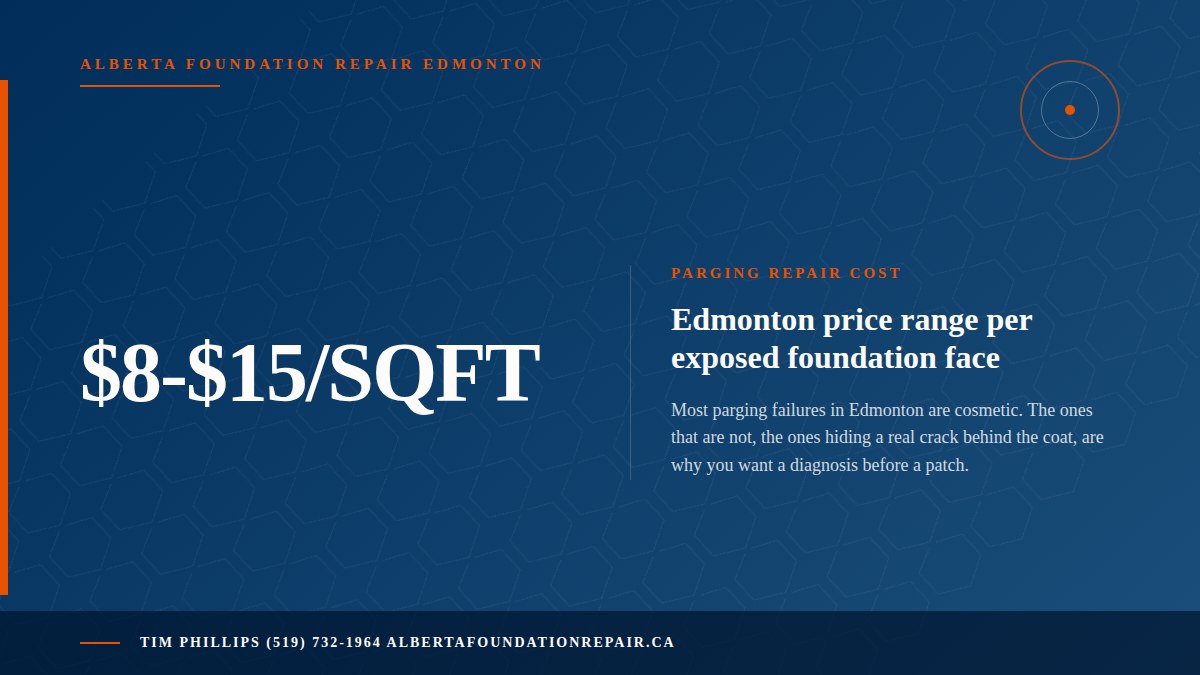
Parging repair pricing in Edmonton ranges from spot patches to full foundation wraps. Market rate for professional parging work in the Edmonton metro is $5 to $10 per square foot for standard residential applications, with polymer-modified systems and ICF foundations on the higher end. Here are realistic 2026 price ranges:
| Scope | Typical Cost | What You Get |
|---|---|---|
| Small spot patch (under 2 sq ft) | $150 to $300 | Chip out failed area, prep, apply new parging, feather into existing |
| Medium spot repair (2 to 10 sq ft) | $300 to $700 | Multi-patch work, colour-matched blending, edge bonding |
| Section replacement (10 to 40 sq ft) | $800 to $2,000 | Full removal and replacement of one wall section |
| Full foundation parging (standard bungalow, 150 to 400 sq ft) | $1,800 to $5,000 | Complete removal, substrate prep, new parging application, cure and protect |
| Polymer-modified upgrade | Add 20 to 30% | Longer-lasting flexible parging that handles Edmonton freeze-thaw better |
| Substrate repair (if concrete/block is damaged) | $300 to $1,500+ | Wall repair before new parging can be applied |
Pricing assumes Edmonton metro area, standard access, and application between May and September. Winter storage and emergency work add costs.
Three factors swing pricing the most. First, access matters. Parging behind landscaping, decks, or close to neighbouring fences takes longer and costs more. Second, substrate condition matters. A sound wall that just needs a fresh parging coat costs much less than one where the concrete is spalling and needs repair first. Third, material choice matters. Polymer-modified parging costs more up front but saves you from redoing the job in eight years instead of 15.
Parging Materials: Traditional vs Polymer-Modified
There are two main material categories used for parging in Edmonton. Traditional cement parging is a portland cement, sand, and lime mix, sometimes called a Type S or Type N mortar. It is the historical standard and still used on many residential projects because it is inexpensive. The problem is that traditional parging is rigid. It does not flex with temperature changes, and Edmonton’s extreme temperature swings from -35 C winter lows to +30 C summer highs produce thermal stresses that crack rigid parging over time.
Polymer-modified parging adds acrylic, styrene-butadiene rubber (SBR), or similar polymer additives to the mortar mix. The polymers produce a coating that is:
- More flexible: Can absorb small amounts of thermal movement without cracking
- Better bonded: Higher adhesion to both concrete and concrete block substrates
- Less permeable: Reduced water absorption, which means less freeze damage inside the coating
- Higher impact resistance: Survives lawnmower contact, ice chipping, and minor mechanical damage
- Better adhesion in dry conditions: Less sensitive to Edmonton’s low ambient humidity during cure
Polymer-modified parging typically costs 20 to 30 percent more than traditional mortar but lasts 50 to 100 percent longer in Edmonton conditions. For most homeowners, the total cost of ownership is lower.
There are also pre-bagged parging mixes designed specifically for this application. Products like Target PM-210, King Parge Coat, and Sika MonoTop are formulated with polymer additives, fine aggregates, and workability enhancers that make them significantly more reliable than field-mixed Type S. Most professional parging contractors in Edmonton use these pre-bagged mixes.
ICF Foundation Parging
Insulated Concrete Form (ICF) foundations are increasingly common in newer Edmonton homes and need a different parging approach than poured concrete or block foundations. The exterior insulation layer on ICF walls does not accept direct parging the way bare concrete does. Proper ICF parging requires mechanical mesh anchoring through the insulation into the concrete core, followed by a fibre-reinforced base coat before the finish parging layer. Skipping the mesh step produces parging that drums and separates within one to two winters.
ICF parging typically costs 20 to 40 percent more than standard foundation parging because of the extra mesh anchoring and base coat work. For Edmonton homeowners with ICF foundations, using a contractor familiar with ICF-specific methods is critical. Standard parging crews without ICF experience often apply parging directly to the insulation, which fails fast.
The Parging Repair Process
Professional parging repair follows a consistent sequence whether the job is a small spot patch or a complete wall replacement. Understanding the steps helps you evaluate whether a contractor is doing the work properly and why DIY attempts so often fail.
- Inspection and drum testing: Map the existing parging, identify all drummy and damaged sections, and assess substrate condition. This determines whether the job is spot repair or replacement.
- Removal of failed parging: Chip or scrape away all loose, drumming, cracked, or damaged parging. Feather the edges where new parging will meet existing material so the transition is not a hard seam that will crack.
- Substrate repair (if needed): Address any spalling concrete, damaged block, or cracks in the underlying wall. New parging cannot hide or stabilize a damaged substrate.
- Surface preparation: Pressure wash the substrate to remove dust, dirt, old paint, efflorescence, and any loose material. The surface must be clean and slightly textured for good bond.
- Pre-wetting: Dampen the substrate 30 to 60 minutes before parging application. A saturated surface-dry condition is ideal. A completely dry substrate absorbs water from the parging mix too fast and prevents proper cement hydration.
- Bonding coat (optional): Some professional installers apply a thin scratch coat of polymer-modified slurry to the substrate as an adhesive bridge between the old surface and new parging.
- Parging application: Trowel the parging onto the wall in one or two coats depending on thickness needed. Typical application is 10 to 15 millimetres. Too thick risks sagging and cracking during cure; too thin risks insufficient protection.
- Finishing: Strike off the surface for the desired texture. Most Edmonton homes use a float finish or broom finish, which hides minor imperfections and resists small-scale damage better than smooth steel-troweled surfaces.
- Moist curing: Mist the parging with water periodically for 48 to 72 hours after application. In Edmonton’s dry summer air, wrap the parged section in plastic sheeting or use damp burlap to hold moisture against the surface for proper cement hydration.
- Cure and protect: Full cure takes 7 to 14 days depending on temperature and humidity. Avoid direct rain during the first 24 hours and protect from foot traffic or mechanical damage until fully cured.
Skip any of these steps and parging lifespan drops significantly. Cold temperature application and inadequate moist curing are the two most commonly skipped steps, and they are the two most likely to destroy an otherwise-good parging job within its first winter.
When to Repair Parging in Edmonton
Parging has a narrow workable window in Edmonton. Material specifications typically require air and substrate temperatures above 5 C during application and for 24 to 48 hours after. For reliable Edmonton work, that translates to late May through mid-September.
Do not apply parging when:
- Air temperature is below 5 C at application or forecast to drop below 5 C within 24 hours
- Substrate temperature is below 5 C (measure with an infrared thermometer on a shaded wall)
- Direct summer sun is heating the substrate above 35 C (causes rapid dry-out and curing failure)
- Rain is forecast within 24 hours (washes uncured parging off the wall)
- Sustained wind is above 30 km/h (accelerates surface dry-out below proper cure moisture)
Cold temperature parging applied in October or November because “it seems warm enough” is the single most common reason for first-winter failure.
The other seasonal consideration in Edmonton is that spring parging (May and early June) sometimes runs into overnight frost risk. Check the 7-day forecast and avoid applications when overnight lows are forecast below 5 C within 48 hours of the job. Mid-summer through early September is the safest window in Edmonton for reliable curing conditions.
The seasonal crack-risk calendar for Edmonton foundations is covered in detail in Why Edmonton Foundations Crack in February. The same freeze-thaw mechanisms that drive foundation cracking also drive parging failure.
DIY Parging: What Works and What Fails
Homeowners routinely ask whether parging is a DIY job. The honest answer depends on scope and expectations.
- Small spot repairs under 2 square feet: A single patch on sound surrounding parging, applied with a pre-bagged polymer-modified product following label instructions, is a reasonable weekend project.
- Cosmetic touch-ups: Filling visible hairline cracks with polymer-modified crack filler or sealant. This is maintenance, not structural repair.
- Clean-up of fallen parging edges: Trimming loose edges and applying a protective sealant coat to exposed substrate until a proper repair can be scheduled.
- Full foundation parging: The surface prep, mix ratios, application thickness, and moist curing over 72 hours are difficult to execute correctly without experience. Most DIY full-wall jobs show visible failure within one to two winters.
- Over-existing failing parging: Applying new parging on top of drumming or cracked existing parging just extends the bond failure to the new layer.
- Painted foundation walls: Parging will not bond properly to paint. The paint must be removed completely before any parging work begins, which is significantly more involved than it sounds.
- Cold-weather applications: Applying parging in October or April to “beat the winter” is the single most common DIY failure mode in Edmonton.
If you are comfortable with masonry work, have a warm dry week in July or August, and stick to a single manageable patch, DIY spot repair is genuinely doable. If you are attempting a full perimeter parging job as your first masonry project, expect to redo the work within two to three years.
Frequently Asked Questions
How much does parging repair cost in Edmonton?
Spot repairs typically cost $150 to $600 for small damaged areas. Full parging replacement on an average Edmonton bungalow runs $3 to $8 per square foot, or roughly $1,500 to $4,500 for a complete foundation wrap. Polymer-modified parging adds roughly 20 to 30 percent to material cost but lasts significantly longer in Edmonton’s freeze-thaw cycles.
Why does Edmonton parging crack and fall off?
Edmonton endures 91 freeze-thaw cycles per year, among the highest in Canada. Water penetrates hairline cracks, freezes, expands 9 percent by volume, and breaks the parging bond from the substrate. Poor surface preparation, incorrect mortar mix, application in cold temperatures, and inadequate curing are the four most common installation failures that accelerate this damage.
Can I DIY parging repair in Edmonton?
Small spot repairs (under 2 square feet) are reasonable DIY projects if air and substrate temperatures are above 10 C and you use a polymer-modified parging mix. Full foundation parging is rarely a successful DIY project because surface preparation, proper mix ratios, application thickness, and moist curing over 72 hours are difficult to execute correctly in Edmonton’s dry climate.
When should parging be replaced instead of patched?
Replace parging entirely when more than 30 percent of the surface is damaged, when drum-sounding areas cover large sections, when the underlying concrete or block is spalling, or when freeze-thaw damage has reached the substrate. Spot repair on a failing parging system is money spent on a problem that will return within one to two winters.
What is the best time of year to repair parging in Edmonton?
Late May through early September is the only reliable parging window in Edmonton. Air and substrate temperatures must stay above 5 C during application and for 48 hours after. Sub-zero overnight temperatures damage curing parging before it reaches adequate strength. Avoid late fall applications even when daytime temperatures seem warm enough.
Does parging protect against water infiltration?
Parging provides secondary protection against splashback and surface water on the exposed portion of a foundation wall. It is not a primary waterproofing system. Below-grade waterproofing depends on membrane systems, weeping tile, and proper drainage, not parging. Parging is a protective finish coat above grade, nothing more.
- Environment Canada, Canadian Climate Normals 1991-2020, Edmonton International Airport Station. Freeze-thaw cycle data.
- Portland Cement Association, Troubleshooting Concrete Surface Problems. PCA Engineering Bulletin EB112.
- Canadian Standards Association, CSA A179: Mortar and Grout for Unit Masonry. CSA Group, Mississauga.
- National Research Council of Canada, Building Science Insight: Moisture Damage to Masonry Walls. NRC Construction.
- Alberta Masonry Council, Residential Parging and Stucco Best Practices. Edmonton.
If your parging is flaking, cracking, or drumming when you tap it, the clock is already running. Every freeze-thaw cycle takes more material off and pushes moisture deeper into the wall behind. Early repair is dramatically cheaper than waiting until the substrate is damaged.
Tim Phillips and Alberta Foundation Repair handle parging inspection, repair, and full replacement across Edmonton, St. Albert, Sherwood Park, Spruce Grove, Leduc, and Beaumont. We drum-test the entire perimeter, identify failed sections, check substrate condition, and quote honest options, not oversell you on a full replacement when a spot repair will do.