When Is a Foundation Crack an Emergency in Edmonton?
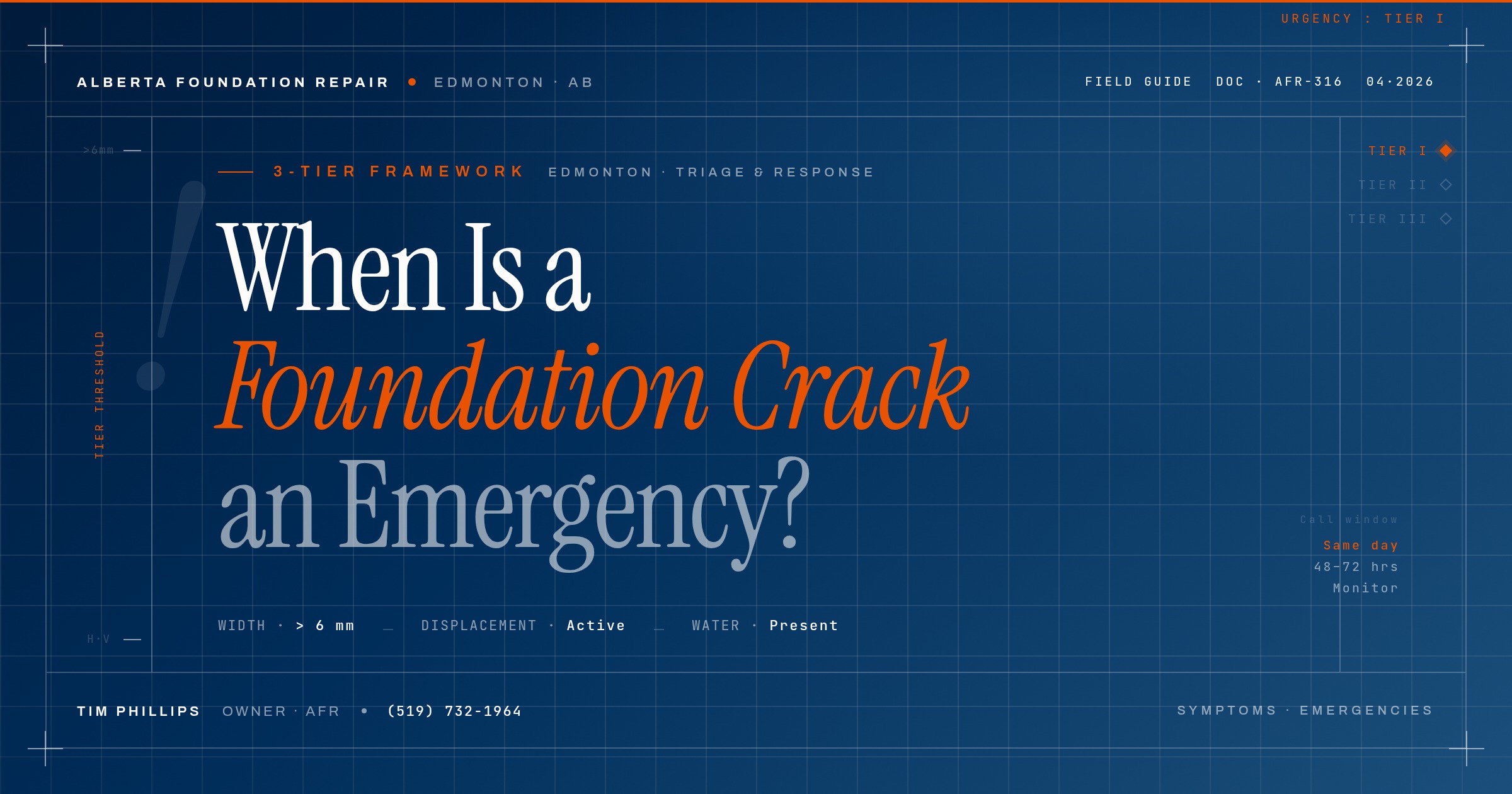
Quick Answer: A foundation crack becomes an emergency when it is wider than 6 mm, horizontal, actively leaking, or showing displacement between the two sides. Call the same day for a horizontal crack, a bowing wall, or active water entry. Most hairline vertical cracks under 3 mm are not emergencies but should still be monitored before the next Edmonton freeze-thaw cycle.
In This Guide
Reading time: 10 minutes
You found a crack. Maybe you found it this morning and it looks fresh. Maybe you have been staring at it for months and it finally widened. Either way, the question is the same: is this the kind of problem that can wait until payday, or is this the kind that needs a phone call before dinner.
The honest answer is that most Edmonton foundation cracks are not emergencies. But some are. Knowing the difference saves you either a panic-priced weekend callout or a flooded basement the next time it rains. This guide gives you the exact framework Tim uses on every site visit to sort the crack in front of you into one of three buckets: call today, call this week, or document and monitor.
Not every crack is an emergency, but telling the urgent ones apart is exactly what saves a basement. Our guide to telling a harmless crack from a dangerous one in Edmonton shows where a true emergency sits among all the cracking you might find, so start there before you panic.
The 3-Tier Emergency Framework
Every crack Tim looks at gets placed in one of three categories. The category decides everything else: the urgency of the call, the cost of the response, and whether Tim needs to be on site tonight or this week to read the cause.
Tier 1: Call Today
- Horizontal crack running across the foundation wall. Almost always indicates hydrostatic soil pressure pushing the wall inward. Risk of wall failure.
- Crack wider than 6 mm (1/4 inch) with any visible displacement between the two sides.
- Active water entry during rain or snow melt that was not happening last season.
- Visible wall bowing or tilting, even without a crack yet.
- Crack running through a load-bearing column, beam support, or stair step in the foundation.
Tier 2: Call This Week (Within 48 to 72 Hours)
- Crack that widened noticeably in the last season (measurable difference from a past photo).
- Step crack (diagonal through block mortar joints) in a concrete block foundation with minor displacement.
- Crack in a newly purchased home that was not disclosed in the inspection.
- Multiple hairline cracks appearing together in a pattern that was not there before.
- Doors or windows that suddenly stick combined with any visible wall crack.
Tier 3: Document and Monitor
- Single hairline vertical crack under 3 mm with no water entry and no displacement.
- Shrinkage crack in a home less than ten years old that has been stable.
- Old crack that has been there for years with no change, no leak, no offset.
- Fine surface spider cracks in parging that do not extend into the structural wall.
Why These Three Tiers Matter in Edmonton Specifically
Edmonton foundations sit on 65% glacial till with a plasticity index as high as 44%. That clay swells and contracts through every freeze-thaw cycle, exerting stress competitors in milder climates never see. A crack that would be Tier 3 in Victoria is often Tier 2 here because our soil keeps working on the same weakness. Edmonton homeowners cannot safely assume “it has not moved in years” without also checking “has the last two winters been unusually wet or unusually cold.”
Seven Signs a Foundation Crack Is an Emergency
If any one of these seven signs is present, move the repair conversation to the top of your week. Stack two or more together and treat it as a same-day call.
The Emergency Signal List
- Width over 6 mm (1/4 inch): The width threshold where national engineering sources consistently flag structural risk. Measure with a ruler, not by eye.
- Horizontal orientation: Horizontal cracks indicate soil pressure or hydrostatic force pushing the wall. They rarely appear without a reason and rarely stop on their own.
- Visible displacement between the two sides: One side of the crack is higher, lower, or offset from the other. This is active shearing, not cosmetic cracking.
- Active water leak through the crack: Even a slow drip during heavy rain indicates the crack is not just sealed against the interior. Water is a second-stage symptom, not a starting point.
- Rapid growth over weeks or months: Any crack that measurably widened since your last measurement is active. Stable cracks are manageable; active cracks are not.
- Multiple cracks appearing together: One vertical crack is often shrinkage. Three cracks forming a pattern on the same wall is typically differential settlement or heave.
- Wall bowing or inward deflection: If you can see or feel the wall is no longer plumb, the crack is secondary to a larger structural problem. Emergency.
Tim Phillips, Alberta Foundation Repair: “The question I ask homeowners first is not how wide the crack is. It is whether they can feel the wall is no longer straight. A 2 mm vertical crack on a plumb wall is almost never an emergency. A 2 mm crack on a wall that has moved inward 15 mm at the top is a different conversation entirely. Always check the wall, not just the crack.”
Cracks That Are Usually Not Emergencies
A non-emergency crack is not automatically a DIY job either. Tier 3 candidates still have to pass the five-gate qualification before a kit is the right call.
Not every crack needs a callout. Misreading a routine crack as an emergency costs homeowners thousands of dollars in unnecessary repairs every year in Edmonton. These patterns are usually routine and safely handled at a planned repair appointment.
Typically Non-Emergency Patterns
- Single vertical shrinkage cracks: Common in homes 1 to 10 years old as concrete finishes curing. Narrow, stable, dry.
- Fine diagonal cracks near window or door openings: Stress concentrations at corners, usually cosmetic if the wall is plumb.
- Hairline cracks in parging or stucco: The exterior coating cracks before the structural wall. Ugly but not dangerous.
- Older cracks with dried efflorescence but no fresh water: The crack leaked once, years ago, and has since stabilized. Document and keep watching.
- Small settlement cracks in slab-on-grade floors: Garage floors and basement slabs crack at control joints by design.
For a deeper look at which cracks indicate what, our Edmonton crack type guide walks through every pattern Tim sees in the field, with photos of the differences between shrinkage, settlement, and structural cracks.
Why Edmonton Seasonality Matters
For homeowners seeing several symptoms beyond the crack itself, the broader twelve-symptom repair diagnostic covers the full pattern of what Edmonton foundations signal across an entire house.
The same crack is not equally urgent in every month of the year. Edmonton foundations follow a predictable damage calendar, and the tier your crack belongs to can shift with the season.
Edmonton Crack Urgency Calendar
December to February: Frost heave is at maximum. Active cracking during this window is almost always Tier 1 or Tier 2. Frozen soil exerts up to 50,000 kPa of pressure, and water expands 9% when frozen. See our guide on why foundations crack in February.
March to May: Spring thaw. Rapid soil contraction exposes settlement that winter hid. Cracks that looked fine in January can appear suddenly in April. Treat new April cracks as Tier 2 until proven stable.
June to August: Summer drought shrinks clay. Gaps open below and alongside footings. Most vertical shrinkage cracking happens here. Usually Tier 3 unless paired with other symptoms.
September to October: Clay re-absorbs moisture before winter. Watch for water entry through cracks that were dry in summer.
November: Pre-freeze window. Any crack you plan to repair should be booked before the ground freezes to avoid winter surcharges and frozen-soil excavation.
What to Do in the First 24 Hours
Before you call anyone, spend fifteen minutes collecting the information a professional will need. This speeds up the phone triage and often saves a site visit fee because the photos and measurements alone can confirm whether the crack is Tier 1, 2, or 3.
The 15-Minute Emergency Documentation Kit
- Photograph the full wall: Step back and capture the crack in context. Include the floor and ceiling for scale.
- Close-up with coin reference: Place a Canadian dime beside the crack for scale (a dime is 18 mm across). Photograph.
- Measure the width: Use a ruler or crack gauge. Note the widest point.
- Mark the ends: Pencil marks at each end of the crack, dated. This tells you next month whether it has grown.
- Check the exterior side of the same wall: Cracks often show on both sides. Photograph.
- Check for water evidence: Damp drywall, efflorescence (white crystal deposits), mineral staining, or active drips.
- Check the wall plumb: Hold a level or a long straight edge against the wall. Any visible gap at top or bottom means the wall is bowed.
When to Stop Using the Basement
If the wall is visibly bowing, if you can see daylight through the crack, if water is actively flowing, or if you hear cracking sounds from the foundation, treat the lowest level of the home as unsafe until a professional has assessed it. These conditions are rare but they do occur in Edmonton after severe weather events. Err on the side of evacuation.
What Happens at an Emergency Inspection
A Tier 1 call gets a same-day or next-morning response in Edmonton. Here is what Tim does on arrival so you know what you are paying for and what the deliverable is.
The Emergency Inspection Sequence
- Free visual inspection: Walk the foundation, inside and out. Check wall plumb, crack width and depth, drainage, grading, and recent weather exposure.
- Identify the cause on site: Tim inspects the affected wall inside and out, checks plumb, drainage, grading, and recent weather, and reads why the foundation is moving. Edmonton clay heave, settlement, frost, or water all leave different signatures, and the cause decides the fix.
- Classify the repair: Tim places the repair in one of three scopes: contractor-handled (injection, levelling), engineer-required (underpinning, wall anchors), or engineer-recommended (borderline structural).
- Emergency temporary measures: If the wall needs bracing before the permanent repair is planned, Tim installs temporary supports the same day.
- Written assessment and quote: Before leaving, you have a written scope, a price range, and a timeline.
For the full inspection walkthrough and what Tim checks room by room, our Edmonton foundation inspection guide covers the complete checklist. If the scope requires engineer involvement, our structural engineer guide explains exactly what APEGA requires and what it costs.
Frequently Asked Questions
How wide is too wide for a foundation crack?
The industry-standard structural threshold is 6 mm (1/4 inch). Cracks under 3 mm (1/8 inch) are typically hairline and cosmetic if stable. Cracks between 3 mm and 6 mm are borderline and should be monitored with marked ends and dated measurements. Anything over 6 mm with displacement is an emergency.
Can I wait until spring to repair a foundation crack in Edmonton?
It depends on the tier. Tier 3 hairline cracks can wait. Tier 1 cracks cannot, because frozen soil in winter exerts up to 50,000 kPa of pressure on the wall and an already-stressed crack can fail catastrophically. If water is currently entering the basement through the crack, waiting until spring is never the right answer because the problem will worsen through every freeze-thaw cycle.
Is a diagonal crack from a window corner an emergency?
Usually not on its own. Diagonal cracks at window and door corners are stress-concentration cracks and are often cosmetic if the wall is still plumb and there is no displacement. They become Tier 2 when they widen measurably across a season, extend into the adjacent wall sections, or appear alongside sticking doors or sloping floors.
Why does my foundation crack only leak in spring?
Spring thaw and rain saturate the soil around the foundation at the same time the ground is releasing the winter frost load. Water finds every path through the wall, including cracks that are dry the rest of the year. A seasonal leak indicates the exterior waterproofing has failed or the drainage around the home is not moving water away. Our guide on water leaking through a foundation crack in Edmonton covers next steps.
Should I stay out of the basement if a crack is growing?
Only if the wall is bowing, if you can see daylight through the crack, or if water is actively flowing. A slowly widening hairline crack on a plumb wall is not a life safety concern, just a repair priority. A wall visibly out of plumb by more than 25 mm is. When in doubt, move belongings away from the affected wall and call for a same-day inspection.
Sources
- National Research Council Canada (2023). National Building Code of Canada 2023, Alberta Edition, Part 9: Houses and Small Buildings. BILD Alberta. Link
- Alberta Geological Survey. Surficial Geology of the Edmonton District, Earth Sciences Report ESR 1962-06. Link
- National Research Council Canada. Canadian Building Digest: Frost Action and Foundations. Link
- US Army Corps of Engineers (1983). TM 5-818-7: Foundations in Expansive Soils. Whole Building Design Guide. Link
- American Concrete Institute. ACI RAP-1: Structural Crack Repair by Epoxy Injection. Link
- British Geological Survey. Shrink-Swell Soils (Jones), Geological Society Engineering Geology Special Publication. Link
Get Your Foundation Inspected in Edmonton
If what you are looking at on the wall feels like Tier 1 or Tier 2, do not wait. A same-day visual inspection is free and tells you within fifteen minutes whether you are dealing with an emergency or a documented monitor-and-wait situation.
Alberta Foundation Repair, Edmonton and surrounding areas, (519) 732-1964.
Tim inspects every structural job on site and identifies the cause before quoting. That means you know exactly why the foundation is moving before anyone drills a hole or writes an emergency report.