Foundation Repair Warranty Edmonton: What Is Actually Covered
Quick Answer: Edmonton foundation repair warranties range from 1-year workmanship to “lifetime transferable” promises, but the fine print differs dramatically. A warranty is only as strong as its exclusions, its transferability clauses, and the company’s likelihood of being around when you claim. Ask specifically about earth-movement exclusions, re-crack coverage, and what “transferable” means legally.
A warranty only means something when it stands behind a properly done Edmonton foundation repair, so it is worth knowing how the work itself is meant to be carried out. With that groundwork in mind, here is what the coverage on your repair should actually promise.
Seven Red Flags in Edmonton Foundation Warranties
Before the positive framework, here is what to scan any warranty document for first. These phrases are not always dealbreakers, but each one changes what you are actually buying. If you see three or more of these in a quote, get the warranty reviewed by someone who is not the contractor selling it to you.
- “Excludes damage caused by earth movement, soil settlement, frost heave, or expansive clay.” This exclusion voids the warranty on the exact conditions most Edmonton foundation repairs address. Technically it leaves only construction defects covered, which is not what homeowners think they are buying.
- “Transferable one time only to the next owner.” Sounds transferable. Is not, practically. If you sell and the buyer sells again, the warranty dies. A warranty that survives exactly one ownership transfer is a one-transfer warranty, not a lifetime transferable one.
- “Warranty valid while company remains in business.” This clause makes the warranty worthless if the contractor closes, rebrands, or sells. Foundation repair has a high business turnover rate. A warranty tied to corporate existence is not a warranty.
- “Re-cracks covered if they occur along the same fracture line.” Almost no re-crack occurs along the exact original fracture line; new cracks form parallel or adjacent to the old injection. This exclusion sounds protective but covers almost nothing in practice.
- “Lifetime” without defining whose lifetime. Lifetime of the homeowner? The house? The company? Legally vague “lifetime” language is often interpreted in court as the company’s lifetime, which takes us back to red flag 3.
- “Covered only if annual inspection is performed by our company at homeowner’s expense.” Mandatory paid maintenance requirements turn a warranty into a subscription. The annual fee often exceeds the cost of the original repair over a decade.
- “Does not cover consequential damage, interior finishes, or personal property.” If the repair fails and water ruins the basement, the warranty pays to fix the foundation crack but not the drywall, flooring, or belongings. Standard but worth knowing, because most homeowners think of warranty as “they cover what goes wrong,” not “they cover one narrow thing.”
The Three Warranty Types You Will Be Offered in Edmonton
Not every warranty is the same thing with different marketing. There are three structurally distinct categories, and contractors use the words interchangeably even though they are not.
1. Workmanship Warranty (usually 1 to 5 years)
Covers errors in the work itself. If the injection did not cure correctly, if the port spacing was wrong, if the contractor left the job unfinished, workmanship warranty pays to redo the work. Does not cover failures caused by the soil, climate, or homeowner action. Baseline warranty. Every legitimate contractor should offer at least this.
2. Materials Warranty (usually manufacturer-backed, 10 to 25 years)
Covers failure of the polyurethane, epoxy, waterproofing membrane, or helical pile itself. Backed by the manufacturer, not the contractor. A Sika or Emecole materials warranty continues even if the contractor disappears because the claim goes to the manufacturer. This is the warranty with the longest real lifespan in most cases.
3. Performance Warranty (often marketed as “lifetime” or “transferable”)
Covers the outcome, not the work or the materials. Promises the crack will not re-leak, the wall will not move, or water will not enter. This is the most valuable warranty if honoured and the most commonly hedged with fine-print exclusions. Every “lifetime transferable warranty” claim in Edmonton is a performance warranty; the question is always what the exclusions remove from its scope.
Five Questions to Ask Before Signing Any Warranty
These questions produce answers that either confirm the warranty is real or reveal which category of fine print applies.
The Warranty Interrogation List
- “Show me the exclusions section of the written warranty before I sign.” Legitimate warranties have written exclusions. If the contractor can only describe them verbally, there is no warranty contract to enforce.
- “If the foundation re-cracks within five years for any reason, what happens?” Listen for whether the answer is “we fix it” or “we evaluate the cause first.” Cause-evaluation language often means the warranty excludes soil-related re-cracks, which is most re-cracks in Edmonton.
- “If I sell the house in seven years, what does the new owner need to do to claim?” A transferable warranty should not require a transfer fee, a new inspection, or any action by the current homeowner. Tim has seen clauses that require a paid $300 inspection before each transfer.
- “What is your company’s incorporation date and who owns it?” Foundation repair has significant turnover. A warranty backed by a three-year-old numbered company is structurally weaker than one backed by a 25-year-old firm with an owner who lives in Edmonton.
- “Does the warranty cover the failure of the waterproofing, the injection, or both?” These are separate systems. A “foundation repair warranty” that covers only the crack injection leaves the exterior waterproofing uncovered, which is where most real failures start.
What Tim’s Warranty Actually Covers
AFR’s warranty is not the flashiest in the market. It does not say “lifetime transferable” because Tim is not willing to make a promise he cannot guarantee twenty-five years from now. Here is what the written contract actually says.
AFR Warranty Structure
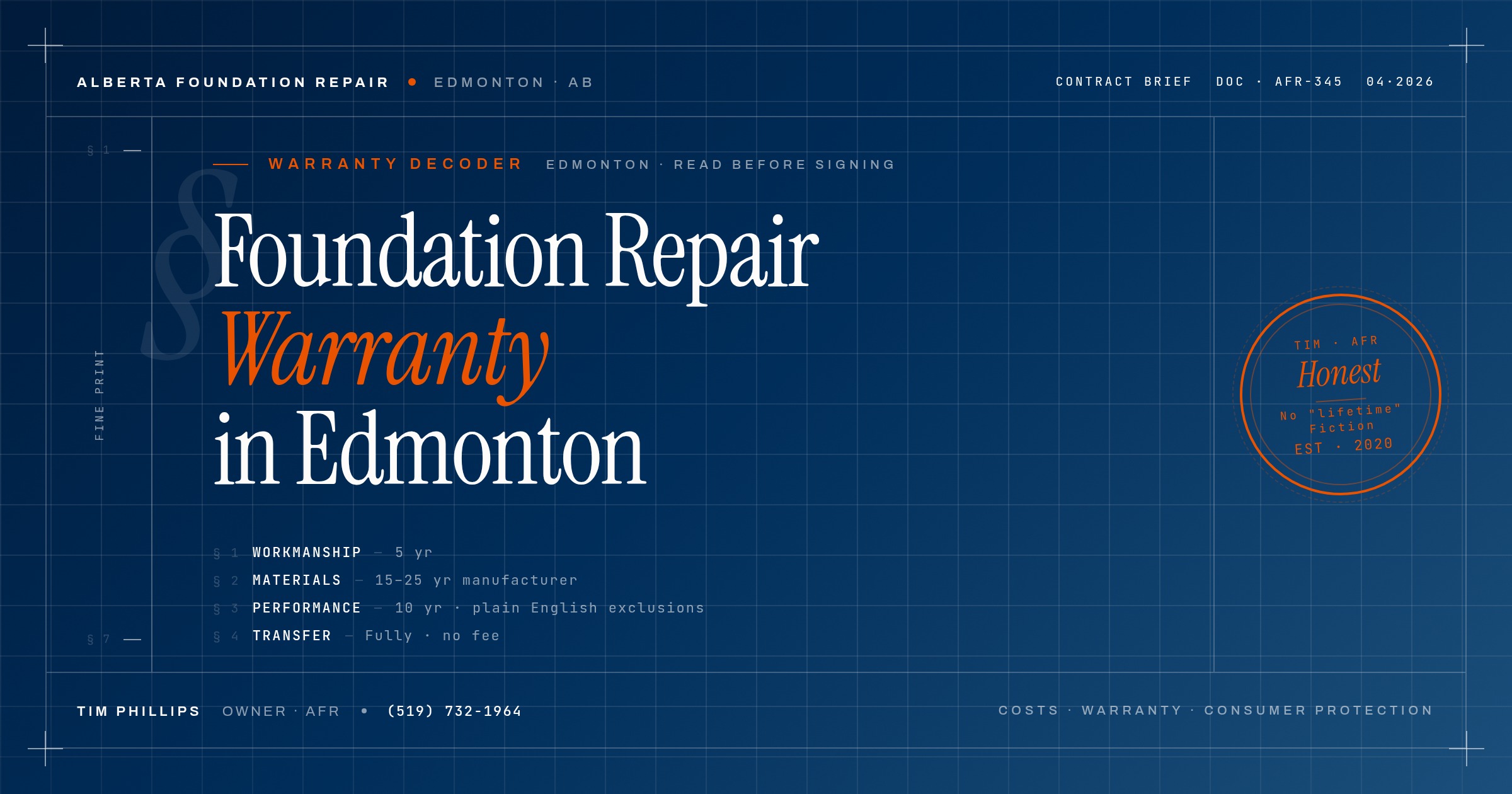
- Workmanship: 5-year warranty on the specific work Tim performs. If the injection fails because of how it was installed, Tim returns and re-does it at no charge.
- Materials: Manufacturer warranty passed through (typically 15 to 25 years on Sika and Emecole polyurethane, separately on any waterproofing membranes installed).
- Performance: Written 10-year warranty that the specific crack repaired will not re-leak, with exclusions that are stated in plain English on the contract (not in fine print). Exclusions are limited to: new cracks forming elsewhere on the wall, earth-movement events beyond the original scope of work, and homeowner actions that change drainage or grade.
- Transferability: Fully transferable to any future homeowner with written notice. No transfer fee, no re-inspection requirement. If you sell, the buyer gets the remaining warranty period.
- What happens if Tim closes the business: Workmanship warranty ends. Materials warranty continues through the manufacturer. Performance warranty ends. This is honest and it is why performance warranty is 10 years, not “lifetime.”
Tim Phillips, Alberta Foundation Repair: “I write shorter warranties than some of my competitors offer. The reason is that a 10-year performance warranty I can actually honour is worth more than a ‘lifetime transferable’ warranty that nobody can predict. Foundation repair is long-horizon work, and the client deserves to know the limits. The honest answer on any warranty is that it is only as strong as the company standing behind it.”
How to Compare Competing Warranties on Edmonton Quotes
Buyers reviewing past repair documentation as part of a home purchase should weight transferable warranty paperwork heavily. Our Edmonton home-buying foundation guide covers exactly which paperwork to demand from sellers.
When you have two or three quotes in hand, the warranty comparison often gets glossed over because the dollar figures dominate attention. Here is the framework that produces an apples-to-apples comparison.
First, translate each warranty into “what would happen if the crack re-leaks in year 7.” Write out the scenario for each contractor and compare those three answers. Contractor A with a “lifetime transferable” that excludes earth movement might cover nothing. Contractor B with a 10-year workmanship warranty might cover full re-injection. Contractor C with a 5-year warranty might cover nothing because year 7 is past the window.
Second, check the contractor’s actual business longevity. APEGA-licensed, Better Business Bureau history, Google Maps review timeline. A warranty offered by a company incorporated in 2023 is structurally riskier than the same warranty offered by a company that has been operating since 2010. Both might be completely legitimate businesses, but the risk of warranty non-performance differs.
Third, compare the materials warranty specifically, because that is the one most likely to be honoured. Manufacturer warranties survive contractor closures and transfer cleanly to new owners. A quote using a known-brand injection material (Sika, Emecole) with a documented 25-year materials warranty is backed by a different entity than a quote using an unbranded polyurethane the contractor applies in-house.
Why the Fine Print Matters More in Edmonton
Edmonton’s freeze-thaw climate and clay soil put more stress on foundation repairs than most other markets. That means warranty exclusions hit harder here. An “earth movement” exclusion that would rarely be invoked in Victoria is invoked routinely in Edmonton. A “soil-related re-crack” exclusion that would almost never apply in Winnipeg applies on a material fraction of Edmonton re-cracks because the clay behaviour is more aggressive.
The practical implication: Edmonton homeowners should value the workmanship and materials warranty components more than the performance warranty, because workmanship and materials are the ones most likely to pay out when a repair fails. A quote with a strong workmanship + materials warranty and a modest performance warranty is often better than a quote with a bold “lifetime transferable” performance warranty and weak workmanship coverage.
For the specific repair scenarios where warranty matters most, see our Edmonton crack repair pricing guide and underpinning guide. Both repair types have different warranty norms, and what is strong for one is not necessarily strong for the other.
Frequently Asked Questions
Is a “lifetime transferable” foundation repair warranty real in Edmonton?
Sometimes. The word “lifetime” is legally vague and most contracts define it as the lifetime of the current homeowner, not the structure. “Transferable” typically allows one or two transfers with conditions. Read the actual written contract carefully and do not rely on the phrase alone, because the fine-print exclusions vary dramatically. A warranty that excludes earth movement, soil settlement, and frost heave is covering very little in an Edmonton climate.
What happens to my foundation repair warranty if the contractor closes?
The workmanship portion ends immediately because there is no company to perform the work. The manufacturer materials warranty continues because the claim goes to Sika, Emecole, or whoever supplied the product. Performance warranties tied to the company end with the company. This is why a contractor’s business longevity matters as much as the warranty paper.
Should I pay more for a longer foundation repair warranty?
Only if the longer warranty has enforceable exclusions you have read and accepted. A 25-year warranty with broad exclusions is worth less than a 10-year warranty with narrow exclusions. The warranty is only as strong as what it actually covers, and what it covers is defined by the exclusions list, not the headline term. Compare exclusions first, term length second.
Sources
- Alberta New Home Warranty Program. Coverage Overview and Claims Process. Alberta Municipal Affairs. Link
- Consumer Protection Act of Alberta, RSA 2000 Chapter C-26.3. Government of Alberta.
- Sika Canada. Sika Injection Systems: Material Warranty Terms. Link
- American Concrete Institute. ACI RAP-1: Structural Crack Repair by Epoxy Injection (material standards). Link
- Association of Professional Engineers and Geoscientists of Alberta. Permit Holder Directory. APEGA. Link
Get Warranty Terms in Plain English Before You Sign
Bring any warranty document to a visual inspection and Tim will read it with you, highlight the exclusions, and tell you what is genuinely covered versus what is marketing. No pressure to switch contractors. Sometimes the best thing he can say is “that warranty is actually solid, go ahead with them.”
Alberta Foundation Repair, Edmonton and surrounding areas, (519) 732-1964.