Basement Waterproofing Edmonton: Interior vs Exterior Guide
Basement waterproofing is one of the most misunderstood foundation services in Edmonton. The term covers everything from a $500 crack injection to a $40,000 full exterior excavation, and contractors use the same word for very different work. This guide separates the real options, explains which one fits which problem, and gives honest 2026 Edmonton pricing for each.
Why Edmonton Basements Leak More
This article covers waterproofing at the system level, the weeping tile, the membrane, the sump. For the narrower situation where water is coming through one specific crack in the wall, start with the single-crack leak guide before you decide on a full waterproofing project.
Edmonton has three compounding problems that most Canadian cities do not. Expansive glacial till clay puts constant pressure on foundation walls and holds water against them. Frost penetrates 2.4 metres into the ground every winter, cracking foundations from within. And Edmonton endures 91 freeze-thaw cycles annually, accelerating the failure of every layer of waterproofing.
- 65 percent montmorillonite clay: Swells 20 percent when wet, applying lateral pressure against foundation walls
- 2.4 metre frost depth: Frost penetration exceeds most footing depths, driving hydrostatic pressure from below
- 91 freeze-thaw cycles per year: Every weak point gets worked on repeatedly, progressively widening cracks and separating membranes
- Rapid spring thaw: Saturated clay releases water faster than drainage systems can clear it, flooding weeping tile systems
- Dry summer shrinkage: Clay pulls away from foundations, opening gaps that fill with water on the next rain
- Poor 1970s-1980s construction standards: Many Edmonton homes built with inadequate or absent waterproofing membranes
Addressing one of these problems does not fix a leaky basement. All of them interact. A properly waterproofed Edmonton basement accounts for every one of these mechanisms, which is why the work is more involved than waterproofing a basement in a drier climate.
Exterior Waterproofing: The Full System
Exterior waterproofing is the original engineered solution. It stops water before it reaches the foundation wall. For new construction, this is the standard approach. For retrofits, it is the highest-performing option when access and budget allow.
- Excavation to footing: Dig the full depth of the foundation to expose the exterior wall and footing
- Wall cleaning and crack repair: Power wash the foundation, repair any cracks with appropriate injection or parge coat
- Waterproofing membrane: Apply a continuous waterproofing membrane (rubberized asphalt, self-adhered polymer, or spray-applied elastomeric)
- Drainage board or dimpled membrane: Install a drainage plane that channels water downward to the weeping tile while protecting the membrane from backfill damage
- Weeping tile installation or replacement: Clean rigid PVC with filter sock, surrounded by clean drainage gravel
- Gravel envelope: Extend the drainage gravel envelope up the wall to improve water conveyance
- Backfill: Compacted backfill in lifts, avoiding membrane damage
- Final grading: Slope surface away from foundation at minimum 2 percent for the first 3 metres
Exterior waterproofing done right is close to permanent. The membrane can last 40+ years, the weeping tile 40 to 50 years, and the combined system keeps the foundation wall dry enough that internal cracks rarely leak water. The downsides are cost, landscape disruption, access requirements, and the week or more of excavation work required.
Waterproofing Membrane Products Used in Edmonton
The Alberta market uses several professional-grade waterproofing membranes for exterior foundation work. Not every product is suitable for Edmonton’s freeze-thaw cycles.
- Bakor 770-06: Rubberized asphalt self-adhered membrane. Up to 25 year lifespan in Alberta conditions. Widely used and code-compliant.
- Blueskin WP 200: Self-adhered membrane with primer, strong cold-weather adhesion. Henry Company brand.
- Delta MS: Dimpled drainage membrane, often paired with a sealer for combined drainage and waterproofing.
- Polyguard 650: Rubberized asphalt with polyester reinforcement, used in heavier commercial and Insulated Concrete Form (ICF) applications.
- Spray-applied elastomeric coatings: Cold-applied polymer spray, fast coverage, good for irregular foundation shapes.
Edmonton’s deep frost penetration and clay soil movement mean the membrane must handle thermal cycling, backfill contact pressure, and occasional hydrostatic loads. Cheaper asphalt emulsions (dampproofing) do not meet these demands and should not be used as a waterproofing layer on Edmonton homes.
Interior Waterproofing: What It Can and Cannot Do
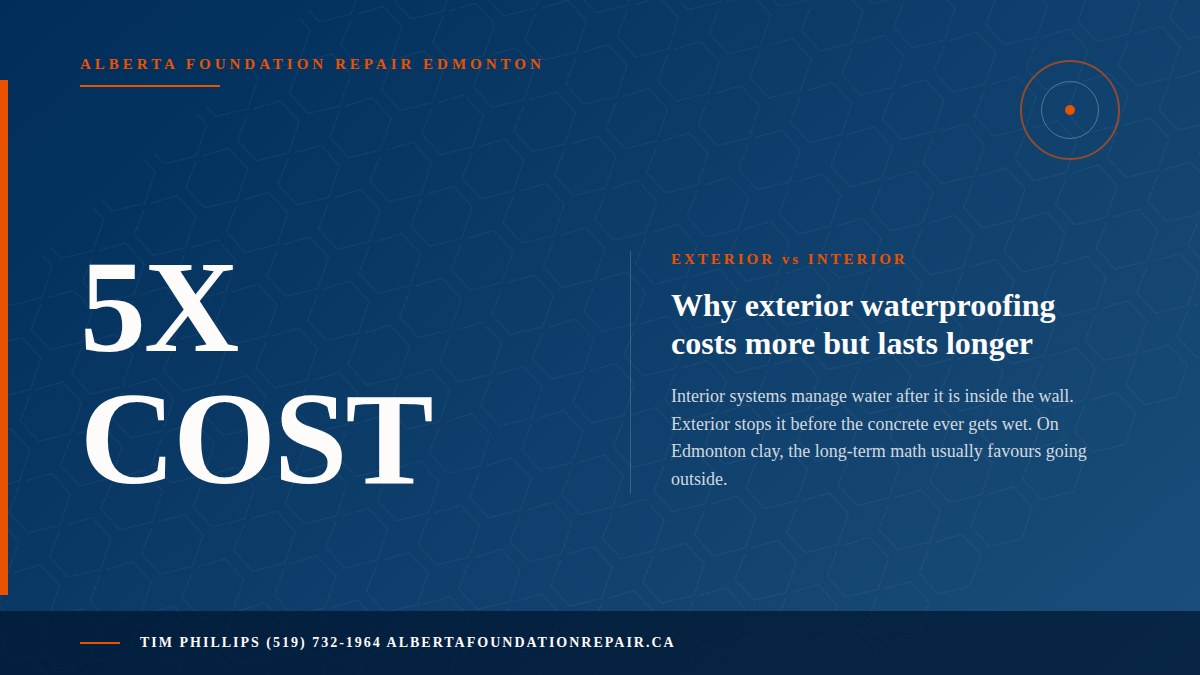
Interior waterproofing is a retrofit solution. It accepts that water will reach the foundation wall and focuses on collecting and draining it inside the basement before it can cause damage or flooding. Interior systems cost 40 to 60 percent less than exterior waterproofing, require no excavation, and cause minimal disruption to the rest of the property.
- Interior drainage channel: A perforated pipe or drainage channel installed in a slot cut along the wall-floor joint, draining to a sump
- Vapour barrier panels: Plastic dimpled panels attached to the lower portion of the wall to direct seepage downward into the drainage channel
- Sump pit and pump: Collects water from the interior drainage and lifts it outside the foundation
- Battery backup sump pump: Essential for Edmonton because most basement floods happen during power outages caused by the same storms driving water into the basement
- Crack injection (optional): Polyurethane injection of active cracks to reduce water volume reaching the drainage channel
Interior waterproofing does not stop water from reaching the foundation wall. It cannot reduce hydrostatic pressure or prevent ongoing freeze-thaw damage to the exterior of the foundation. That matters most on high water-table lots, like those near the Sturgeon River in St. Albert. It cannot stop mould or mineral migration through the wall. For homes with severe exterior water pressure or structural wall issues, interior systems manage the symptom without fixing the cause.
Hybrid Approaches and Targeted Repairs
Most Edmonton basement waterproofing projects are not full exterior or full interior. They are targeted combinations that address specific problems without the cost of a full system overhaul.
- Single-crack polyurethane injection: Active crack letting water in. $1,500 to $3,500 per crack. See Epoxy vs Polyurethane Foundation Crack Injection.
- Cove joint seal: Seal the wall-floor joint where most cove leaks originate. $800 to $2,500.
- Window well drainage upgrade: Replace drainage gravel, install cover, add drain line to weeping tile. $500 to $2,000. See Window Well Edmonton.
- Downspout extension and regrading: Redirect roof water and restore positive grade. $300 to $1,500. The cheapest and most underused fix.
- Section exterior waterproofing: Excavate and waterproof only the problem section of wall instead of full perimeter. $4,000 to $12,000.
- Partial interior drainage: Install interior drainage only along the wall that leaks, not the full perimeter. $2,500 to $6,000.
Honest diagnosis determines whether a targeted fix will work. Sometimes a single crack injection solves the problem completely. Sometimes interior drainage is the right scope for a recurring wall leak. Sometimes the only lasting fix is full exterior work. The wrong answer is quoting a full system when the real problem is one window well or one crack.
Basement Waterproofing Cost Edmonton
| Scope | Typical Cost |
|---|---|
| Single crack polyurethane injection | $1,500 to $3,500 |
| Cove joint seal (per linear foot) | $40 to $90 |
| Window well drainage repair | $500 to $2,000 |
| Section exterior waterproofing (partial excavation) | $4,000 to $12,000 |
| Full interior drainage system | $8,000 to $20,000 |
| Full exterior waterproofing + new weeping tile | $15,000 to $40,000 |
| New sump pit and pump | $1,500 to $3,500 |
| Battery backup sump pump (add-on) | $800 to $2,000 |
| Downspout extension and regrading | $300 to $1,500 |
How to Choose Between Methods
- Single visible crack, localized leak: Targeted crack injection. $1,500 to $3,500.
- Wall-floor joint leaking after rain: Cove joint seal or partial interior drainage. $2,500 to $6,000.
- Chronic multi-wall leaks, seasonal flooding: Full interior drainage system with sump and backup pump. $10,000 to $20,000.
- Structural wall damage, horizontal cracks, bowing: Full exterior waterproofing with wall repair. $20,000 to $40,000+.
- Planning major landscape renovation: Opportunity to add exterior waterproofing at lower incremental cost. Add $8,000 to $15,000 during existing excavation.
- Pre-sale disclosure fix: Minimum viable repair that satisfies inspectors and buyers without full system upgrade.
“The question I hate most is ‘should we do exterior or interior’. The real question is what is the actual problem, and the answer to that is different for every house. Exterior is the gold standard but it costs money and tears up the yard. Interior is the practical fix for half the homes in Edmonton. The wrong answer is picking one without looking at the specific problem.”
Tim Phillips, Alberta Foundation Repair
When to Waterproof Your Basement
Exterior waterproofing is a warm-season project in Edmonton. The practical window is May through October, matching the frost-free soil window for safe excavation and membrane application. Winter exterior work is rarely possible and never economical.
Interior waterproofing, crack injection, and drainage system work can happen year-round because the work stays inside the conditioned envelope of the building. This is useful for emergency repairs and for homeowners who discover a problem mid-winter and cannot wait until spring.
Contractor Credentials to Look For
Basement waterproofing is one of the most overclaimed services in Edmonton. Many contractors will quote waterproofing when what they are really doing is crack injection or damp-proofing. Before signing anything, verify these credentials:
- WCB clearance letter: Confirms the contractor carries active Workers’ Compensation coverage. Uninsured crews on your property expose you to liability.
- Liability insurance: Minimum $2 million general liability, with $5 million being the professional standard for excavation work.
- APEGA-registered engineer for structural scope: Any waterproofing work that touches structural wall elements or foundation underpinning requires APEGA stamped engineering drawings.
- Alberta Safety Codes Council permit (where applicable): Some waterproofing work requires a building permit, especially when combined with structural repair.
- Written warranty with transferability: A warranty that does not transfer at sale loses most of its value.
- BBB accreditation or verifiable local track record: Trust signal, not a replacement for credentials.
- Local references, not just online reviews: Ask for Edmonton job addresses you can drive by to see completed work.
Warranties and What They Actually Cover
Waterproofing warranties in Edmonton vary widely. Read them carefully before signing.
- Structural exclusion: Many warranties cover water intrusion but exclude cracks, movement, or structural changes caused by clay soil
- Act of nature exclusions: Heavy rain events or flooding may not be covered under “normal conditions” clauses
- Transfer limitations: Warranties that do not transfer to new owners lose most of their value at resale
- Service call fees: Some warranties cover repair but charge service fees for every visit
- Maintenance requirements: Warranties may be voided by lack of regular sump pump service or downspout maintenance
Ask specifically what is covered, what is excluded, how long the warranty lasts, whether it is transferable, what service fees apply, and what maintenance you must perform to keep it valid. Written answers only.
Frequently Asked Questions
How much does basement waterproofing cost in Edmonton?
Basement waterproofing in Edmonton costs $2,000 to $40,000 depending on approach. Interior crack injection runs $1,500 to $3,500 per crack. Interior drainage systems run $8,000 to $20,000. Full exterior waterproofing with membrane and weeping tile replacement runs $15,000 to $40,000. Small targeted repairs can be under $2,000.
Is interior or exterior basement waterproofing better in Edmonton?
Exterior waterproofing is the engineered solution because it stops water before it reaches the foundation wall. Interior systems collect water after it has already entered and drain it to a sump. For Edmonton clay soil, exterior is the correct answer when access and budget allow. Interior is the practical retrofit when exterior excavation is impossible.
Can a basement be fully waterproofed in Edmonton?
Yes, but only with proper exterior waterproofing combined with functioning weeping tile, correct grading, and a reliable sump system. Every layer has to work together. A basement with exterior membrane but failed weeping tile can still leak. A basement with new weeping tile but cracked foundation walls can still leak. The full system is what makes the difference.
Why do Edmonton basements leak more than other cities?
Edmonton has three compounding problems: expansive clay soil that pushes water against foundations, deep frost penetration (2.4 metres) that cracks foundations from inside, and 91 annual freeze-thaw cycles that accelerate any weakness in the waterproofing system. Most Canadian cities have one of these; Edmonton has all three.
How long does basement waterproofing last in Edmonton?
Exterior waterproofing membrane typically lasts 20 to 40 years depending on product quality and backfill conditions. Interior drainage systems last 25 to 40 years. Polyurethane crack injection lasts 20+ years. Epoxy injection is permanent when the substrate does not move. Regular maintenance of sump pumps, downspouts, and grading extends all of these.
- National Research Council of Canada, Building Science Insight: Moisture Management in Basements.
- Canadian Foundation Engineering Manual, 5th Edition (CFEM 2023). Foundation drainage and waterproofing standards.
- Canadian Construction Materials Centre, Waterproofing Membrane Product Evaluation Reports.
- Environment Canada, Canadian Climate Normals 1991-2020, Edmonton International Airport.
- Alberta Building Code (NBC 2023 Alberta Edition), Section 9.13: Dampproofing and Waterproofing.
Tracing the path water takes around your foundation
Keeping an Edmonton basement dry is really about controlling water at every stage, from the moment it hits the grade to the point it should be carried safely away from the footing. Each guide below tackles one link in that chain.
Basement waterproofing is not one service. It is a range of solutions from $1,500 targeted crack injection to $40,000 full exterior overhaul. The right choice depends on the actual problem, the foundation condition, site access, and budget. Tim diagnoses first and recommends the least expensive fix that actually solves the problem.
Call Tim at Alberta Foundation Repair for a free visual inspection of your basement leak problem anywhere in Edmonton, St. Albert, Sherwood Park, Spruce Grove, Leduc, or Beaumont.